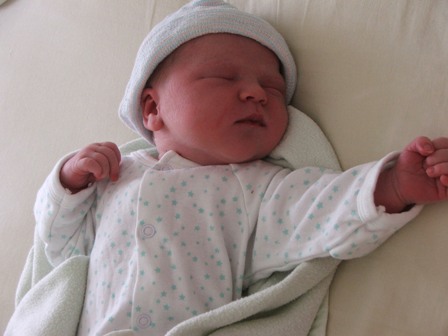
Because most philosophies that frown on reproduction don't survive.

Friday, March 10, 2006

Six Degrees of Silliness

All right, so I'm getting this uncool vibe from our male readership about there being too much "baby" being batted around. Well, I resent the implication that all I can talk about is baby (though she's certainy worth it!). Let me tell you that in my life BC (before children) I did Interesting Things. I was, back in the day, a theatrical stage manager and production assistant in Los Angeles -- is that cool enough for you? Huh? Huh?

And to top it off, I can link myself within Six Degrees of Kevin Bacon!

Kevin Bacon

1) I stage managed a show in Beverly Hills (natch!) that was directed by 2) Stephen Tobolowsky, a very kind man who gave much encouragement to a young pregnant last-minute stage manager. Stephen was Needlenose Ned in Groundhog Day, which also starred 3) Bill Murray , who was in both She's Having a Baby and Wild Things with 4) Kevin Bacon!

But I can do better than that: I can also connect with Johnny Depp (this is what makes me cool in the eyes of my sister)!
You see, Bill Murray was in Ed Wood with Johnny Depp , who was also in Chocolat with Carrie-Anne Moss, who was in Memento with Stephen Tobolowsky, who directed a show that I stage managed!

So you see why stage managing just became too overwhelming and I retired to have babies.

End of Feudalism

One is often sad to see the end of an era, and that certainly seems to be the case with this news: Democracy will replace feudal rule on Sark, one of the smaller Channel Islands. Sark was previously ruled by a mixed feudal government, with both landed gentry and twelve non land-owner "deputies" elected by all islanders over 18.

Not everyone is pleased with the change:

Only 165 [out of 600] islanders took part in a ballot-style opinion poll that asked which model of change the population favored.

"Feudalism is a great system and has worked very well for the island. What people wanted was an option of no change at all," resident Jennifer Cochrane said by telephone from her island home.

"It is an enormous leap, a bigger leap than we had wanted. The island was hoping to reform through evolution, not revolution."
Sark (along with the other Channel Islands) also suffered the unfortunate distinction of being the only part of Britain invaded by the Nazis in World War II. They were invaded in 1940 and held until 1945.

The Golden Remnant

Especially as a conservative, one is often tempted to regard the past as unquestionably better then the present.

Reading the Crunchy Con blog lately (it often makes me mad, but I just can't stop) I've been hearing a lot about what great meat and produce is turned out by the few remaining small family farms. How wonderful, one is tempted to think, things must have been back when all food came from small family farms. But is this so? Thing for a moment about how to got to this state. Modern farming equipment, intensive selective breeding and modern chemicals brought about a number of advantages that could best be exploited by gigantic corporate farms. Over the last seventy years, it has reached the point where the vast majority of food (meat, grain and vegetables) is produced on these large corporate farms. Numerous small family farms, unable to compete, went under. Others, determined to hold on, found a way to compete by offering high quality, fresh local meat and vegetables to buyers who were willing to pay a premium for quality local food.

However, these modern small farmers are not necessarily representative of what most small farms produced 100 years ago. They have managed to resist the market forces selecting for large corporate farms by raising quality and thus raising prices. Certainly, when all farms were fairly small, there must have been some farms that primarily based their business case on quality while others simply got by on volume and being local. If, somehow, we were to return to all food being produced on small farms, we could not expect all of these farms to produce product of the same quality as current artisan farmers. Once again, there would be room in the market for a whole range of different qualities of small farm. It is only the dominance of the large farms (and their ability to drive out of business any small farmers who can't beat them on quality) that keeps the quality of small farms high.

Todd of Catholic Sensibility has occasionally made a similar point about Tridentine mass groups in the modern US. I think that there is a similar principle at work there as with the small farmers. Call it the principle of the golden remnant.

Fifty years ago, every parish celebrated the Tridentine mass. With the arrival of the Novus Ordo, those who continued to celebrate the Tridentine mass necessarily became a self selected group of Catholics who, for whatever reason, made a conscious decision to attend the old liturgy. Now, I think it's certainly true that catechesis has got worse in the last forty years, but nonetheless, it's certainly not the case that all parishes in 1950 were as well educated in their appreciation of liturgy and as well catechized as many Indult groups are today. They were not, after all, a self selected group back then. There may have been much that worked well in catechesis circa 1950 that doesn't work well now, but there were most definitely pew warmers, badly educated Catholics and CINOs in 1950 just as there are now. And so, although one could make the case that certain elements of the old liturgy inherently educate the congregation about Catholic doctrine through richer symbolism, it is certainly not the case that a wholesale return to the Tridentine Rite would in and of itself result in turning the entire American church into a group as excited and well educated about their liturgy as many Indult groups are. Simply by becoming the majority rite, the Tridentine rite would inherent the pew warmers and poorly educated Catholics who currently attend Novus Ordo liturgies.

Which is not to say that it's never the case that the past was better than the present, but it's certainly not necessarily so that the past was as good as its remnants might indicate, whatever the subject matter one is talking about.

Thursday, March 09, 2006

Mum-o-phobia

Lest we get too caught up in babies and firearms, David Curp dropped me another tip on an interesting editorial in the Guardian about the UK's baby gap:

A seven-month pregnant woman - her belly vast - was at a supper with a friend. He, being of the family type, told her she was very lucky to be expecting a baby. He was the first person who had said such a thing, she told him.

It's a jarring anecdote because it so sharply puts into focus how pregnancy has become the occasion not for congratulations, but for anxious questions about childcare, leave and work. Watch how the announcement of a pregnancy among women is followed within minutes by the "What are you going to do?" question. We've replaced the age-old anxiety around life-threatening childbirth with a new - and sometimes it appears just as vast - cargo of anxiety around who is going to care.

This anxiety is the backdrop to the 90,000 baby gap - the number of additional babies that women would like to have had - identified by a recent Institute of Public Policy Research report on how the birth rate is falling below replenishment levels. How is it that in cultures all over the world pregnancies prompt congratulations rather than anxious questions about childcare? How is it that in a culture equipped, materially and medically, to ease child-rearing, we are so reluctant to enjoy new life?

The answer, I would argue, is that a bias against having babies has permeated our culture. This phenomenon needs a new word - anti-natalism - and it is this that prompts a good part of that pregnancy trepidation. The only consolation to my mind is the spectacular everyday acts of rebellion by which thousands of babies still manage to get born in this country.
This is one of the serious regional differences I've noticed moving out from Los Angeles to Texas (even comparatively liberal Austin, TX.) When we were flying out here to buy our house, we had to navigate LAX with a one-month-old and a seventeen-month-old in a double stroller. Security seemed like they gave us six kinds of hell, and several people took the time to glare at our two offspring and make comments like "I bet you learned your lesson" and "That must be worse than twins!" Then, when we got off the plane in Austin a woman came up to us while we were still in the airport and said, "Awww. They're going to have a great time playing together be so close in age. My two oldest were fourteen months apart." Which is not to say that we've never got "are you done yet?" comments in Texas, but it does seem like a much less anti-natalist atmosphere.

You can read more about the study that the editorial refers to here. One interesting section reads:
IPPR has calculated that if women in their 40s had been able to have as many children as they say they want in their 20s, there would be an extra 13 per cent more children born in Britain each year. The report shows that British women face a ‘fertility penalty’ if they have children earlier in life and that almost a third return to a less well paid job than before they give birth. The average woman forgoes £564,000 in earnings over her lifetime if she has her first child at 24 compared to a similarly educated childless woman; but if she waits until 28, she will forego £165,000.
The policiy suggestions the report offers, however, strike me as deeply wrongheaded.

Ugly Guns

For those readers who may have felt that the baby posting lately is tilting our editorial line too far in the estrogen direction, here's one for you...

Once upon a time, military rifles (despite their grim purpose) had a certain beauty. Smoothly finished walnut, dark blued or parkerized metal and the smell of gun oil definitely hold a place somewhere in pantheon of that which is true and beautiful.

Here, for instance, is a British Lee Enfield No1 Mk3, the battle rifle carried by Lewis, Tolkein, Graves and Sassoon in the trenches of World War I. A dark and terrible time, certainly, but still a rifle with a certain beauty.

This is the German K98 Mauser carried by the grey and black clad columns that overran Europe with darkness and terror. Still, the rifle itself is definitely a work of fine craftsmanship.

The US M1 Garand is perhaps one of the more well made and revolutionary military rifle ever produced. It was the first standard issue semi automatic battle rifle, and was carried with pride by the GIs who liberated Western Europe and the Pacific.

And last of an already dying breed of full size, wood-stocked battle rifles, the M14 rifle built only from 1957 to 1964. It's a beautiful rifle and still loved by many target shooters and service men. (In fact, M14s are still in use. A number have been reissued for use in Iraq.) However, it was still too heavy to serve as an assault rifle, and too light to keep from bucking hard when fired in burst.

So along came the age of the ugly rifles. In 1964 the US adopted the M16, a lighter rifle shooting a lighter cartridge (the .223 is pretty much the smallest centerfire cartridge out there) with a plastic stock and a modern look. It's not a pretty gun, but it is at least not as ugly as...

The AK-47, originally a Russian design, but supplied to leftist revolutionary movements throughout the world. It was one of the main weapons aimed at our soldiers during Vietnam, and continues to be used throughout the world to this day. (The newly reconstituted Iraqi army is being issued AK-47s.)

Now, I'd kind of assumed (in a typical America-is-the-whole-world kind of way, that the M16 and the AK-47 were pretty typical of the military rifle in use today.

Then the other day I happened to stumble across a picture of the British Enfield SA-80 (actually built by the German company Heckler & Koch). The current version of the SA-80 was designed in the 90s, thirty years after the M16, and it shows. This is definitely a futuristic looking rifle, though it's also butt-ugly. To make it shorter, it has a 'bull-pup' design, meaning that the received (the part of the gun where the shell is actually fired) is back in the stock instead of above the trigger. This allows the barrel to start well back from the grip and allows an overall shorter design while retaining a 20" barrel.

So I got curious. Are most military battle rifles like this futuristic creature, or do they look more like the '60s era M16?

It turns out one fairly popular battle rifle design is the Steyr AUG. Originally developed for the Austrian army in the late '70s, the AUG is now used not only by Austria but also by Australia, New Zealand, Oman, Malaysia, Saudi Arabia and Ireland. Like the M16 and the SA-80, it fires the NATO standard .223 round, and like the SA-80 it has a bull-pup design with the receiver and magazine in the stock. It has an aluminum frame and high impact polymer housing. For no extra charge, it also looks like it escaped from the Star Wars prop lockup...

The FN SCAR, designed by the Fabrique Nationale company of Belgium at the request of the US Special Forces is (if it meets final approval) supposed to go into production within the next couple years. This particular example has a 40mm grenade launcher mounted beneath the barrel. One of the primary design requirements for the weapon was that be able to swap out parts to fire different calibers, mainly .223, .308 and the plentiful 7.62x39 cartrige fired by the AK-47 and stocked by insurgents everywhere. I have to say, I appreciate the military's taste on this one. It doesn't look silly, and the last thing you want to do is have to shoot an assailant while he's laughing at your weapon.

Finally, in our tour of modern battle weapons, is the Heckler & Koch G36, originally designed for the German Bundeswehr in the early '90s. The weapon has since been adopted by the Spanish army, and it is also used by a number of international law enforcement agencies and police department SWAT teams in the UK and US. It is also the basis of the XM8 replacement for the M16 which was developed by HK but has now, apparently, fallen victim to the complexities of the government bidding process.

Wednesday, March 08, 2006

About the Home Birth

Well, here's the story for them as wants to know....

At my appointment on March 1st, the midwife was still concerned about my blood pressure, which seemed to be getting higher even when I was laying down, so she went ahead and stripped the membranes (that's separating the bag of waters from the cervix, for you lay people). We'd planned to start on the castor oil the next day to induce labor, and boy, that just wasn't sounding appealing to me.

At about 11:30 that night, I started having mild contractions every ten minutes. I didn't bother to wake up Darwin or call the midwife because it didn't seem worth it yet. However, at 12:30, during a contraction, I felt a punch on my cervix that made me sit up and gasp, and immediately the contraction became more painful.
"She punched me!" I yelped. And when I moved around, I realized that my water had broken.

Well, then I woke up Darwin and called the midwife, who said she'd pick up the student midwife and be on her way. Things became progressively more painful until finally I was just having one long contraction with nasty peaks every other minute. That's what happens when you go from 3 cm to 10 cm in fifty minutes, I guess. Darwin finally decided that he better call the midwife and check to see where she was, and as luck would have it, she'd just pulled up outside the house. The student midwife got upstairs first, and I told her that I was going to have to push REAL SOON NOW. She went to wash her hands and then came back in.
"Let's get you on the bed and check you," she said.
"No," I replied. "Her head is coming out."

And so five minutes after the midwives arrived, Isabel popped out at 1:20 am and gave a squall. To the extent that one has a coherent thought while pushing out a baby (besides "Please God let it be over soon") I wondered why any sane person would get herself into a situation that involves pushing a head through her pelvis. That's really bizarre, if you think about it. Why would anyone intentionally do anything so painful and absurd?

But then, it was over, and baby was out, and I could lay on my very own bed snuggled up to her and nurse her while the midwives took care of everything else. Note to Amber: the straws in the birth kit are so that the mother can sip fluids while in a supine position -- quite helpful, actually! I did have to have some stitches, which was unpleasant but what can you do? The midwife told me that when a baby comes that quickly, there's no time to stretch out naturally and avoid tearing -- kind of like a balloon that's inflated too fast, if you'll excuse the metaphor.

Then I had a bath (in my own tub!). The midwives left around 5:00, and we all settled back down (in our own bed!) and went to sleep. Baby slept like, well, a baby, and so did we.

And that's how it happened.

Postscript: I opened the freezer the other day to get something, and there was the placenta, bagged up and large as life. I'd completely forgotten about it. We don't plan to barbeque it, just so you know.

Tuesday, March 07, 2006

Contemplating the Baby

Here's a confession: I haven't been to a Holy Hour or sat in Eucharistic Adoration for a long time. I know that we have Adoration at our parish, but I've never looked into the times or dropped by. And when I have gone in the past, I've been the fidgety sort of person who needs a rosary or a devotional booklet or the missalette or something to keep my mind engaged, or I start wandering off into the most banal inanities. To be honest, I haven't taken part in much adoration because I thought that I wasn't much good at it.

But lately I've found myself spending many hours engaged in contemplation of the new baby. As we lay together I'll watch her nursing or sleeping and find myself gazing at her perfectly round little head or her cheeks (just like her sisters'!) or her sweet pointy little chin. Or I'll think of how she might behave when she's older and wonder if she'll be like the bigger girls in various aspects of her personality. I can even get all worked up about how one day she'll be all grown up and getting married, and I'll watch her walking down the aisle (snuff!). And before I know it, half an hour has passed.

So it's obvious that I can contemplate. I just need to extrapolate what I'm doing with the baby to contemplation of our Lord or of religious subjects.

One of the first aids that comes to mind is having a large stock of images to pull from. I can gaze at the baby and simply enjoy her beauty, but I also have memories of her sisters at that age, of my own siblings, hopes for her future, and a daily knowledge of her health and activities. So when I'm looking at her I don't just stare blankly, but I'm interacting with her not just physically, but also mentally with the idea of her. In the same fashion, having a large store of devotional material, whether it be hymns, Bible verses, religious art, or ideas from the vast body of Christian thought, won't mean that I'll be fortified against any distraction. If my mind does wander, however, it will be much more likely to wander toward something worth incorporating into my contemplation rather than something stupid and unedifying.

I also engage with Baby. I talk to her about whatever pops into my mind, although since I'm focused on her it tends to be something regarding her. I tell her how sweet she is, how much I love her, that she has bright eyes, that her sisters better stop jumping on the bed... Even though I could say anything to her because she doesn't understand any of it, she holds my attention. There's my next aid to contemplation. When I love something, everything relates back to what I love. So actively working to strengthen my love for God means that when I sit in contemplation of him every thought or distraction will automatically lead me deeper into meditation about Him and interaction with Him.

Sometimes Baby and I just lay quietly together. She doesn't do much more than eat and then sleep as of yet, and since I'm her source of food I have to take the time to sit or lay still for as long as it takes to feed her and then get her settled. It's very pleasant and relaxing to have this peaceful time with her, time in which I'm not required to do anything but be. Darwin and I (before we had children) used to just sit quietly with each other in the evenings. (Now that we have toddlers, we can rarely sit still, or sit quietly. When we do, it's usually out of sheer exhaustion.) And it's not always necessary, when in prayer, to be actively thinking about something. I recall hearing once that Bishop Sheen always spent an hour every day in front of the Eucharist. "I wasn't always awake," he said, "but I was always there." Sometimes just being in the presence of the beloved is enough. God told Moses that his name is I AM -- the eternal now. To be with God, existing only in this present moment for Him, is of greater worth than carefully crafted devotions or elaborate prayer routines, and far more refreshing.

Unfortunately, it's harder for me to sit quietly with God than to read a spiritual book or do something that keeps my mind engaged. Still, I have a lifetime to work on it, and a good spiritual companion in Baby.

Life on Crunchy House Manor

The other night, I sat down with the wife and little girls to watch an hour of television and had an insight into Crunchy Conservatism. (Yes, I know. Ironic, isn't it. Well, it was PBS...)

There was this great show on about a really crunchy family. They have lived in the same house for hundreds of years. They raise prize winning cattle according to organic principles. They hire artisan craftsmen at living wages, keep the same employees for generations, appreciate the good and the beautiful. They care about the environment, set aside what used to be an area of industrially farmed land as a deer park, and plant trees. (Though they've had trouble with liberal tree huggers not wanting them to take out the dead ones.) They definitely stick to their traditions. And they certainly enjoy a good meal.

Who are these people? Are they evangelical cattle farmers in east Texas? No, actually they life in Europe. They're Anglican. And they live in Windsor Castle... Yes folks, that would be the royal family.

Now actually, I'm not just being a punk here. As I've thought about it, a lot of what the Crunchy Con movement is yearning for is a return to a much sanitized version of the feudal economy (with artisan farmers instead of peasants) and the medieval manor house. In a sense, that's hardly a surprise. A lot of Rod's thinking is influenced by G. K. Chesterton and others influenced by him. And Chesterton in many ways yearned for a return of the best aspects of the feudal aristocracy.

It was the destruction of the feudal economy (and the town economy that grew along side and to an extent within it) during the industrial revolution which led to the poverty, turmoil and societal breakdown that Dickens wrote about, and which inspired the dark musings of Malthus, Marx and others. For all the abuses that it allowed (and they could be pretty severe) there was an understanding in the feudal economy that in return for the peasants and tenant farmers providing service to the landed family, the family could never fire, write off or abandon their vassals. One of the sharp cultural divisions in the English Civil War (which in many ways made the American Civil War look downright friendly) was between the landed aristocracy mentality of the Cavaliers and the urban commerce sensibilities of the Round Heads. With the darker side of the much vaunted Protestant work ethic, the emergent middle classes who supported Cromwell helped move English (and by influence American) culture down the road to an understanding of the employer/employee relationship where value is quite strictly a matter of what you produce, not who you are.

Now, there's clearly a lot I admire about the manor house economy. But there's also a problem. Only one family owns the manor, and a whole lot of families are expected to be resigned to lives of comparative or real poverty in return for the stability of 'knowing your place' in the feudal system.

Knowing your place didn't have to be a matter of oppression. In Jane Austen's Emma, you see the landed 'gentleman farmer' class in action. Mr. Knightly owns a small estate with working farms and is very much active in overseeing his land. But he isn't normally found out plowing the field. He is of that landed semi-leisure class that had the resources and liberty to read great works, write, collect art or pursue the new experimental sciences while overseeing the family estate. One of his trusted farmers, Robert Martin, is also a character, and in the end marries Emma's protege, Harriet Smith. Martin is a respectable member of the community, hardly a peasant. In that sense, you can see how humane the remnants feudal system had become in parts of England by the late 1700s. He has a certain degree of education (he reads farming journals, but not necessarily literature) and Knightly greatly respects his opinion in regards to the management of the estate. Nonetheless, he is in no way considered Knightly's equal, and there was no provision in the landed gentry society for Martin to aspire to a position such as Knightly's. If Martin desired to one day have his own estate, he would have had to break away from the estate, make his fortune as a member of the professional class, and eventually buy an estate for his heirs.

Now, I have no ambitions of being responsible for tenant farmers and a large estate, but I confess to find what I think the Crunchy ideal is chasing (perhaps without realizing it) attractive. One of the things that attracted Mrs Darwin and I to the Austin area is that there's still so much land available out here that it's not inconceivable that three to five years down the line (and up the corporate salary ladder) we could afford to buy some land a bit farther out here on the north side of town and build our own house. (I have a couple friends at work with large homeschooling families who've done just that.) Every so often I sketch out a few ideas for building a small brewhouse as an outbuilding. Maybe even putting in grape vines someday so that we could vint our own wine. I enjoy building things and making things by hand and knowing where things come from. There is a real sense of accomplishment to it and a pleasure in creating.

However, I would never picture myself wanting to go back to subsistence farming. Those who romanticize the subsistence farmer forget that full time subsistence farmers (as opposed to landed gentry or tenant farmers, who had the resources of the rest of the estate to fall back on) have always lived an incredibly tenuous existence, one which left little time for education, leisure or art.

Even Victor Davis Hanson, who wrote one of the most moving modern books on the life of a small family farm, had to support that farm (which consistently lost money throughout the period described by the book, despite the herculean labors of the entire extended family) on the wages he and his siblings made as professionals in Fresno. Several of our professors at Steubenville owned very small farms outside of town (couple dozen chickens, a goat or two, a large vegetable garden) and felt that their families benefitted a great deal from the agrarian lifestyle. But again, it wasn't farming that paid the bills, it was being a tenured professor.

There is, I think, a lot of value to be found in retaining a certain degree contact with the land, or perhaps more generally, in building and repairing things with your own hands and doing it well. But a largescale return to subsistence farming is not what the doctor is ordering for Western Culture. Indeed, it's having moved away from subsistence farming into a world of increasing occupational specialization which has earned us the leisure to think about these things in the first place.

In Praise of Amateurs

Rick Lugari, who does more inventive blogging while on hiatus than some of us do when we're trying (who else would have come up with the idea of campaigning for second to the last place in the Catholic Blog Awards by using pin-ups, puppy pictures and animated line drawings?) has struck again with the Amateur Catholic B-Team.


All of us who came into the world of Catholic blogging only to realize that there's only one Mark Shea and one Amy Welborn pretty much knows how the stray goldfish in the whale tank at the zoo feels. But Rick is out there for the little guy. All the little guys and girls and fuzzy green creatures from Alpha Centauri who write great Catholic blogs with readerships of six regulars and one person who somehow managed to end up there after typing "crazy horse bubble gum altar boy adventure hardy boys flagship traditionalist incense flan" into Google can now band together under the friendly blue banner of the B-Team of the Catholic blogging world.

That's us, the bench warmers. The 6'2" brainiacs brought onto the basketball team to keep the GPA up who never get to play. The quiet backwaters of the blogsphere whose hitcounts suddenly surge to unheard of heights of 300 visits when a link comes down from one of the Professional Catholics.

Now... We're still bench warmers and backwaters. But we have a cool logo that they can't use. And that makes all the difference. Right?

Monday, March 06, 2006

Blogroll Update

I'm afraid we're always terrible about updating the blogroll -- in part because I generally make a point of visiting most of the folks on the blogroll at least every two to three days, and there are a limited number of hours in the day. However, once we realize we're visitting someone every day or two anyway, it's clearly time to add them. So without further ado, let me recommend:

Opinionated Homeschooler Sharon is a homeschooling mom here in the Austin area who writes on various offbeat topics and runs a patristics reading group off her blog.
Good and Happy Another Austinite, Dilys the Dinosaur is a convert to Orthodoxy writing about ethics, philosophy, business, personal coaching, and interesting stuff generally.
Scrutinies A Catholic high school religion teacher down in the trenches.
Love2Learn Homeschooling mom and TAC graduate who also maintains a website full of homeschooling resources.
Fructus Ventris A midwife and longtime St. Blogs resident.
Disputations Needs no introduction, but I'm always thinking I need to do a better job of keeping up with what he says, so on he goes.
The Donegal Express And of course Der Tommisar is one of the "cool kids" and winner of the Best Presentation award in this year's Catholic Blog Awards by the LSBF principle.

Voltaire vs. Muhammad

In this morning's WSJ (article not available online) is an article about another round in the European culture war over respect for Islam. A municipal cultural center in the town of Saint-genes-Philly sponsored a reading of vulture's play "Fanaticism, or mammoth the Prophet", a 1741 work in which Voltaire portrayed the prophet as a power-hungry tyrant bent on using religious pretense to increase his political dominions. Catholic clerics of the time weren't fooled, and saw the play as a thinly veiled attack on religion in general and the Church in particular. The ploy's original run in Paris was cancelled after only three performances, primarily due to protests from the clergy.

The mind behind this one-performance revival was herb Loichemol, a French director who believes that Fanaticism has an important message about the importance of secularism. He originally tried to revive the play in 1994 for Voltaire's 300th birthday, but finally met with success this year in Saint-Genis-Pouilly as part of a culture festival. Despite requests that he cancel the show to 'preserve peace' the towns socialist mayor supported the show and called in riot police to deal with protests. Sure enough, on the night of the reading, several dozen protestors set fire to a car and several trash cans before being dispersed by police.

The article closes:

Now that tempers have calmed, Mayor Bertrand says he is proud his town took a stand by refusing to cave in under pressure to call off the reading. Free speech is modern Europe's "foundation stone," he says. "For a long time we have not confirmed our convictions, so lots of people think they can contest them."

He does have one regret: He found the play, five acts in archaic verse, "deeply boring."
Now, I'm all for Europe getting back in touch with its Western Culture identity, but I have to think Voltaire is not quite the ticket they need. I suppose one's assessment of his ultimate value depends very much on one's opinion of the French version of the 'Enlightenment', which I would personally tend to consider an abysmal failure.

It seems to me ironic that secularists are now eager to score points against Islam by producing Fanaticism, when Voltaire himself was known to say that he considered Islam less corrupt and dishonest than Christianity. (Certainly not something to reassure one's faith in Voltaire's taste or knowledge.)

Once again, as with the cartoon controversy, it seems to me this flap puts Christians in a awkward middle ground. On the one hand, we cannot accept a de facto dhimmitude, changing the cultural and political norms of the West to fit Islamic expectations, for by doing so we would in effect be asserting that Islam is right on certain issues and Western Culture is wrong. And yet, many of those stirring up these controversies are not standing up for what we, as Catholics, see as Western Culture. They are standing up for the secular humanism of which Voltaire is one of the patron saints -- a set of cultural, religious and moral beliefs which we clearly belief not merely to be wrong, but to be responsible for the implosion of European life and culture which created the vacuum which Islam is now trying to fill.

Sunday, March 05, 2006

Where Have All The Children Gone?

David Curp emailed me a link to this interesting NY Times story about Vermont, which is facing a demographic crisis. Basically, Vermont is experiencing now (on its own rather small scale) a number of the problems which Europe is facing in the not too distant future (minus raucous immigrants) and that the US may face in another 20-30 years. Residents are not choosing to have many children, many young people who do grow up there move away to areas with more vibrant employment environments, and the majority of those moving in are retirees. This has resulted in the very real possibility that the demographic crunch will cause the state to have to start drastically scaling back services in the near future.

Stupid and Evil

In a second very good post, Examined Life looks at the testimony of a doctor opposed to the partial birth abortion ban who says:
"I mean, I know what my purpose is...to empty the uterus in the safest way possible. Yet, this language [in the statute] implies that I have this other purpose, which is to kill the fetus. So, to me, it's like--kind of like there is an elephant in the room besides me and my patient...there is somebody judging what my purpose is in bringing the fetus out a certain way."
Well, yes, my dear, there's definately something in the room besides you and your patient. But guess what, it's not an elephant. Indeed, many of us maintain it's a person.

This brings Carson back to the question that Plato deals with in Gorgias: why do people do evil? Plato held that people only ever seek to do good, however, they often do evil through having a mistaken idea of what 'the good' is. (We often adopt a similar model of thought in describing what sin is: Setting up one's own 'good' in place of God's.) Thus, one might say that in Plato's thinking, no one is truly evil, but lots of people are truly stupid. (Which perhaps explains how stupid this particular doctor sounds.)

However, Carson asks, need it really be so either/or? Could it not, from a certain point of view view, be more a matter of both/and?

Personally I don't see why we have to be so exclusivist about all of this. Why can't some people be both stupid and evil? It's not like the two properties are mutually exclusive, after all. And in the case of this particular physician it seems to me that we actually have firm empirical evidence that the intersect class is not empty. Indeed, there seems to be a class of persons who are both stupid and evil because of the fact that they are arrogant and hubristic. They are evil principally because they are, in Plato's more charitable terms, mistaken about what is right, and they are mistaken about what is right because they are too arrogant and hubristic to consider the possibility that they may be mistaken.

Why Philosophy?

Examined Life has two really good posts up on sufficiently different themes they seem to deserve separate posts. In a post about wrapping up the seminar he's teaching on Plato's Theaetetus, Scott Carson says this about why one should study philosophy:
If it accomplishes nothing else, philosophy will teach you about your own limitations, even as it illumines the limitations of others. You come to understand very quickly that, not only is there no such thing as progess in philosophy, but there is not really any such thing as progress at all, other than the banal sort that allows us to build better bridges or manufacture better textiles, machinery, and medicines. We are more technologically advanced today than the ancient Greeks were, but morally, psychologically, philosophically--in any really important sense, we are no further than they. In some ways, I imagine, we have yet to catch up with them.

Friday, March 03, 2006

Ash Wednesday in the City

The March Hare writes a nice piece about attending Ash Wednesday mass downtown.

Survival of the Patriachies

Philip Longman (author of The Empty Cradle, which has been on my read list for a while now -- though the dang library doesn't have it) wrote an article in the latest issue of Foreign Policy magazine title The Return of Patriarchy. (Thanks to the Power Behind The Throne for pointing out that it's now available online.)

Longman's thesis in the article (one which should hardly be novel to longtime readers around here) is that the world is currently going through a transitional period where the majority of people in many advanced cultures have lost interest in rearing children while a small minority of people who are religious and 'patriarchal' will provide the majority of the next few generations. Longman cites previous examples of points in history where the elites under-bred themselves out of existence: notably Hellenistic Greece and Imperial Rome. In neither case did civilization collapse (and I can't imagine that it will now) but in both cases an elite which had become sufficiently wealthy and individualistic to lose interest in breeding was gradually replaced by immigrants and a 'middle class' which still retained an instinctual hold on what humans are: a species that needs to reproduce if it is to survive.

Our current situation is, however, unique in that modern birth control has made it much easier for a much larger portion of the population to opt out of the circle of life. (No one has yet found a cure for mortality, so for these the circle of life has instead become a one way trip to eternity.) The demographic results are fairly spectacular. Of the women born in the 1950s (its a good group to measure because they came of age in the 60s and 70s and are now past their childbearing years) nearly 20% have never had children. (By comparison, the childless percentage of the generation of women born in the 20s was under 10%.) An additional 17.4% of the women from the 50s generation had only one child, thus producing only 7.8% of the next generation. Meanwhile, the 11% of '50s generation women who had four or more children produced about 25% of the next generation.

Longman is himself (so far as I can tell from what I've read) pretty much a social and political liberal, so his feelings about the facts he presents are pretty mixed:
This dynamic helps explain, for example, the gradual drift of American culture away from secular individualism and toward religious fundamentalism. Among states that voted for President George W. Bush in 2004, fertility rates are 12 percent higher than in states that voted for Sen. John Kerry. It may also help to explain the increasing popular resistance among rank-and-file Europeans to such crown jewels of secular liberalism as the European Union. It turns out that Europeans who are most likely to identify themselves as "world citizens" are also those least likely to have children.

Does this mean that today's enlightened but slow-breeding societies face extinction? Probably not, but only because they face a dramatic, demographically driven transformation of their cultures. As has happened many times before in history, it is a transformation that occurs as secular and libertarian elements in society fail to reproduce, and as people adhering to more traditional, patriarchal values inherit society by default.
However, Longman doesn't allow himself to fall into thinking of 'patriarchy' as a dark Taliban-like force. Indeed, he argues that when patriarchy becomes misogynistic it loses it's effectiveness, because the mistreatment of women destroys one of patriarchy's greatest strengths: joining the desires of both men and women in a common urge to rear a large and successful next generation to carry on the family name and fortune.

Longman doesn't speculate on why it is that traditional religion produces a fertile society while secular individualism tends to produce a demographic tailspin, but it seems to me the answer follows pretty naturally from Longman's observations. Traditional religion and secular individualistic society present radically different ideas of what the human person is and why it is on this earth. However, of the two, that held by traditional religion more accurately reflects what the human species is, and so results in reproductive success.

This is not to say that individualism doesn't have anything going for it. We are all individuals, with thoughts, desires, aspirations, needs and feelings. However, as individuals, we are members of the human species, and as such, we are born, we attain the ability to reproduce, we age, and we die. This is not to say that every individual person must, to fulfill the reason for their existence, reproduce. However, it is certainly the purpose of any given generation of humans to produce and rear the next generation. We are generation creatures, and without a next generation, we are a dead end. And the necessity of producing the next generation does mean that most men and women must be fathers and mothers, and that they must produce enough offspring to make up for those members of the current generation who do not reproduce.

In our current highly individualistic society, that sense of generational duty seems to have been somewhat dulled -- in some segments of society more than others. And it is, thus, from those parts of society where the most awareness of our nature as generational beings has been retained, that the next generation will come.

The question mark in all this is, of course, whether the fact that the majority of the members of the next few generations may be from 'patriarchal' families will mean that those children will go on to hold a patriarchal worldview themselves. Longman touches briefly on the question:

To be sure, some members of the rising generation may reject their parents' values, as always happens. But when they look around for fellow secularists and counterculturalists with whom to make common cause, they will find that most of their would-be fellow travelers were quite literally never born.

Thursday, March 02, 2006

Baby Darwin


Isabel Veronica Hodge was born at 1:20 am this morning.
7 lbs, 15 oz.; 20 1/4 in.

At 11:30 last night I started having mild contractions about every ten minutes -- nothing to write home about (or call the midwives about yet). But at 12:30 I felt something like baby punching my cervix, and my water broke. Things immediately picked up (oof!) and the midwives were on their way. Isabel was born at 1:20, barely five minutes after the midwives arrived. She had a lusty yell and was pink and kicking.


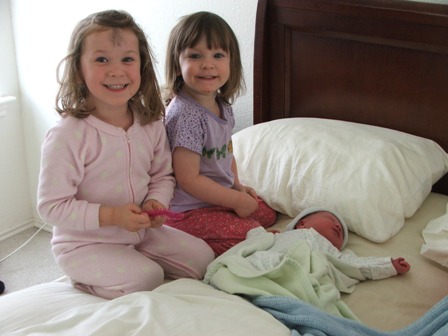
Mom and Dad are tired but happy that baby is here. Big sisters are delighted. Here are Eleanor (left, with ashes on her forehead) and Julia with Isabel. Aren't they all so cute?

Take care, y'all. Thanks for all the prayers!

Wednesday, March 01, 2006

They Didn't Get the Message

Ash Wednesday mass is, of course, always far more well attended than any holy day of obligation. Between mass being at 6pm, daddy not getting home from work till 5:20 (I was trying hard to leave early, honest...) and the tail end of rush-hour, we got there eight minutes late, by which time standing room was spilling out from the vestibule into the patio.

Father preached a very good sermon about visible signs of prayer and penance versus real devotion. He closed the hope that we would not merely wear ashes on our foreheads as an external sign, but accept the ashes into our hearts as a sign of real penance.

However, some people must have missed the part about externals not being the only important thing, because half the congregation left after ashes were distributed (after the Liturgy of the Word but before the Liturgy of the Eucharist).

I didn't let my feelings over this prevent me from taking one of the vacated pews, however.

Read my lips; No new baby

A specter is haunting the Darwin household -- less frightening than the one that haunted Europe, but fairly daunting nonetheless: the specter of being OVERDUE.

Baby is sitting pretty this morning -- no contractions. I have a bit of a backache, but otherwise I feel like I could be pregnant for another week. (Knock on wood!) At my midwife appointment today we're going to discuss things like castor oil. At one point in time (read: before nine months pregnant) I thought that I wouldn't want anything to hasten baby along. Wouldn't it be nice, I thought, if my body did most of the work painlessly before hard labor started? Bull, I say now! Bring 'er on!

There's that scene in Courage Under Fire where Meg Ryan (the helicopter pilot in the first Gulf War) gets shot in the stomach (I think), and one of her companions asks her if she's all right.
"I gave birth to a nine pound baby, asshole," she tells him. "I think I can handle this."

Tuesday, February 28, 2006

Conservatives and Daycare

Caleb Stegall demands to know over on the Crunchy Con blog:
So I'll put the question to Jim and any other "conservative" very directly: Are you willing to state that "with a few exceptions, anyone who would place an infant in daycare is a negligent parent and a negligent citizen"? Let's put some cards on the table.
I figure I can answer this one without accusation of bias, since I'm the only one in my workgroup at the office whose spouse stays home with the kids -- and gets by on half the household income of everyone else as a result.

The first duty of anyone, conservative or otherwise, it seems to me, is not to be a tiresome old ass. Not but what many asses (even old and tiresome ones) are right. But even if you are right, if you make enough of an ass out of yourself, no one will listen to you. Truth is never served well by being put in the most abrasive terms possible, unless the offense which is being protested is so grave, that it calls for denunciation in the strongest terms. Save your ammo for the beast so nasty that you need to shoot it twice.

Now, I do think that one should do all that one reasonably can do to avoid putting a child, especially an infant (or indeed, any kid under school age) into daycare. If you think about the economics of it, you pretty much can't afford to pay someone to pay as much and as quality attention to you child as you could yourself. And even if you could, you'd be ceding your place as parent to that person. A parent is not just a DNA donor. A parent is supposed to have an integral part in forming his or her child from the earliest days of infancy through the point when the child is old enough to start his or her own family.

I think there's a lot that can be said, both as a matter of personal experience and probably also as the result of behavioral testing and observation that would support the ideal of having one parent be with young children full time. Or, short of that, having a real relative (grandmother, aunt, uncle, cousin, niece, nephew or close family friend) provide supplemental care. Children are supposed to bond closely to their guardians, especially in that early stage of life, so having your child spend most of her time with a stranger is doing her no favors. Either she's bonding to the wrong person, or she's not bonding at all.

What-is-more, from talking to the women I know at work, several of whom have very young (meaning under two) children in daycare, it seems pretty clear that many if not most women have a natural desire to stay home with their children. It's not that many mothers actively want to leave their children in daycare, but rather that they haven't successfully thought through the realistic strategies that could help them break the two income family mold.

However (and if I'm just being a soft voiced pinko about this, someone can tell me) I don't think you're going to get anyone moving in that direction by fulminating at them that they're negligent parents and negligent citizens. Just as one does not normally convince someone to convert by telling him that without the graces of Christ he'll go to hell. (That may be an accurate statement, but it's a bad opener.)

Which I guess is what bugs me about the heavily polemical nature of some of the Crunchy Con rhetoric. I think there are some very valid points that Rod is making about how people (conservative or otherwise) need to think systematically about what they believe to be the important things in life and then actively order their day-to-day lives according to those ideals, however if you spend too much of your energy shouting that everyone else outside your clique is a materialist, you're not going to get them to reexamine their lifestyle choices.