Because most philosophies that frown on reproduction don't survive.

Friday, August 04, 2006

Seal-ing his fate

Help out a local boy attain his dreams of B-movie stardom!
I'm sure by now everyone has heard the hype of this summer's soon to be released blockbuster…Snakes on a Plane.

To celebrate the release the Alamo Drafthouse is holding the 'Blanks on a Blank' filmmaking challenge in which teams are randomly assigned an animal and a vehicle and then given the task of creating a disaster movie with only one rule - incorporate the line that Samuel L. Jackson will never live down (earmuffs if you're watching with the kids).

So the cast and crew of 'Seals on a Scooter' needs your support and here's what you can do to help us out…this will take some time as all films are roughly 5 minutes. If you are short on time then just view and vote '100' for 'Seals on a Scooter'.

1. Direct your web browser of choice to www.blankonablank.com
2. Enter the site and click the "Create an account" link
3. Get yourself registered
4. Then click the 'Films' link at the top of the page.
5. The list of films will then display - click on the 'View Film' link for a particular film and watch away.
6. After the film completes assign it a score and then click the small 'Return to Films List' link at the bottom of the page.

7. It would be most helpful if you assigned a score of '100' to Seals on a Scooter and '0' to all others.
8. And no the Alamo couldn't have made this process any more difficult.

Thanks for your assistance…
The winning team gets to send 2 members to the L.A. premiere of 'Snakes on a Plane'…
Please help make a young seal's dream of walking the red carpet and appearing in US Weekly come true.

Yours,
M.F. Seal
I might have preferred "Yaks on a Humvee", but that's just me.

Off the face of the earth

I've found it easy to resist the surge of commentary about Mel Gibson's drunken remarks about Jews, mainly because I'm not particularly a fan of Gibson's. I thought The Passion was definitely one of the more interesting attempts at serious religious art in the film medium, but aside from that I've thought every movie that he's directed was just terrible.

But I was amused by this opening paragraph in an editorial in this morning's WSJ:
So Mel Gibson, arrested in Malibu, Calif., for drunk driving, tells a police officer that "the Jews are responsible for all the wars in the world." Pity the actor for not substituting the word "Israelis" for "Jews." The latter apparently confirms his long-suspected anti-Semitism. The former would have made him a darling of right-thinking progressives the world over, especially at this moment of Middle East stress.
That had kind of been my own thought as well, to be honest.

Of course, Israel represents a rather interesting question in regards to the whole idea of Just War. I tend to support Israel for something of the same reason that John Derbyshire once gave: Because in a generally oppressive and uncivilized area of the world they are one of the few fairly just and egalitarian democracies. (Ironically, the runner up in that category is arguably Lebanon.)

However, there is another half of conservatism that is much less sanguine about Israel. Some say this is because of anti-Semitism (and there is some of that in certain paleo-conservative circles from what I can see) but I think it is also because Israel represents something of a puzzle in that it is so new. Fifty years ago there was no state of Israel, and 100 years ago there was not a Jewish majority population in that area. Israel is an example of a phenomenon which has become very rare in the modern world, though it happened often in the 'Dark Ages', of a people moving into a previously populated area and securing political control over it essentially by force.

The Normans did this to England in 1066, and before them the Danes did much the same to parts of central England in the 700s to 900s. Before that, the Saxons did the same thing to the Celts and Roman Britains when they invaded. By comparison, the Israelis took a fairly peaceful route: moving into the area while it was under Turkish and then under British control, and building up to where they represented a sizeable percentage of the population before demanding political control. And yet, there is a sense in which the local Arab population can rightly see Israel as an invading population.

Much of just war doctrine centers around whether or not a war is defensive in nature. If your country is invaded, it's generally considered just to defend it. Going off and invading someone else's country requires much more work to justify -- some maintain that it can't be justified at all.

And yet, pretty much all the territory on this earth is conquered territory many times over. Which raises the question: at what point is one required to admit that no matter what you think about how the current owners acquired their territory, their right to it should now be respected? People have long memories. In Northern Ireland the IRA and the Orange Men are still fighting it out over the wrongs committed by Cromwell and William III, as well as the much more recent oppression of the Irish Catholic population. In the Balkans grudges stretch back 1000 years or more.

Israel is new by comparison -- unless you count the country established in 1948 as possessing true historical continuity with the Israelite kingdom that was dispersed in 70AD. And yet, looking at the map of the world, a goodly portion of them did not reach their current form until after 1948. I don't think there's any period of time one can lay out which makes a new country "established" rather than "invading".

Israel has stood the test of time for more than a generation, and it offers its Muslim citizens as much freedom and more opportunity, in many ways, than most of the surrounding Muslim countries do. It seems to me that at this point in history, all reasonable observers must acknowledge it as a country that is here to stay (not an invading population) and that with that status comes a need to proportionately defend itself from attack. Not that anyone has ever accused Hamas and Hezbollah of being reasonable...

The Schedule

In an attempt to get more organized (more on that later, if time permits!) Darwin and I sat down last evening and created a little "curriculum" for the girls for fall. It's a simple list of what we want the girls to accomplish. Some of the resources we have, some are ordered, and some we need to find, but I think it's an achievable set of goals.

Noogs (4)

Religion
Writing
Math
  • Basic addition and subtraction
  • Learn to tell time
  • Study the calendar: learn the days of the week, the months, and the seasons
Reading
Personal
  • Make Bed
  • Put dirty clothes in hamper
  • Brush own hair and teeth

Babs (just about 3)

Religion
  • Basic prayers: Our Father, Hail Mary, Glory Be, Grace before meals (she has these pretty much down, but it doesn't hurt to keep working on them)
  • Read Tomie De Paola's Bible Stories out loud.
Writing
  • Memorize alphabet and identify letters
Math
  • Identify numbers
  • Work on counting
Reading
Personal
  • Put dirty clothes in hamper
  • Potty training
  • Brush own teeth
Baby (5 months)
  • Cut that tooth!
Seeing it all written down looks a bit intimidating, frankly. However, I think that these are things we would be working on whether or not I consciously planned them out. And it seems that it can't be too soon to start documenting what we're doing, both for future reference and in case anyone ever wants to give us trouble about homeschooling (God forbid!).

Thursday, August 03, 2006

The Spam Fantastic

I just read yesterday about the phenomenon of "empty" spam: spam that contains large chunks of literature (generally of the 18th-century variety) to slip past filters. Lo and behold, today it happens to me! In a solicitation for Mr. Clean's Magic Erasers, I received the synopsis of what seems to be a blood-and-guts Spanish tragedy. Anyone want to hazard a guess as to what play this could be?
Act I, Scene i Don Andrea, a Spanish courtier, has been killed in battle against the Portuguese. His soul is brought out of oblivion by Revenge to witness the death of his killer, Balthazar, at the hands of his lover, Bel-Imperia. Act I, Scene ii A Spanish General describes the battle, in which the Spaniards were victorious, to the King of Spain. Lorenzo and Horatio bring Balthazar as a captive before the King who says that he shall be treated with honour. There is debate between Lorenzo and Horatio as to who took Balthazar captive. The King decrees that Lorenzo shall have Balthazar's weapons and horse, and that Horatio shall have the ransom. He places Balthazar in Lorenzo's charge. Balthazar asks Horatio to keep him company. Act I, Scene iii The Portuguese Viceroy learns that Balthazar has not been killed in the battle, but taken prisoner. Villuppo claims that Alexandro tried to kill Balthazar which caused the Portuguese rout. The Viceroy has Alexandro led away, while Villuppo hopes to benefit through his deception. Act I, Scene iv Horatio tells Bel-Imperia about Andrea's death. Bel-Imperia transfers her affections to Horatio and have her revenge on Balthazar. Lorenzo and Balthazar come across her. Balthazar is in love with Bel-Imperia and there is witty, but pointed by-play between them. Bel-Imperia drops her glove which is retrieved by Horatio who reports that the King and Portuguese Ambassador are coming. Hieronimo, Horatio's father, arrives with a dumb-show which he explains as England triumphing over Spain. The Ambassador interprets this as a warning to the King for Spain not to be too proud after the victory. Act I, Scene v Andrea complains that all he has seen is Balthazar having a good time. Revenge assures him that it will not last.
...Act IV, Scene i Bel-Imperia claims that Hieronimo is not doing anything to avenge Horatio. He already has a plan in mind. Lorenzo and Balthazar enter. As one of the entertainments for the wedding, Hieronimo intends for them to act in a play about Erasto, the Knight of Rhodes, with each of them taking a part, and each speaking a different language. Act IV, Scene ii A distraught Isabella enters. She kills herself. Act IV, Scene iii A brief scene in which Hieronimo is preparing for the play. Act IV, Scene iv The play is acted before the King and Viceroy. In the guise of the Turkish emperor's lieutenant, Hieronimo stabs Lorenzo who is playing Erasto the Knight of Rhodes. Bel-Imperia, as Perseda, stabs Balthazar (the Turkish emperor) and then herself. Hieronimo reveals the truth and tries to kill himself, but is arrested. The King threatens to torture Hieronimo into telling him who his co-conspirators were, but Hieronimo bites out his own tongue. He then stabs the Duke of Castile and kills himself. Act IV, Scene v Andrea is now satisfied and the dead are all given their just rewards. Lorenzo, Balthazar, Pedringano and Serberine will all be punished suitably, as will the Duke of Castile.

Pretty lurid stuff! An honorable mention goes to the reader who does my Google work for me.

AND the Honorable Mention goes to: both A Philosopher and Bernard Brandt, who inform me that this is none other than Thomas Kyd's A Spanish Tragedy (seems I wasn't far off in my guess!). I've shortened the synopsis accordingly.

Genetic Outlaw

Several people, most recently Kevin Jones of Philokalia Republic, have already linked to this, but I thought this BusinessWeek opinion piece on genetic testing and eugenics by Prof. Elizabeth Schiltz was definately worth quoting:
Scientists are beginning to tell me precisely how much dissident acts like not aborting my son cost society. A study published in 2000 in the American Journal of Medical Genetics concluded that the average lifetime cost of each "new case" of Down syndrome is $451,000. This study differentiated the lifetime costs of various types of prenatally diagnosed disabilities leading to abortions in one hospital in Michigan. For reasons I can't fathom, Down syndrome turns out to be the most expensive by far. In contrast, the lifetime costs of conditions like spina bifida ($294,000) and cleft lip or palate ($101,000) seem almost negligible.

This study was offered to quantify the cost of banning "second trimester elective terminations for prenatally diagnosed abnormalities." Imagine the public outrage that would greet the publication of a study calculating the cost of not terminating pregnancies if it were broken down into a category such as family income. Although most of our civil rights laws now include "disability" in the litany of prohibited bases for discrimination—along with race, gender, and ethnic origin—our enlightened liberal commitment to diversity appears to go only so far. While we are willing to mandate accommodation to make jobs or public transportation accessible to a person with spina bifida, the social cost of accommodating her birth is increasingly being seen as exceeding her worth.

This emerging public consensus in favor of eugenics is not the product of any sort of reasoned debate. There has been no referendum, no debate in Congress, no move to amend the Constitution. It's emerging from the collective force of countless decisions by loving and caring mothers and fathers, in consultation with conscientious medical professionals who are using the truly miraculous and astonishing discoveries of brilliant scientists plunging deeper and deeper into the mysteries of life. These people are not intentionally practicing eugenics in order to create a perfect master race. They are simply trying to alleviate potential suffering and protect the quality of the lives they are bringing into the world.

But it is time for us to acknowledge the collective effect of these private decisions. Do we truly endorse the implicit message we are sending to our disabled brothers and sisters—that our commitment to diversity does not extend to genetic diversity? We need to confront the disconnect between how we see ourselves—as an enlightened, liberal society committed to fully integrating people with disabilities in all sectors of life—and how people living with the disabilities we would identify for extinction must see us.

Issues like this will doubtless come more and more to the fore in the coming decades, both because the improvement of medical technology will make greater 'improvement' of the human race possible, and because these sorts of issues cut to the very center of the issue of what it means to be human.

Wednesday, August 02, 2006

Math Bleg

Several readers commented on how my "What you should know by 18" list was pretty light on the math and science (though I hope some of the addendums in the comments helped with that). One of the issues there is that I had a hard time coming up with a good idea of what the minimum a civilized and functional person should know in these fields would be. It really was meant to be a pretty basic list. (A high school student could do all the reading on that list in under a year, I'm pretty confident.)

The other problem, however, is that although I deal with data analysis on a daily basis as part of my job, I've honestly forgotten most of the higher math I ever knew. I went through calculus in high school (I used the Saxon textbooks and did moderately well) but that's ten years behind me now. On a daily basis, I mostly just end up summing and averaging large record sets. Once in a while I do a little regression analysis: but that's just by using the crutch of trend() and forecast() functions in Excel, not through any solid remembrance of the math involved.

But this is something I've been feeling increasingly guilty about lately. And as my projects seem to get more and more mathematically intensive, one of these days it's going to come back to bite me.

So for those of you with serious mathematical chops: Can anyone recommend a good refresher book on higher math? On a practical level, it wouldn't hurt me to read up more on the kinds of business data analysis that I do on a regular basis, but at a more basic level I feel like I never fully "got" calculus and some of the other elements of higher math, although I gained the ability to get through problem sets with relative facility. I tend to be the sort of person who needs to nail the general theory in order to feel like I really understand what I'm doing at the particular level. So I'm thinking I may need something that takes something of a top-down approach. I still have my high school calculus text book sitting around, but I'm kind of wondering if I need to take a different approach.

Suggestions welcome.

Tuesday, August 01, 2006

Painted Ladies

For them as cares:

1. Two walls of the living room have been painted -- the easy walls. Now for the twelve-foot ladder and the huge heavy overflowing bookcase.

2. The carpet was cleaned this morning. Night and day, folks, night and day. I almost don't hate it.

The before pictures are waiting to be picked up, but the after pictures are going to take a bit longer. But it's quite a difference, believe me!

And that's what I did this summer, teacher.

Bad news for Jack

Please keep eight-year-old Jack in your prayers:
We just received the bad news tonight that Jack's cancer is back. He had a MRI done on Friday because they were concerned because his blood counts were still low.
They are cancelling the bonemarrow transplant because it would be of no use....the chemo they're using is obviously not working. Tomorrow Jay and Suzy will meet with the doctors to see if there are any other options, such as a clinical trial in another city that will accept him.
We obviously need that miracle...
Thank you so much for all of your prayers....it is such a comfort to our family to know that others are out there praying for our Jack.
Once again, here's the prayer for Jack.
Venerable Louis and Zelie Martin, Servants of God,
You offered many prayers for your own sick children.
We unite our prayers with yours for Jack's healing.
May God look favorably on your intercession and, in His Mercy, grant us our request.
May His will be done in all things.

Venerable Louis and Zelie, pray for us!

I'd Like Mine In Green

Much has been said over the last couple weeks in the ranging argument about art and whether it is morally/culturally/aesthetically acceptable to modify it, with the main disputants being Steven of Flos Carmeli, Tom of Disputations and ZippyCatholic.

The 'cultural conversation' side of the argument seems to be of the opinion that editing a work to remove content you object to is morally upright and culturally unproblematic because once an author completes his work, it is the property of the current owner and of society as a whole, rather than the artist. The artist thus, the theory goes, has no particular right to never see his work changed.

My own thinking is that a piece of art represents a crystallization of the artist's thought, and thus of him. And in that sense, while one is certainly welcome to create derivative works which make one's "commentary" on a existing piece of artwork (in the world of music variations on a theme are sometimes more interesting than the original theme), changing or destroying the original piece seems far too grave a step -- erasing, as it does, the distilled piece of thought and personhood which the artist left behind. (Obviously, this all has to do with modifying an original work. Clearly, modifying a copy of the original is of less import to the wider culture, regardless of whether it is morally or aesthetically right in and of itself.)

I wonder, however, how the pro-modification disputant would address the question of a strictly aesthetic desire to modify an original work. Say someone decided that the Venus of Urbino should have a cat next to her instead of a lapdog. Would it be part of the 'cultural conversation' to paint out the dog and replace it with a cat? Certainly, certain people might feel there is a moral imperative to put a stitch or two of clothing on Venus before she gets cold, but would those who support the idea that it would be already to throw a little drapery over her also support changing strictly aesthetic elements of the painting?

Or say you really felt that Blue Boy should have been Green Boy. Would one be justified in painting over the original. Obviously, one could make a knock-off painting, and some have to varying effect. (Goodness...) But could one modify the original?

And if not, does this not suggest to those who are holding that modifying a work for moral reasons is acceptable that there is some degree of weight to the original creation of the artist, such that even in their own view one must have a sufficiently good reason to change a work of art, beyond mere whim?

Monday, July 31, 2006

Forest & Mote

An old real-world friend has just ventured into the blogsphere with a new Catholic blog: Forest and Mote. The LogEyed Roman writes in his first post about how a Christian does not need to remain silent because he has a log in his eye, so long as he acknowledges the log's existence when mentioning specks to others.

Beaten At Their Own Game

Saturday's Wall Street Journal had an interesting article (not available to non-subscribers unfortunately) about how Wal-Mart has just sold all its stores and inventory and pulled out of Germany. It seems the big box discounting machine couldn't make it in Germany.

Was it because elitist shoppers were repulsed by the low quality of merchandise? Was it because Europeans didn't want their historic cities blighted by big box monstrosities?

No. It was because the Germans were already better at playing the discount retailer game than Wal-Mart.

Part of this was the difficulty of adjusting to new rules. Germany mandates limited business hours by law, so Wal-Mart couldn't win out by being open when German discount stores like Aldi were closed. German law also forbids selling product at a loss -- thus removing Wal-Mart's ability to get people in the door with loss leaders.

The larger problem was that German shoppers turned out to be ruthlessly tight-fisted, and willing to go to multiple stores to get the cheapest price on each item. Wal-Mart makes much of its money off getting people to do all their shopping at Wal-Mart, bringing people in the door with some extraordinarily low prices but making it up with everything else in the basket.
Some 80% of German consumers are about 20 minutes from an Aldi, according to Nestle's research. The hard discounters account for about 40% of the German retail market, compared with Wal-Mart's share of less than 2%, analysts say.

German shoppers are accustomed to buying merchandise strictly based on price, German retail consultants say. They are willing to buy laundry detergent at one store and then go to another to get a better price on paper towels. That behavior is called "basket splitting." It is the antithesis of what American shoppers like: one-stop shopping. A big plank of Wal-Mart's strategy in the U.S. and elsewhere is getting shoppers to turn to it for an increasingly wide array of goods.

German shoppers, used to bagging their own purchases, were turned off by such American practices as clerks who bagged groceries. And some German employees objected to American-style workplace rules such as Wal-Mart's prohibition of romantic relationships between supervisors and employees. A lawsuit by workers forced Wal-Mart to lift its ban.
I was slightly surprised to hear that bottom-rung discounters accounted for so much of the German market, but it makes sense. Despite being famous for historic cities and luxury cars, the per capita income of Germany is much lower than the US (I recall reading a few years ago that if Germany was a US state, it would be the third poorest in the country in terms of per capita income) and their unemployment is significantly higher. For all that Europe is known for quality food and appliances, it's also known for three to four hundred square foot apartments.

Though I don't have any particular animosity towards Wal-Mart (though we don't shop there much) it's vaguely pleasing to see them being beaten at their own game.

Sunday, July 30, 2006

What Your 18-Year-Old Needs to Know

When my folks were getting into homeschooling back in the mid eighties, there was a really popular series of books for parents out there, each titled What Your X Grader Needs To Know. I don't know if these are still around and popular -- the monkeys are rather young yet, and MrsDarwin and I have a rather blase approach to homeschooling since we feel like we've been there before.

But for whatever reason, I was thinking this weekend about things one ought to know before being turned out into the world to college or work of basic training of wherever it is that you head off to at eighteen. This is a pretty rough list, and I'd love to see what else readers would suggest. It's not so much meant to be a sum-and-total of necessary education, but sort of a minimum required list for being civilized and functional.

By the time you leave home at 18 you should:

  • Read two out of these three: The Iliad, The Odyssey, The Aeneid
  • Read four of Plato's dialoges including Apology and Phaedo.
  • Have read all books of the Bible at least once.
  • Read Augustine's Confessions.
  • Read Beowulf
  • Read at least one of the volumes of the Divine Comedy (Inferno or Purgatorio would be the recommended choices).
  • Read Introduction To The Devout Life.
  • Read The Little Flowers of St. Francis and The Little Way of St. Therese.
  • Read Brideshead Revisited and Lord of the Rings.
  • Read C.S. Lewis' The Four Loves.
  • Read at least one novel by each of the following: Dickens, Austen, Dostoyevski
  • Read/see at least four Shakespeare plays including Hamlet and Macbeth.
  • Read the Constitution of the United States.
  • See Citizen Kane, The Third Man, Casablanca, The Godfather, Lawrence of Arabia, Bridge Over the River Kwai, Chinatown and at least one Hitchcock movie.
  • Know how to calculate the profit and loss and balance sheets of a small business.
  • Know the basics of how a relational database works (e.g. a database with order, order detail, products, and customer tables)
  • Know the basics of how to use excel.
  • Know how to calculate compound interest.
  • Know how to replace a hard drive, add additional RAM and reinstall an operating system on a computer.
  • Speak a foreign language well enough to communicate on a basic level.
  • Know how to drive a manual transmission car.
  • Know how to change a tire and change your oil.
  • Know how to operate basic power tools safely and build simple furniture (like a bookshelf or table).
  • Know how to cook at least five different meals.
  • Know how to do your own laundry.
  • Know how to shoot and clean a rifle and handgun.
  • Be able to run mile in under nine minutes.
  • Memorize the Nicene and Apostle's Creeds, the Gettysburg Address and at least one piece of poetry longer than 100 lines.

I can't claim to have done all this stuff by the time I was 18, but I never claimed to be fully civilized or fully functional. Still, I wish I had done all this stuff by 18, and it doesn't seem impossible to do so.
------------------------------

MrsDarwin adding on here:

By the time you leave home at 18 you should:

  • Know how to change a diaper
  • Be able to bake a loaf of bread from scratch
  • Hear Handel's Messiah, Tchaikovsky's 1812 Overture, and Beethoven's Fifth Symphony
  • Know the table of elements
  • Be able to start and to finish a conversation politely
  • Be able to compose a thank you note, a letter of sympathy, an essay, and a job application
  • Know how to read music, and play at least one instrument
  • Understand how the human reproductive system works (both male and female)
  • Have spoken in public at least once
  • Know how to lay a fire
  • Know how to thread a sewing machine and sew a straight stitch, and know how to sew on a button by hand
  • Have nurtured a simple vegetable or flower garden
  • Know how to set a table and use a cloth napkin
  • Know how to draw basic three-dimensional shapes
Update:
By popular demand:
  • Know how to balance a checkbook
Another Update:
Opinionated Homeschooler has some good thoughts on the list.

Also, to clarify a bit -- wanting to keeping the post down to something like a vaguely reasonable length, I tried to make some decisions about scope that would make sense. For instance, I think everyone should have read Winnie The Pooh, but since most people do this by the age of eight, I left it off. Other things, I assumed were covered by higher level items. So I assumed that between calculating compound interest and being able to produce a simple balance sheet, you must therefore also know how to manage checking and savings accounts and deal with a credit car or home loan.

The list was also pretty clearly a Catholic list. If you weren't Catholic, St. Francis, St. Therese and St. Francis de Sales would drop off, though I think anyone in Western Culture would do well to read the Bible, Augustine and Dante.

Opinionated Homeschooler is dead right in adding some Aquinas plus math through calculus (sorry MrsDarwin) to the list, as well as knowing the rules to football, baseball and poker.

The great stumbling block for me was trying to think of what you ought to know about science. Some things are so basic it seemed hardly worth mentioning: Know the names and the order of the nine planet. But the tricky thing with science is that it's not based on a few basic seminal works that you to understand the field. That's what strikes me as the weak point of great books programs where science education consists of reading Origin of Species, Newton's Principia, and several of Einstein's seminal papers. Reading "great works" of science is certainly helpful, but it doesn't really get you there.

I continue to be stumped by the science angle, so I'd be eager to hear suggestions -- seeing as some of our readers know a great deal more about science than I do. The one thing I'm pretty sure at this point should go on is:
  • Be able to explain and use Newton's universal laws of motion.

Thursday, July 27, 2006

Art: A Piece of Eternity

The conversation about art and its modification continues, and Tom at Disputations some interesting posts on the topic. One of the topics that's being batted around in the comments is: If art constitutes a contribution to the 'cultural conversation' (a premise which I'm not sure what I think of, since I'm always leary of 'conversation' metaphors) then isn't modifying an artist's work simply more of the conversation?

There seem to be two basic points of view. The one essentially says that the work of art is itself the artist's statement about the world, and so changing it in any way constitutes attempting to modify the artist's message: essentially making as if he had something other than he did. Thus modifying art is seen as lying and also attacking the integrity of the artist's expression.
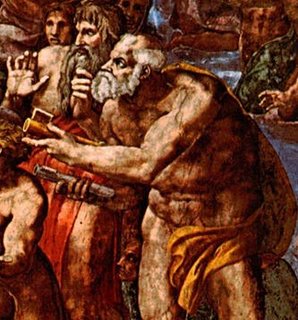
The other view sees art as the artist's contribution to 'the conversation' as a specific moment in time. Taken in that sense, changing the work of art consists of making a further contribution to the conversation, and not in any sense falsifying the original statement of the artist.

I'm hesitant to try to nail all this down rationally, in that I am not sure that my beliefs about art are all that rational. (I'm not saying that they're irrational so much as that they are not derived from me sitting down and reasoning out a position.) Still, having thought about it for the past few days I believe I can say that the reason why changing another artist's work strikes me as such a bad idea.

As several people have pointed out, art is a sub-creative act. We imitate God by creating a small fragment of a world, ordered by our ideas of beauty and how the world is (or ought to be). However, there is another sense in which the artist's act is 'godlike', in that the artist is trying to stretch beyond the boundaries of our mortal condition by creating his own 'world' which (if properly taken care of) stands to last many centuries after the artist himself has turned to dust. Thus, the art created by some unknown sculptor in Greece 2400 years ago still conveys a statement that, "Once I lived, and I saw the world thus. Once I created that which was beautiful." Thus, through art, man strives for life after death, through concretizing his thoughts in such a way as to share them with others years, centuries or millennia hence.

Some would call this desire for one's own thought and vision, unchanged by others, to last our the centuries selfish. All very well for the artist, but what good does it do the viewer to have these static artifacts of some long dead person's vision sitting around? To my mind, it actually gives the viewer quite a bit. In viewing the art or reading the words of a long dead artist, we come to experience as clearly as we ever can experience such things how another person thought and felt and viewed the world. What he was, what he believed the world was, and what he wished to convey to people after his death. Thus, if someone changes the artist's work, that person also robs future viewers of the ability to truly know the artist. When art is changed or destroyed, the artist dies again.

Now, some artist aren't worth keeping alive for eternity. I'm hesitant to actively destroy art (count me out on book burning, even of really execrable stuff) but at the same time I see no particular reason to take care of art that isn't good, or that is actively bad. But changing art (unless you're creating a wholly new piece based on someone else's original) seems to violate this 'art as eternity' purpose.

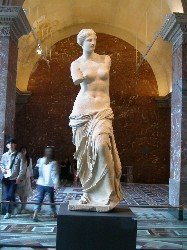
If there's an argument against this way of looking at things, I think it's probably that there's some art whose greatness no one questions which is no longer whole. The Venus de Milo is an obvious example. The Parthenon Frieze is another.
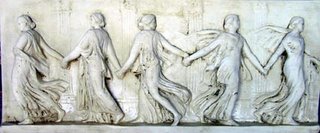


These works are of unquestioned value, yet we don't see them as they were originally created. And more disturbing yet, to my assessment, is the possibility that part of what makes these works so appealing is that the slight vagueness that age has imposed upon these works. Were they more beautiful when newly made, or does the fact that we ourselves must fill in the gaps provide a universality that the original, newly-minted, lacked?

High times in the organic aisle

I was at the grocery store last night, perusing the organic section for peanut butter, when the fellow looking in the organic freezer case said, "Ha!" I turned to him questioningly.

"They've got hemp waffles now!" he exclaimed. "Flying high at the breakfast table!"

"I sure wouldn't give them to my kids," I said. "They're wired enough as it is."

Anyone out there ever tried hemp waffles? I'm mildly curious -- but not curious enough to pay a premium price that exotic waffles command.

Wednesday, July 26, 2006

Let's Not, Please

Every so often, terribly clever people suggest terribly foolish ideas. John Hawk's pointed to one of these the other day. As I mentioned the other day, there's a lot of work being done right now on studying Neanderthal DNA. (And if you want to read more about such things, Hawk's blog is a simply astounding resource.) Howevere, it seems that a few of the folks involved have some rather grander designes. From the NY Times (registration required):

If Dr. Paabo and 454 Life Sciences should succeed in reconstructing the entire Neanderthal genome, it might in theory be possible to bring the species back from extinction by inserting the Neanderthal genome into a human egg and having volunteers bear Neanderthal infants. This might be the best possible way of finding out what each Neanderthal gene does, but there would be daunting ethical problems in bringing a Neanderthal child into the world again.

Dr. Paabo said that he could not even imagine how such a project could be accomplished and that in any case ethical concerns "would totally preclude such an experiment."

Dr. Lahn described the idea as "certainly possible but futuristic."

The most serious technical problem would be creating functional chromosomes from Neanderthal DNA. But ethical questions may be less surmountable. "My first consideration would be for a child born alone in the world with no relatives," said Ronald M. Green, an ethicist at Dartmouth College. The risk would be greater if, following the plot line of Mary Shelley's "Frankenstein," a mate were created as a companion for the lonely Neanderthal. "This was a species we competed with," Dr. Green said. "We would not want to recreate a situation of two competing advanced hominid species."

But Dr. Green said there could be arguments in the future for resurrecting the Neanderthals. "If we learn this is a species that was wrongly pushed off the stage of history, there is something of a moral argument for bringing it back," he said. "But the status quo is not without merit. Curiosity alone could not justify what could be a disaster for both species."
You do have to wonder sometimes, both about the scientists and 'ethicist' blue-skying about this, and about the NY Times reporting taking this with a straight face and printing it.

Something Rotten in the State of Literature

Deep Furrows wrote the other day about the disconnect between the love of literature that often inspires people to go into Literature as an academic field, and the often highly anti-literary modes of analysis that are currently in vogue thoughout great swaths of the academic establishment in Eng. Lit. faculties.

One of the commenters linked to an article in the New York Review of Books on the same subject which is also very much worth a read, if only to hear the sad tale of how the phrase "the invaginated eyeball" came to be presented in all supposed academic seriousness.

It all reminds me of the high-school-clever comeback I developed by Junior and Senior years when people kept asking me "if you're so into books, why aren't you planning to study English?" Answer: "Why, because I like literature." In all too many of today's elite colleges, though who actually love the written word (especially if they love it for what it is rather than what can be done to it) would be well advised to stay far away from the English department.

Tuesday, July 25, 2006

Out, damned spot

1. I was finally overcome by my disgust for the couch.
2. I was finally overcome by my disgust for the nasty carpet.
3. My two youngest siblings (13 and 15) are going to be staying with me for a week.

Add it all up, and you get a New Look in the living room.

No, the carpet isn't going, but it's being cleaned. Baby will be crawling soon, and I feel that I can't in good conscience place her on the living room floor in the condition it's in now. But since the cleaning is scheduled for next week, it seemed like this week would be a good time to try and paint the living room, especially since I have some built-in help and babysitting with my siblings coming out. Making younger siblings work when they visit is another way of saying "I love you."

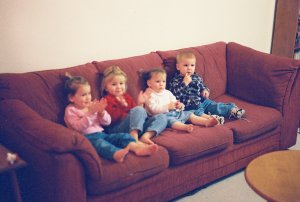
And since I already threw out the old couch, it seemed as good a time as any to get a new one, especially with visitors coming. Thanks to the miracle of craigslist.com, I found a couch I liked in the afternoon and picked it up that evening. In 24 hours I've gone from this:


(bonus shot of our girls [first and third] early last year)

to this:

(That's not my living room, silly! But it is my couch now, and woe betide the first person who spills something on it.)

If everything goes as planned, I might post some pictures next week of the Extreme Living Room Makeover, Darwin edition.

Akin on Embryo Adoption

Jimmy Akin had a very well thought out post of the moral issues surrounding embryo adoption yesterday, which made what struck me as some very sound distinctions about the separate acts of reproduction and care/nurturing which are involved in conception and pregnancy:

My own instincts are with the second group--that it is morally permissible to adopt embryos in order to keep them from dying.

To my mind, the definitive moment of reproduction is conception. When that happens is when you have a new human being. What happens to it next is not reproduction, because the reproduction has already taken place and we have a new person. What follows (implantation in the womb and subsequent gestation) is simply caring for a new person who already exists and thus is not subject to the same kind of moral unalterability as the act of reproduction itself.

In other words, human reproduction is inviolable, which is why IVF (like adultery) is wrong, but most of what is happening during pregnancy is not reproduction. A new human is produced--and thus reproduction takes place--at the very beginning of pregnancy. What follows is growth, development, and care.

I was somewhat surprised that a majority of the commenters seemed to be at odds with Akin's stance. I wonder if, with all of the moral issues which Catholics are used to opposing such as cloning, IVF, surrogate motherhood, etc. that the concept of embryo adoption suffers a certain guilt by association in the minds of many conservative Catholics, because it 'looks too much like' IVF or cloning.

Whatever the reason, I think the reproduction followed by nurturing description which Akin uses is one of the main differences between Catholic teaching and mainstream American feeling these days. My impression is that many people envision all of early pregnancy or in extreme cases pregnancy as a whole as one long act of reproduction, which doesn't actually produce 'a baby' until very late in the process. This may make intuitive sense to many people at an emotional level, but it presents problems physically, since there is a continuity of existence throughout the development of the embryo/fetus/baby from conception to birth and beyond. From an empirical perspective (and though I by no means hold that the empirical perspective is the only or even the most important way of viewing the world -- it certainly is the best way we have of understanding the physical world around us) it is conception at which something clearly happens. What occurs after that is clearly development. A great deal of development to be sure, but development within a continuity of existence. Any other dividing line must be based upon how some external observer feels about the unborn child -- and I am deeply skeptical of any system which claims that what something is depends upon how others perceive it rather than upon its own being.

Monday, July 24, 2006

Unfertilized Embryos?

If you follow science to any degree, you realize how incredibly ignorant most mainstream reporting on science is. The average reporter doesn't seem to know much more about science than he or she does about religion (One sense in which both fields are in the same boat), though despite this most reporters are sure that science somehow has all of tomorrows answers, though traditional religions at best have yesterday's answers.

So it's hardly surprising that one of CNN's blonde talking heads (Fox isn't alone in this affliction, it seems) had a gaffe on air in which she talked about how stem cell researches only wanted to use 'unfertilized embryos'.

However, it's significantly more disappointing to see someone from ScienceBlogs making the same mistake. "...using unfertilized and otherwise discarded embryos for research that might lead to life-saving cures." You can have an unfertilized egg, and you can have a discarded embryo, but having an unfertilized embryo is an impossibility by definition.

And people accuse us of not belonging to the 'reality based community'...

The Source of Middle East Conflict

One of the great elder statesman of our democracy has finally explained to all of us the real reason Hezbollah has succeeded in starting a war between Israel and Lebanon. The Detroit News reports:
U.S. Sen. John Kerry, D- Mass., who was in town Sunday to help Gov. Jennifer Granholm campaign for her re-election bid, took time to take a jab at the Bush administration for its lack of leadership in the Israeli-Lebanon conflict.

"If I was president, this wouldn't have happened," said Kerry during a noon stop at Honest John's bar and grill in Detroit's Cass Corridor.

Bush has been so concentrated on the war in Iraq that other Middle East tension arose as a result, he said.

"The president has been so absent on diplomacy when it comes to issues affecting the Middle East," Kerry said. "We're going to have a lot of ground to make up (in 2008) because of it."
Well don't I feel small. Clearly things would be pretty peachy between Israel and it's Arab neighbors if only we had someone with more diplomatic experience in the White House.