Because most philosophies that frown on reproduction don't survive.
Showing posts with label assault rifle. Show all posts

Friday, January 11, 2013

Assault Weapons Part 3: Gun Control

In Part 2 I described the essentially cosmetic characteristics which were used to define some civilian rifles based on military assault rifle designs as "assault weapons" in the 1994 Federal Assault Weapons Ban (AWB). During the ban period (1994 to 2004) and even more so since, military style rifles have become dramatically more popular in the civilian market.  The AR-15 (the family of civilian rifles based on the military M16) is now the most popular type of civilian rifle in the US with dozens of models on the market. However, these rifles continue to have a very bad reputation with gun control advocates and they have been used in several recent highly publicized crimes such as the Aurora, CO movie theater shooting and the Newton, CT school shooting. This has led to renewed calls for increased regulation or outright bans of "assault weapons". In this third and final post on the "assault weapon" issue, I'd like to address the following issues: How often are military style rifles used in crimes? Are they particularly suited to crime? Did the 1994 AWB have any discernible effect on crime? Do military style rifles have legitimate civilian purposes?

How Much Are "Assault Weapons" Used In Crime?
The Coalition to Stop Gun Violence takes a fairly standard line on "assault weapons" in its page on the topic:
Assault weapons possess features specifically designed by the world's militaries to make it easier for the shooter to fire a sustained, high volume of rounds into a wide area. As a result of America's weak gun laws, these weapons entered our civilian marketplace decades ago, and criminals quickly learned how to exploit their military features.
However, these claims about the widespread adoption of military style rifles by criminals do not seem to align well with the facts. According to a report this year by the Congressional Research Office "By 2007, the number of firearms [owned by US civilians] had increased to approximately 294 million: 106 million handguns, 105 million rifles, and 83 million shotguns." (page 8) However, according to the FBI's uniform crime report, only 3.6% of murders are committed using rifles, a number that would include both "assault weapons" and more traditional rifles. Rifles were outranked in numbers of murders committed in 2010 by handguns (60.2% of murders), knives (13.1%), fists, kicking and other uses of the human body (5.7%), blunt objects (4.2%) and shotguns (3.7%). Another way to think of this is: Although there are roughly the same number of rifles and handguns available in the US, handguns are used in homicides at a rate nearly 17 times that of rifles.

A 2004 report prepared for the National Institute of Justice to assess the effectiveness of the (then expiring) Federal Assault Weapon Ban wrote:
Numerous studies have examined the use of AWs in crime prior to the federal ban. The definition of AWs varied across the studies and did not always correspond exactly to that of the 1994 law (in part because a number of the studies were done prior to 1994). In general, however, the studies appeared to focus on various semiautomatics with detachable magazines and military-style features. According to these accounts, AWs typically accounted for up to 8% of guns used in crime, depending on the specific AW definition and data source used (e.g., see Beck et al., 1993; Hargarten et al., 1996; Hutson et al., 1994; 1995; McGonigal et al., 1993; New York State Division of Criminal Justice Services, 1994; Roth and Koper, 1997, Chapters 2, 5, 6; Zawitz, 1995). A compilation of 38 sources indicated that AWs accounted for 2% of crime guns on average (Kleck, 1997, pp.112, 141-143).

Similarly, the most common AWs prohibited by the 1994 federal ban accounted for between 1% and 6% of guns used in crime according to most of several national and local data sources examined for this and our prior study (see Chapter 6 and Roth and
Koper, 1997, Chapters 5, 6)
...
Although each of the sources cited above has limitations, the estimates consistently show that AWs are used in a small fraction of gun crimes. Even the highest estimates, which correspond to particularly rare events such mass murders and police murders, are no higher than 13%. Note also that the majority of AWs used in crime are assault pistols (APs) rather than assault rifles (ARs). Among AWs reported by police to ATF during 1992 and 1993, for example, APs outnumbered ARs by a ratio of 3 to 1 (see Chapter 6).
From all of these, it would seem that military style rifles simply are not used that much in crime. This should not actually be all that surprising. The reason why the modern assault rifle is such an effective military weapon is that it is able to deliver accurate fire (and do so rapidly enough to allow a single soldier to tie down multiple enemy soldiers) at a distance of up to several hundred yards. This function (delivering accurate fire out to several hundred yards) is useful to civilian sport shooters as well, but it is of no use to criminals, who generally are using guns at a distance of just a few feet. That is why handguns are favored by criminals. Long distance accuracy and even rate of fire are not nearly as important in crime.  Indeed, in most crimes employing a gun, the gun is not even fired; it is used as a threat.  Far more important to criminals is the ability to carry a gun without it being seen until it is produced. Rifles, however military in appearance, do not fit well in a pocket.

Compactness is also the reason why handguns are primarily used by civilians in self defense. According to the same Congressional Research Office report cited above (page 13):
Another source of information on the use of firearms for self-defense is the National Self-Defense Survey conducted by criminology professor Gary Kleck of Florida State University in the spring of 1993. Citing responses from 4,978 households, Dr. Kleck estimated that handguns had been used 2.1 million times per year for self-defense, and that all types of guns had been used approximately 2.5 million times a year for that purpose during the 1988-1993 period.
This would suggest that while handguns are used in 89% of murders that are committed with guns, they are also used in 84% of cases of self defense. (As with the use of guns in crime, in the majority of cases of self defense, the gun is never fired, it is only drawn as a threat.)

Military rifles do seem to hold an attraction to some people bent on mass kills, as shown by the use of AR-15 rifles by the killers at Aurora, CO and Newton, CT. However, these cases are incredibly rare, only a handful over the last decade, as compared to the millions of military style rifles owned and used by completely law abiding citizens. Nor are military style rifles in any way required to perpetrate horrific mass killings as examples such as the Virginia Tech shooting demonstrate. Although gun control advocates tend to emphasize that "assault weapons" are designed to be fired "as fast as possible", the fact of the matter is that the civilian rifles which are termed "assault rifles" do not fire any faster than more traditional designs of semi-automatic rifles, or than pistols and revolvers. Virtually all handguns manufactured in the last 100 years, and a significant percentage of the rifles manufactured in the last 50, can be fired as fast as the trigger can be pulled. The attraction of military style rifles for mass killers is not that they offer some technological edge in killing that other guns do not possess, it is that their appearance ties in with their deluded images of themselves, allowing them to think of themselves as looking more deadly. In this sense, the selection of a gun with a military appearance is much the same as the selection of "tactical gear" which often serves little practical function for the crime planned, but which allows the killer to imagine himself to be military and dangerous in appearance.

Did the 1994 AWB Reduce Crime?
Murder rates and violent crimes rate did fall significantly from roughly 1994 (the year when the AWB was enacted) through 2000 and have remained flat to slightly down since that time. However, rifles (and thus necessarily the subset of military-style rifles) remained a roughly stable (and very small) percentage of guns used in crimes throughout the period. The National Institute of Justice Report showed some evidence that military style rifles were used less in crimes after the 1994 ban (pages 42-45) however it also noted that since rifle manufacturers came out with legal ban-compliant versions of their military style rifles, the actual number of military style rifles sold went up during the ban rather than down (page 35-36). Given this increase in sales of military-style rifle and the fact that the "ban" did not actually remove any of the existing "assault weapons" from circulation, it seems likely that any small change in the rate of their use in crimes would have been coincidental.

Altogether, the NIJ conclusion that the ban had little clear effect on crimes seems pretty likely:
Should it be renewed, the ban’s effects on gun violence are likely to be small at best and perhaps too small for reliable measurement. AWs were rarely used in gun crimes even before the ban. LCMs [large capacity magazines, defined by the AWB as magazines holding more than ten rounds] are involved in a more substantial share of gun crimes, but it is not clear how often the outcomes of gun attacks depend on the ability of offenders to fire more than ten shots (the current magazine capacity limit) without reloading.
Now that eight years have passed since the expiration of the, with sales of "assault weapons" skyrocketing but the number of murders falling, it seems hard to make a case that the expiration of the AWB has had any effect on crime either.

Do military style rifles have legitimate civilian purposes?
The somewhat peculiar rhetorical fall-back which is sometimes executed in the face of this data goes something like this: "Sure, assault weapons may only be used in a small percentage of crimes, but these are guns which have no legitimate civilian purpose, so why not ban them and achieve whatever small reduction in violence that would result?"

This seems like an odd argument in the face of the fact that military style semiautomatic rifles are one of the highest selling types of rifles in the US. With millions of these rifles being owned by US citizens and only a few hundred being used for crimes each year, it seems fairly obvious that there must be legitimate civilian purposes for them. Millions of civilians are choosing to spend $700-$2000 in order to buy these rifles, and very few of them are using the rifles to commit crimes, so whatever they are doing with them would seem to be "legitimate civilian purposes". As I described in more detail in Part 2, these rifles are actually pretty well suited both to target shooting and to home defense.

Are military style rifles exceptionally "high power" rifles?
One of the other claims that I often see in news stories is that military style rifles such as AR-15s are far more "high powered" rifles than normal civilian rifles. Coalition to Stop Gun Violence collects a number of quotes from such stories on their "What Law Enforcement Says About Assault Weapons" page:
"We're literally outgunned. You're talking about the kind of firepower that can go through vehicles, through vests, and that can literally go through a house."
...
"These are state-of-the-art weapons ... My firearms experts over here tell me that...no body armor that we have would have saved our officers from these weapons here. I mean, in fact, many of them are capable of slicing through a vehicle. This is just how deadly these weapons are."
...
“[A semiautomatic AK-47 rifle] can lay down a lot of fire in an urban area where there is basically no cover from it. You can conceal yourself from these weapons, but they’ll rip through a car. They’ll rip through a telephone pole. They can rip through just about anything in an urban environment. Everybody understands when they read the morning paper that you have to push as much as you can to get these guns off the street."

It is true that rifle bullets are very powerful and destructive things, often capable of going through walls or piercing the metal body of a car. However, this is the case with all rifle bullets. Indeed, the intermediate size rounds fired by assault rifles are significantly lower power than the rounds typically used by hunters. The 5.56×45mm NATO round fired by the AR-15 packs a force of 1,300 foot-pounds of energy. The 7.62×39mm fired by the AK-47 is slightly more powerful at 1,500 foot-pounds. However, the .308 Winchester, a common hunting cartridge, is far more powerful than either one at 2,600 foot-pounds.  Every common hunting cartridge is more powerful than those used by military assault rifles.  The suggestion that "assault weapons" fire unusually high powered rounds compared to standard rifles is directly contrary to the very purpose of the shift from battle rifles to assault rifles after World War II, which was to move to a lower power (and thus lower recoil) cartridge that would be easier for soldiers to shoot.

What perhaps gives rise to this confusion is that "assault weapon" rounds pack far more force than standard pistol rounds. For instance, the 9mm Luger round (which the ATF reports is the most common caliber of pistols traced by police in connection with crimes -- and which is also the caliber of pistol most often carried by police themselves) carries a force of only 400 foot-pounds, a little less than a third of that of the AR-15's 5.56×45mm NATO.

Is there a legitimate purpose to "high capacity magazines"?
Magazine size is perhaps the number one area in which new gun control legislation is likely to focus. The 1994 AWB banned the manufacture and importation of magazines holding more than ten rounds for any type of gun with a removable magazine. This had the largest effect on semiautomatic pistols. Most pistols made in the last 20 years hold over a dozen rounds in their standard magazine.  (This isn't because the guns are particularly "high capacity", it's just the number that fit in a magazine the same length as the pistol's grip.)  Military style rifles also often came with a larger magazine holding 20-30 rounds.

Gun control proponents point out that there are very few situations in which a civilian would need to have a magazine holding more than ten rounds of ammunition. Hunters usually only get one good shot at an animal. Target shooting is usually done in sets of 5 or 10 shots. Very few self defense situations require firing more than ten shots.

However, at the same time, very few crimes involve the firing of large numbers of shots either. The National Institute of Justice study on the AWB reported that only 3% of instances of gun violence involved the firing of more than ten shots -- though those 3% did account for 5% of gunshot injuries, a slightly disproportionate share.

Gun rights advocates respond with two fairly indisputable points: To the person intent on firing a lot of shots in the commission of a crime, carrying extra loaded magazines is easy and changing magazines is incredibly fast.  With no particular training it takes about a second to drop an empty magazine and put in a new one.  Further, given that there are already, by government estimates, 20-30 million magazines holding more than ten rounds in current circulation, even if the manufacture of more were banned, there are so many already available that the ban would do little other than increase the cost.  An sort of buy-back or confiscation program would be very difficult to enforce simply because of the huge number of magazines in circulation.  As such, it seems very hard to imagine than any ban of the manufacture of new magazines holding more than ten rounds would do anything other than annoy gun owners -- something which at times seems to be considered an end unto itself among gun control advocates.

Summing up: In the face of terrible crimes, there is a strong desire on the part of civil society to "do something". In the coming weeks and months we will see that instinct playing itself out in full force. An attempt to ban or regulate "assault weapons" is likely to be one of the centerpieces of this attempt to do something. However, for all their black and angular aesthetic, "assault weapons" are not different in function than other common rifles. They substitute metal stocks and grips for wood, and they sometimes feature military style features that have little relevance to civilian use (lugs to which a bayonet can be attached, flash suppressors, etc.) but these features do not make them more dangerous. Indeed, the lighter weight cartridges which they share with the military assault rifles which are their technological ancestors are actually significantly less powerful than the standard hunting cartridges fired by most "normal" civilian rifles. The rifles labeled as "assault weapons" are owned by millions of law abiding citizens, and they are very rarely used in crimes. The urge to ban or regulate them is an urge to put appearances over substance.

I don't own an "assault weapon", indeed I've never shot one.
But I would like to own one of these someday if they're still legal:
The M1A, civilian version of the M14, the last US battle rifle.  While
I've come to appreciate the AR-15 a lot more while researching these
posts, I"m a wooden stock and .30 cartridge kind of guy.


Previous posts:
Assault Weapons Part 1: Battle Rifle to Assault Rifle

Assault Weapons Part 2: Assault Rifles vs. "Assault Weapons"

Tuesday, January 08, 2013

Assault Weapons Part 2: Assault Rifles vs. "Assault Weapons"

In Part 1 I discussed the history of military service rifles and the development of the "assault rifle" during and after World War II. To briefly review (especially for those who got tired of all the technical detail and skipped most of it): A military assault rifle is a rifle with a selective fire feature (the ability to shoot in semi-automatic, burst or fully automatic mode) which fires a smaller, lower power rifle cartridge suitable for battlefield confrontations out to 300 yards. Assault rifles are so named in contrast to full size "battle rifles" which fired a larger, higher powered rifle cartridge similar to those used by most modern hunters, and also in contrast to submachine guns, hand-held fully automatic weapons (usually with some kind of stock) that fired a pistol cartridge rather than a rifle cartridge. These were accurate only at very short ranges. The assault rifle, with its compact size, selective fire and small rifle cartridge combined the best features of the battle rifle and the submachine gun and thus made a far more versatile all around military weapon.

In this post, I'm going to discuss the civilian rifles based on military assault rifles. I'll discuss how these civilian rifles are similar to their military cousins and how they differ, why they have become so popular with shooters (the AR-15, the civilian rifle based on the M16 design, is reported to be the highest selling rifle design in the country with models being produced by over a dozen gun manufacturers), and finally I'll discuss the legal definition of "assault weapons" as found in the 1994 federal assault weapon ban (now expired). I'll specifically tackle the merits of additional legal restrictions on civilian "assault weapons" in a third post.

Military to Civilian

As I described in my previous post, the military purpose of the assault rifle had two basic components: selective fire and a smaller rifle cartridge which was accurate out to 300 yards yet was easier to shoot in burst or full auto mode than a full size high power rifle cartridge. Military and civilian gun technology have always advanced hand in hand. Lever action, cartridge repeating rifles and revolvers were introduced for military use during the Civil War and proceeded to become wildly popular on the civilian market during the following 50 years. After World War One, bolt action rifles (mainly based on military designs) became the standard civilian rifles and semi-automatic pistols (many of them based on the military versions like the Colt .45 and the German 9mm Luger) became increasingly popular. After World War II, rifles from the war or based on designs used during the war (including millions of M1 Garands and M1903 Springfields sold off as military surplus for civilian use as well as German K98 Mausers which were confiscated from conquered Germany and sold on the civilian market) became popular for civilian use. However, assault rifles were, by definition, excluded from the US civilian market because the 1934 Firearms Act had banned civilian ownership of machine guns in the US. Thus, any rifle with selective fire was automatically illegal for civilian US ownership. As early assault rifles began to make their way onto the US market (either as military surplus or with civilian models of military weapons) any assault rifle intended for the US market had to be modified in order to permanently remove any burst fire or automatic fire features. This means that any gun sold legally to civilians in the US (with a few rare exceptions for collectors with very special licenses issued by the federal government) does not fit the military definition of an assault rifle, since it lacks a selective fire feature. It is simply a "military-style" rifle which shoots a lower power rifle cartridge the same as the cartridges used by real military assault rifles.

When Colt got the contract to build the M16 for the US military, it also released a civilian model, the AR-15. (AR stands for Armalite Rifle, Armalite having been the manufacturer which originally developed the design and sold it to Colt.) The AR-15 was different from its military cousin the M16 in that it did not have a selective fire feature, and several internal components of the rifle were modified in order to make it harder for enterprising owners to modify the gun in order to make it into a fully automatic machine gun. A few other manufacturers offered civilian rifles based on the M16 design (and all civilian rifles based on this design are loosely referred to by shooters as "AR" rifles, even though "AR-15" is a trademark of Colt) but these guns were not widely popular. Other civilian rifles based on modern military rifle designs (or surplus military rifles from other countries which had been modified to disable selective fire features) were also available for sale in the US, but again, sales of them were not particularly high.

Arguably, the main reason for this is that civilian rifles based on military designs fired cartridges which most hunters considered to be too light for hunting. Indeed, the .223 Remington cartridge which is fired by the AR-15 is not allowed for hunting deer and other full size game in some states, because it is believed that it is too small and low powered to kill humanely. The primary hunting use of the .223 (for which it was popular prior to its adoption by the military as the 5.56x45 NATO) was "varmint hunting" at long ranges. Ranchers used these high velocity, highly accurate but small cartridges to shoot pests like prairie dogs, coyotes and the like at long distances.

There were, of course, exceptions to this. The Civilian Marksmanship Program (originally set up in 1903 as a government program but spun off as a semi-private organization in 1996) holds national target shooting matches in which the US service rifles (the M1 Garand, and the civilian versions of the M14 and M16) are the only allowed rifles.  The original purpose of the CMP was to improve the marksmanship of the general population in preparation for wartime service, thus the emphasis on military rifles.  And, of course, some shooters simply enjoyed using the civilian version of the US service rifle for sport shooting.

How "Assault Weapons" Became Popular

Civilian versions of military assault rifles were available on the US market ever since the development of assault rifles, however, it wasn't until several factors came into alignment in the early 1990s that they began to become highly popular.

As the Cold War wound to a close and the iron curtain came down, the governments of Eastern Europe found themselves pressed for cash and sitting on huge arsenals of aging military rifles, not just assault rifles but even millions of bolt action Mausers and Mosin-Nagants dating back to World War II and before. They began to sell these rifles on the international market. Western-made civilian versions of military rifles (such as the Colt SP-1, the AR-15 sold during the 70s and 80s) had been fairly expensive. These communist block guns, however, were far cheaper, and there was also dirt cheap surplus ammunition being sold for them.

At the same time, AR-15 type rifles benefited from the popularity of the Gulf War. In the 70s and 80s the M16 had been closely associated with Vietnam, and many gun owners derided it as under powered, unreliable, over priced, made of plastic, etc. The M16 (and its civilian cousins) had been gradually improved in the 25 years since its adoption by the military and so Gulf War era M16s were genuinely higher quality than their Vietnam era ancestors. At the same time, the M16 had arguably been unfairly derided in the wake of an unpopular war and the low military morale that followed it. After the Gulf War, respect for the military was far higher and respect for its standard rifle rose as well.

Sport shooting culture was changing during this period as well. Rather than being solely devoted to hunting, an increasing number of shooters were interested primarily in sport shooting at gun ranges and being prepared for potential self defense use of guns. For those who shot almost exclusively at gun ranges, the fact that the cartridges fired by civilian versions of military assault rifles were fairly light for hunting game didn't matter, and the fact that cheap military surplus ammunition was available made civilian versions of military rifles much cheaper to shoot than standard hunting rifles. Further, for gun owners concerned about self defense, military style rifles offered intimidating looks more likely to cause an assailant to flee while also being compact and light. The lower power cartridges fired by military style rifles also made them more suitable for home defense than a full size hunting rifle.

Arguably the biggest boost to the popularity of military style rifles, however, were the attempts to ban them. Little regulatory attention had been paid to military style rifles until the Stockton Shooting in 1989, in which an alcoholic drifter and frequent criminal named Patrick Purdy bought an AK-47, decorated it and his tactical jacket with legends such as "Freedom", "Victory", "Hezbollah", "PLO", and "death to the Great Satin"[sic] and opened fire on elementary school children at Cleveland Elementary School in Stockton, CA, which he had himself attended sixteen years before. Five children were killed and twenty-nine wounded before Purdy took his own life. California passed a ban on military style rifles which it termed "assault weapons" later that year, and President George H. W. Bush signed an executive order restricting the importation of military style rifles from outside the country. These efforts culminated in the passing of the Federal Assault Weapons Ban in 1994, which banned the import or manufacture of rifles which certain military style features.

Gun rights organizations pointed out (rightly) that the features banned by the AWB were in the main cosmetic. The controversy focused huge amounts of attention on military style rifles. Shooters who had never thought about trying a military style rifle before tried them, and often found they enjoyed them. And anyone who had vaguely thought of buying one at some point snapped one up before the ban was put in effect. As the passage of the ban (which only banned the manufacture and importation of new guns with certain features but did not seek to restrict those which were already made prior to the ban) loomed, sales of the rifles it would ban skyrocketed. Once the ban did pass, many of the less expensive foreign competitors to the American-made AR-15 models became much harder to get while makers of AR-15s quickly modified their designs to be compliant with the ban and continued selling rifles. Thus, due to publicity and the proudly contrarian tendencies of shooters, sales of military style rifles actually went up rather than down after the Assault Weapon Ban. When the ban expired in 2004, sales expanded even more rapidly as the "evil" features became legal again on new rifles. The AR-15 platform is now the best selling type of rifle in the US with so many models available on the market that Field & Stream ran an article back in 2009 listing the "25 Best AR-Style Rifles".

The Legal Definition of "Assault Weapons"

When legislators sought to ban military style rifles, they faced a problem: Since military assault rifle designs already had to be modified in order to remove selective fire features in order to be sold in the US civilian market, there was not actually a functional different between the military style rifles which gun control advocates sought to ban and "normal" sporting rifles. The result was a checklist of what gun rights advocates jestingly referred to as "evil" features.  Any rifle that had two or more of these features was legally defined as an "assault weapon".


However, since these were minor cosmetic features (with the exception of the pistol grip which does have superior ergonomics to the more traditional stock comb grip) the solution was simply to remove the other offending features. Thus, while the above AR-15 could not have been manufactured under the AWB, the one below would not:


As the re-design of the rifles during the ban made clear, the features banned were in no way essential to the operation of the rifle. A flash suppressor may be useful for Navy SEALS conducting a night attack, but it makes no difference one way or another on the gun range or in committing a crime. A folding stock may make a carbine slightly more compact, but it certainly doesn't make it small enough to stuff down one's pants when going to hold up a liquor store. And the last time there was a deadly bayonet attack on US soil was probably during the Civil War. The only element of the law (one which applied to all guns, not just to "assault weapons") which might arguably make a gun "less deadly" was the ban on detachable magazines holding more than ten rounds of ammunition. Though as crimes such as Columbine show, it's still quite possible to have a deadly mass shooting in which high capacity magazines play no part. Regardless of what one may think about the need to ban or regulate military style rifles, the 1994 ban clearly achieved virtually nothing.

In the final post in this series, I'll look in more depth at the arguments for gun control laws banning or limiting "assault weapons".

Monday, January 07, 2013

Assault Weapons Part 1: Battle Rifle to Assault Rifle

This is part one of a series on "assault weapons", a topic likely to be in the news a great deal as the new congress tackles the possibility of new gun control measures. The term "assault weapon" is itself a frequently disputed one, having come in to currency with the "assault weapons" ban of 1994 (which expired to little fanfare in 2004.) It is based on the term "assault rifle" though the weapons legally defined as "assault weapons" by the ban were not technically assault rifles. Thus I am going to start out by examining the development of the "assault rifle" as a piece of military technology.

Looking back to the early days of our country, muzzle loading black powder muskets and rifles hurled large pieces of lead at comparatively low velocities (under 1000 feet per second). Muskets in the Revolutionary War shot .75 caliber musket balls. Caliber refers to the diameter of the bullet and it's normally a fractional number of inches. Thus, the musket balls of the Revolutionary War were three quarters of an inch in diameter. By the Civil War, musket balls were replaced by bullet-shaped .58 caliber "minie-balls". Although they were smaller in diameter, they were longer, so the actual mass was similar: 500-600 grains which translates to 1.1 to 1.4 ounces. (If you want a way to think about this, a quarter weights .2 ounces or 87 grains, so a Revolutionary or Civil War bullet weighed about as much as a stack of six quarters.)

Trapdoor Springfield

After the Civil War, the army adopted cartridge-based rifles. First the black powder .45 caliber "trapdoor" Springfield, a single shot cartridge rifle whose breech flipped open to load. Then, in 1892, the five shot .30 caliber Krag-Jørgensen bolt action rifle, which was the first US military rifle to use smokeless powder, shooting the .30-40 Government cartridge.

M1903 Springfield Bolt Action

Although each of these developments in military technology featured a lighter bullet with a smaller diameter, each also fired the bullet at higher velocity. Energy is calculated as mass times velocity squared times a constant of 1/2. By this calculation, the .30-06 bullets which World War I and II US Soldiers used packed more than twice as much energy as a Civil War era minie-ball, despite weighting only 150 grains (a bit less than the weight of two quarters.)

Improvements in weapons technology had consistently made rifles both faster to shoot and accurate to longer distances. Muzzle loading muskets and later rifles, from the time of the Revolutionary War to the Civil War could be fired at a rate of three shots per minute by trained soldiers, but while the smoothbore muskets of the Revolution were accurate, at best, to a hundred yards, the Civil War era rifles could be accurate out to 300 yards or more. This drastic increase in the accurate range of small arms was one of the factors that significantly changed battle tactics from those of the Napoleonic era. Several decades before, a mass infantry charge such as Picket's famous charge at Gettysburg could have been a decisive means of victory. With the longer range rifled muskets of the Civil War, it led to mass slaughter.

While muzzle loading technology had imposed a fairly strict limit on the rate of fire that infantry soldiers could deliver, the introduction of cartridge rifles allowed significant increases . While a Civil War era rifled musket could only be fired three time a minute even by soldiers well trained in speed drill, the single shot, cartridge loading "trapdoor" Springfield could get off ten shots a minute. The bolt action, five shot M1903 Springfields used during World War One allowed a soldier to get off fifteen aimed shots a minute.

Technological improvements had continued to increase the accuracy of battle rifles as well. By the first world war, the rifles carried by all of the major combatants were no longer limited by the technical specifications of the rifle but by the ability of their users. All of the battle rifles used in the Great War fired bullets of roughly .30 caliber from high powered cartridges and could hit a man-sized target at distances of 800-1000 yards. The issue was: Although the rifles were technically capable of hitting a target at such extreme distances, none but the most skilled snipers had either the eyesight or the steadiness to hit targets at that distance. Indeed, the majority of battlefield fire was exchanged at distances of less than 300 yards.

In the 1920s, the US military began to search for a new standard service rifle, which was to be the first semi-automatic service rifle. A number of designs were tested, and the one eventually selected was the M1 Garand, named after its designer John Garand. Throughout much of its development, the military planned to have the M1 chambered for a lighter cartridge in .276 caliber, however at a late date it had the rifle re-engineered to shoot the same .30-06 as the M1903 Springfield because so much .30-06 ammunition was already on hand. The M1 was adopted as the standard US infantry rifle in 1936, and the US was thus the only major power in World War II whose primary battle rifle was not a bolt action. However, the M1 shot the same kind of high powered .30 caliber cartridge which all of the other battle rifles of the war shot.

US Service Rifles: Two M1903 Sprinfields, an M1 Garant, an M1 Carbine,
an M14 and an M16 (Click to See Larger)
It was in World War II that the need for a lighter gun suitable for rapid fire became increasingly obvious. For most of the war this was achieved through specialization. Most infantry soldiers carried full size battle rifles and a smaller number were issued sub machine guns -- lighter weapons which could shoot in fully automatic (firing continuously as long as the trigger was held down) or burst mode (firing bursts of 3-5 shots every time the trigger was pulled.)  To make then easy to handle (and allow them to carry more rounds) sub machine guns shot smaller, pistol cartridges rather than a full size rifle cartridge and was thus suitable only for short range.
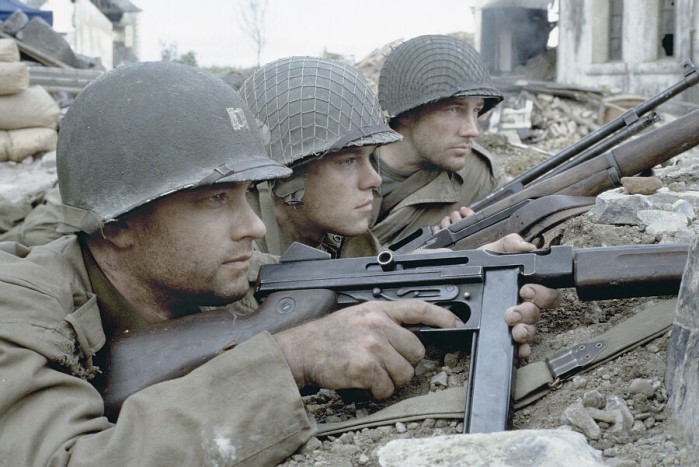
Tom Hanks holding a Thompson
Sub Machine Gun in Saving Private Ryan

Military technologists were convinced that a cross between a full sized battle rifle and a sub machine gun was needed. Such a gun would shoot a rifle cartridge, but a lighter one which would not have as much recoil as a high power .30 round. It should also be capable of shooting in burst or fully automatic mode as well as semi-automatic mode (one shot for each pull of the trigger.)

Germany produced what is often regarded as the first true "assault rifle" near the end of World War II, the Sturmgewehr 44. It shot a shortened .30 caliber bullet with a lighter charge of powder behind it, making the recoil lighter and the ammunition cheaper to produce and lighter to carry, and it could shoot either in semi-auto or full-auto mode. By late 1943, however, the tide was already turning against Germany and its manufacturing capacity was waning. Only half a million were ever produced (compared to over 14 million of their full size K98 Mauser bolt action battle rifle.) However, it provided the inspiration for Mikhail Kalashnikov's development of the AK-47 in Russia after the war. The AK-47 also used a light .30 caliber cartridge and selective fire (the ability to fire either semi-auto or full-auto.) The design became the standard Russian infantry rifle in 1949 and went on to become perhaps the most widely produced rifle design in history.
Sturmgewehr 44

AK-47

The 5.56x45mm round shot by the M16 (left)
next to the 7.62x51mm shot by the M14.
The United States was comparatively late to the game in adopting an assault rifle for its armed forces. After World War II the US sought to improve on the M1 Garand and in 1959 adopted the M14. The M14 did have selective fire and accepted a large detachable magazine.  (The Garand had a unique loading mechanism: it's magazine was fixed but clips of eight shots were loaded in from the top.  Those eight shots could then be fired as fast as the shooter could pull the trigger.  After the last shot, the rifle ejected the metal clip out the top and the bolt locked open.  The shooter then loaded a new clip in from the top and released the bolt to load the next cartridge.)

However, the M14 still fired a full size .30 cartridge, the 7.62×51mm NATO which fired a bullet of the same size as the .30-06 at the same speed. The rifle had many fans and continues to be used to this day by US soldiers and marines who are designated marksmen, but the 7.62×51mm NATO proved too high powered a cartridge to be practically shot in burst or full auto mode, and the rifle itself was heavy. As a result, the US Army adopted the M16 for jungle combat in 1963 and in 1969 made the M16 the standard service rifle. The M16, made with an aluminum receiver and a plastic stock, was five inches shorter and three pounds lighter than the M14 and it shot a much smaller cartridge, the 5.56×45mm NATO, with a .22 caliber bullet weighting about a third as much as the .30 caliber bullet of the 7.62×51mm NATO.

Because the bullet is so light and travels at such high velocity, it is extremely accurate even at long distances. However, due to its light weight it packs only half as much energy as full size .30 caliber rounds. This makes the M16 much more comfortable to fire, especially rapidly, which is the purpose of the "assault rifle" concept, however troops have in some conditions complained that it lacks "stopping power" and in Iraq and Afghanistan many units have a designated marksman with an M14 for situations in which a heavier weapon is needed. For the same reason, many hunters shun the civilian version of the round (the .223 Remington), believing that it is too small to humanely kill deer and other full size game. The round is often found, however, in the "modern sporting rifles" which are similar appearance to military designs. For the recreational shooter, the light rounds fired by military assault rifles are often preferred because they have fairly light recoil, are highly accurate at the 100-200 yard distances found at most rifle ranges, and because ammunition is far less expensive than the larger high powered hunting rounds.

Military technology has continued to develop, but all standard service rifles since the 1960's have been variations on the assault rifle concept.  The standard US service rifle is the M4 Carbine, a slightly modernized version of the M16 design.
M4 Carbine
More recent assault rifles adopted by other nations all have the basic features of selective fire and smaller rifle cartridges. More modern innovations generally relate either to compactness (a number place the action in the stock, behind the trigger, allowing for a shorter overall length of the rifle even while keeping the same length barrel) or modularity.
French FAMAS

German G36

British SA-80

Next in Part 2: Civilian weapons based on assault rifle designs, how they differ from their military cousins, and what the Federal Assault Weapons Ban actually outlawed.