Because most philosophies that frown on reproduction don't survive.

Friday, October 16, 2015

The Great War, Vol 1, Chapter 14-1

It took a little while for me to get rolling on this segment. As I was working on it I realized that the last Jozef section went up in January. If you want to go refresh your mind on old sections, use the table of contents page. However, during the last five days while on a business trip I was able to average a thousand words a day and it's done. Incidentally, the novel as a whole now weights in at a little over 186,000 words. I have another business trip next week, so my goal is to stick to a similar schedule and have the next installment up by next Friday night.


Veszprém, Austria-Hungary. September 17th, 1914. The morning light was still of the luminous, diffuse type just before the sun cleared the horizon as the training squadron clattered up Var Street onto Castle Hill. The sound of a hundred and fifty iron shod horses trotting up a cobbled street between stone buildings was nearly deafening as it echoed and re-echoed. A few people looked out as they passed. A woman waved a handkerchief to the hussars from a window of Madame Kalmar’s establishment. Heads of troopers, Jozef among them, turned to watch her. But the sound of cavalry units riding up through the old town to the castle was too common now to draw any great attention from the town’s civilians.

“Hussars! Stay in line and keep your spacing even!” Sergeant Major Szabo shouted in a voice that carried right down the column of horsemen.

During training a partially reversed hierarchy applied, and the officers-in-training lived in constant fear of the moments when the sergeants stepped in to provide commands they themselves should have given. The sergeants were not actually in command of the cadets, that would have been an unthinkable violation of the distinctions of rank and structure which allowed the Imperial Army, in all its glorious and multi-lingual complexity, to function. But Jozef knew that assessments of the cadets’ performance flowed unofficially but steadily from the sergeants to Rittmeister Koell who commanded the training squadron and from him to the oberstleutnant in command of the reserve regiment as a whole.

Jozef took the sergeant’s words as the reprimand which they were meant to be and snapped his gaze back to the road and his zug. He barked orders to his the men, bringing them into precise order. The commands in Hungarian came naturally now, though he still found more general conversation in the language halting. The hussars edged their horses more precisely into line, and the squadron rode under the archway into the castle in parade ground order, backs straight, chins up, horses stepping precisely in line, no sign of the tiredness which Jozef felt after spending his few hours of sleep trying to find comfort on the lumpy ground cushioned only by his thin bedroll.

Oberstleutnant Zingler, who despite being over sixty himself and commanding a reserve regiment made up primarily of hussars whose girth and stamina were more suited to the hunting lodge than the front lines, yearned for the glories of battle which had been denied him during a forty-year career which had begun just after the disastrous Austro-Prussian War and stretched through the unsatisfyingly long peace up until this present moment. In the interest of building a less aged regiment which might eventually be posted to the front, Zingler had ordered that the cadets conduct overnight field exercises weekly.

Rittmeister Koell, who commanded the training squadron, was rather more typical of the reserve officers in the units headquartered in the picturesque stone fortress which was situated at the highest point in Veszprém, giving it a view out over forest slopes to the spa towns that lined Lake Balaton. Though a great believer in drill and precision, and able to carry off any feat of horsemanship while keeping his back ramrod straight and his shako at the correctly jaunty angle, Koell did not see any reason why turning the cadets into proper officers should interfere with his ability to eat breakfast in his favorite coffee house, spend the hour after dinner drinking slivovitz and smoking cigars over a game of chess at his club, and repose in the arms of his mistress at night. It was not in his character to disobey the oberstleutnant’s request, so instead he arranged the field exercises to interfere with his routine as little as possible. Every Wednesday, after he had taken dinner at a restaurant and played his game of chess at the club, the squadron assembled in the gathering darkness. They rode a short way north, into the lightly wooded hills, and then the cadets and troopers were ordered to make camp in field fashion: no tents, each man heating his own condensed coffee or rations over his own little fire should he feel the need to enhance the outdoor experience. Once the last inspections were done, Rittmeister Koell rode discretely back to the flat of Madame Deák, from whence he returned with military promptness at five-thirty in the morning to rouse the men and lead them back into the town in time for breakfast.

These proprieties to satisfy the oberstleutnant’s orders observed, the rittmeister devoted the rest of his time to that which he understood and appreciated: turning his cadets into the best horsemen that he possibly could. In this no shortcuts were tolerated, and with much soreness of back and leg, Jozef and his fellows had developed an ability in the saddle which would not have disgraced an imperial review.

The training squadron turned into the the regimental stables, the orderly rows of horsemen going through the huge doors four at a time. The long, cavernous stone building with its aisles of wooden stalls housed the regiment’s nine hundred riding horses. A second building, lower down on Castle Hill, held the larger draft horses and their carts, which, should the regiment be deployed on maneuvers or to the front, would carry supplies (including the massive quantities of fodder needed to keep the horses moving) once the regiment left the railhead.

Troopers had to feed, water and groom their own horses, but the officers turned that duty over to the grooms. Within fifteen minutes of riding under the arch into the castle grounds, Jozef and the other cadets walked back the other way, freshly shaved, their uniforms brushed. They turned into one of the cafes which stood just outside the military enclave’s gates. There was not an official officers’ mess, but the two cafes served that purpose, providing not only breakfast, lunch and strong black coffee served in tiny china cups edged with gold, but a place to receive mail, newspapers, and all the elements of civilized life.

“Have you heard this?” One of the officers of the Hungarian Honved was reading to a group from a copy of the local newspaper. The Honved was the militia of the Kingdom of Hungary, a completely separate force from the joint Imperial-Royal Army, which encompassed all nationalities. The castle served as the base for a regiment of Honved infantry in addition to the two Imperial-Royal regiments: Jozef’s own reserve regiment of Hussars and another reserve regiment of light infantry.

Peter Kardos, the lone Hungarian among the Imperial-Royal cadets, joined the group. Jozef hesitated on the periphery of the Hungarian speaking group, almost exclusively Honved officers, but the reading and discussion of the news article soon surpassed his limited ability with the language. He got a cup of coffee and joined a German-speaking group where officers were arguing as the to relative importance of successes against the Serbs along the Drina and humiliations at the hands of the Russians in Poland. The Czechs formed a third knot, the linguistic separation added to by the accusations, increasingly common in the German and Hungarian-language papers, that Czech troops were at fault for the recent troubles on the Polish front, running at the first sign of danger. Off in a corner, a Croat and a Slovak officer played chess and sipped coffee, united not by language or culture but by their isolation from all others.

“Excuse me, Cadet von Revay?”

“Yes?”

The server was carrying a small silver tray with an envelope on it. “This letter was left for you, sir.”

Jozef took the letter, plain blue paper addressed in a precise hand that would have looked well in place on a map or technical diagram.

Cadet von Revay,

Since learning of our relation we have had so few chances to meet socially. Why don’t you come with me out to the family seat this weekend -- just an informal men’s gathering for some stag hunting and similar relaxations. My esteemed brother Henrik is hosting, and his women folk are all off visiting. I can promise you the best of everything and a chance to get to know us rustic members of the family.

Give Rittmeister Koell my compliments and tell him that I’d like you to leave with me at ten in the morning on Friday, to be returned by Monday evening.

Your Obedient Servant and Loving Uncle,
Baron Istvan Revay, Major

Jozef asked the waiter to bring him paper and pen and summoned up all his grammar school exercises -- “you have been invited to the country estate of a nobleman, express your thanks and acceptance in terms proper to a gentleman” -- to compose a suitable yet jaunty reply. After an hour and a number of sheets of paper, he was satisfied that he had produced a letter which looked as if it had been dashed off casually in five minutes by someone of effortless good breeding. He folded the sheet precisely, addressed it, and wadded the failed attempts into a tight ball.

“Give this to Baron Revay when he comes in,” he told the server when the man next brought him a fresh cup of coffee, taking care to light a cigarette with great casualness as he gave the instruction.

An invitation to the family seat to hunt stag with his uncles: at last he would begin to take his father’s position in society, and without the constant hovering and interference of his mother. Would his uncles think that he was like his father? He must see that they did.

[continue reading]

Friday, October 09, 2015

Seven-ish Quick Takes

It's the seventh anniversary of Seven Quick Takes (which is not hosted at Jennifer Fulwiler's blog anymore, but I'm linking to her anyway), so in honor of the occasion, I'm tossing together all the quasi-posts I have sitting in draft.

1. I read Frankenstein several months ago when Enbrethiliel hosted her read-along, and although I found it compelling in many ways, I do have to concur with the raised eyebrow over at Yard Sale of the Mind:
OK: The monster not only is animated from dead people and cows and stuff, but he’s a athletic freak and a genius – because? There’s no healing involved in a creature pieced together like that, so that he’s ready to rumble right off the old animation table, not wracked by pain or failing apart or anything? In a couple years, he acquires a fluency and grace of language equal to that of a remarkably precocious 18 year old English woman? Note that I’m not mentioning anything related to the relatively primitive state of science in 1800 here, just more basic stuff. And some cottagers live adjacent to a 8′ tall Peeping Tom for a year, and just sort of miss it? Never once wonder about that lean-to right there? On notice the eyeball peaking in the room?  But hey, it’s still pretty good.
Let's not overlook the fact that in addition to creating and then abandoning his monster, Victor Frankenstein was a coward and a real prick to those who loved him.

Also, I think we can all agree that speculative fiction of many varieties can demand moral engagement from the reader by presenting new and strange dilemmas, but sometimes readers get so caught up in the novelty (OMG? What if machines have feelings?) that they forget their actual moral obligations to the real people around them.

2.


I thought that I was going to have a revision of Stillwater completed by this weekend, but it isn't going to happen, and I keep putting off writing an explanation to the people I promised to send it to because my excuse is that I'm stripping wallpaper from the princess room. Stripping wallpaper sounds like a fake excuse, like scrubbing one's grout or washing one's hair, and yet it is a big messy labor-intensive project, even if most of it peels right off the walls in long satisfying strips. (I have no idea how old this paper is, but much of the glue has dried up nicely.) Where it holds, however, it holds fast. It takes a resolute arm and a patient grip to scrape it off the wall, but it's the sort of detail work I enjoy. And the soundtrack to Hamilton, absolutely unconducive to writing, is perfect for finicky non-creative work like de-papering.

3. I won't lie -- I love scraping wallpaper. It's instantly satisfying if you are the sort of person who used to pick the paint off of the picnic tables on the school playground or rub Elmer's Glue all over your hands so you could peel it off in one glorious layer (ca. 3rd grade). 

4. I scrape with such dedication because we have a guest coming at the beginning of November, and we want to have the princess room painted before then. (The princess room is where guests stay, because it's at the end of the hall and has its own bathroom. No royalty has actually ever stayed there, but there is an almost 100% likelihood that Herbert Hoover once slept in there. But would you rather stay in the Hoover room or the princess room? I rest my case.) On the home renovation front, we want to have the princess bathroom painted along with the bedroom (and if you saw the peeling paint in the shower, you'd understand), but before the room is painted, we want to have it wired for an overhead light (and if you saw how dark it is in there now with only the 20s-era pull-chain fixtures by the mirror, and only one of them working, you'd understand). Wiring requires an electrician to go in from the crawl space in the attic. The first guys we called came up, looked at the space, were very chatty about getting the work done, and then didn't even bother to send me an estimate. If you have to ask, you can't afford it? I hope not -- we can barely see in the bathrooms. We might as well be showering by candlelight.

5. A month to strip wallpaper doesn't seem like such a long time, until you factor in that Darwin is going to be traveling for business two weeks out of the month, and so I'll be running the show by myself. Every time he has to travel, I think that I'm going to be so organized and in control -- after all, without him around in the evenings, I don't have anything to distract me from working, right? And on the first day he's gone, we have dinner early and the kids go to bed on time. The second day, the schedule slips back. By the day before he gets home, we're eating pizza and going to bed at 10:00. I don't know why I imagine it would be easier to be more virtuous and efficient without him, especially as the point of marriage is mutual help. I'm not a better person when he's not here.

Unfortunately for me in a month where my husband is gone about 40% of the time, we've also picked up several activities that require me to drive people around at various times during the week. So far it's Thursday of the first full week in October, and I haven't missed anything yet (except an orthodontist appointment first thing on Monday morning, which I wrote down on the wrong calendar). But I feel like things could go into the weeds if I don't stay on top of everything. So I'm making lists to keep my schedule from overwhelming me.

Sunday: 12:15, Mass (some weeks I cantor); 3:45-5:15, religion class at church (older four; I teach 7th grade)
Monday: 11:00-12:00), film class (Eleanor and Julia; 6:30 Cub Scouts (Jack)
Tuesday: 2:30-5:00, Drama (Eleanor and Julia, maybe Isabel if they need extra people); 4:30-5:15, Ballet (Diana); 5:15-6:00, Tap (Eleanor and Isabel); 7:00-8:30 German (the whole family)
Wednesday: 11:30-12:30, lunch at the park with friends
Thursday: 10:00-12:00, piano lessons (big four, but the teacher comes to our house); 2:30-5:00, Drama (Eleanor and Julia); 5:50-7:20, Ballet and Pre-Pointe (Julia)
Friday: 2:30-3:15, Schola (whenever I scrape up the fortitude to send out the email and start directing it again); various Friday nights, youth group activities which require a large driving commitment
Saturday: Get out of my hair.

If I do not have dinner precisely timed on Tuesday, everything will implode. If we do not have a sufficient amount of lessons under our belt before we leave the house on Monday and Wednesday, education will implode. If I do not sit and down and stare at the wall for a bit after teaching religion class, I will implode. My youngest two (5 and 21 months) are not reliable about feeding themselves and need to be managed so that they do not implode. My oldest three (all females) implode every 26 days and make the house a battle ground, and if I forget where we are on the calendar, I don't head these off these cyclical meltdowns the right way to maintain peace in the house. 

6. You guys. I have wasted vast amounts of time over the past two months, time when I could have been writing or peeling wallpaper or checking Facebook, watching Key and Peele.


7. And this one.


8. And Meegan.


9. And high on potenuse.


10. And Star Wars.


11. And Les Miz.


Thursday, October 08, 2015

Is US Gun Ownership Causing a Wave of Gun Deaths?

With another senseless shooting in the news, there has been a wave of news analysis stories examining the connection between the huge number of guns owned by civilians in the United States and the number of people here who die by gunfire. Some of these arguments border on the tautological. Some articles, for instance, have been at pains to point out that having access to guns increases the chances that someone will have a gun accident, commit suicide with a gun, or assault someone with a gun. Well, obviously, one would be hard put to have a gun accident, or to kill oneself or someone else using a gun, if one did not have access to a gun.

Since many of these arguments seem to center around the idea that increases in gun availability cause increases in gun deaths, I thought it would be interesting to look at historical trends in US gun deaths of various types and compare them to gun ownership rates. While I'm fairly pro-gun, what I found honestly kind of surprised me.

Let's start by looking at murder. The US, as is well known, has a fairly high murder rate compared to other developed countries. A lot of those murders are committed with guns. Here's a chart showing the murder rate (number of murders per 100,000 in population) since 1981 for gun-murders and non-gun murders.


[These are drawn from the CDC data sets here and here.]

The spike in non-gun homicides in 2001 is the result of several thousand people being murdered by means of box-cutters and airplanes.

As you can see, although there was an increase in gun deaths during the height of the crack-cocaine inspired gang wars of the late eighties and early nineties, the overall trend of both gun murders and non-gun murders is down. Non-gun murders have been falling somewhat faster than gun murders, and the percentage of murders carried out by means of a gun is relatively high at 69% in 2007, the last year the CDC has data for.

As I said, the US murder rate is fairly high compared to other wealthy countries. Here's a comparison of the US gun and non-gun homicide rates with the homicide rates of the UK and Australia. I picked these two because their data is available in English (a matter of convenience for me) and because both countries had gun bans put in place after famous mass shootings, bans which are often pointed to as examples of what the US should do. Here's a comparison of the rates:


[UK data from here. Australian data from figure 2 here.)

Since the rates are so different in scale, it's interesting to index them to the rate of a starting year and see how they've trended.


As you can see, Australia has an indexed trend much like the US (declining less than our non-gun murder rate but more than our gun murder rate) while the UK has actually seen an increase in murder rate since 1989, though it's come off its record high a bit over the last ten years. I also marked a potential inflection point on the graph which is perhaps most interesting because it doesn't mark much of a change in the murder rate. In the 1996-1997 period, both the UK and Australia responded to horrific mass shooting events by passing draconian gun control legislation and removing a lot of guns from civilian hands.

The UK had already passed its first big round of gun control in 1988, in response to the Hungerford Massacre, placing severe restrictions on semi-automatic rifles (and not just the scary looking "assault rifles" which are so often discussed here in the US.) Then in 1997, in response to the Dunblane School Shooting, the UK passed much tougher gun control legislation, virtually banning civilian possession of handguns.

Australia had a similar legal change in the same 1996-1997 period due to the Port Arthur Massacre, in which a mentally disturbed man killed 35 and wounded 23 more.

Both countries not only restricted the sale and ownership of guns, but also instituted massive collection/buy-back programs which resulted in the collection and destruction of over a hundred thousand guns in the UK and over a million in Australia. The result was a widely touted reduction in gun fatalities, as shown by this graph discussion the situation in Australia:
[Attribution: "Gun deaths over time in the US and Australia" by Volutin - Own work. Licensed under CC BY-SA 4.0 via Commons - https://commons.wikimedia.org/wiki/File:Gun_deaths_over_time_in_the_US_and_Australia.png#/media/File:Gun_deaths_over_time_in_the_US_and_Australia.png]

However, what this type of analysis misses is that guns were not actually that large a source of violence in these countries to start with. The Australian government's Institute of Criminology provides some graphs that look at the percentage of murders in Australia committed using guns over the long term, and at the relative trends in gun murders and knife murders in recent decades
Percent of Australian Homicides performed using a gun
[source]

Percent of Australian Homicides using gun vs. sharp instrument
[source]

Guns have never accounted for more than about 40% of murders in Australia, and in the early '90s, shortly before the ban, they only accounted for around 20%. The UK appears to have had pretty similar trends, though I haven't been able to find data as specific. By comparison, guns account for 60% to 70% of murders in the US in any given year out of the last 35.

Perhaps this explains why the banning of guns seems to have had no real impact at all on the already low murder rates of the UK and Australia. The UK saw a flat murder rate for thee years after its ban, then a significant increase, then a reduction back to pretty much right where it was at the time of the ban. Australia saw four years of flat murder rates, then a gradual decline fairly similar to the decline which had been occurring already before the ban. Indeed, the US murder rate dropped much more in the years after the UK and Australian gun bans than did the murder rate in the countries that actually banned guns. In 1995 the US total murder rate (gun and non-gun) was 6.7 times that of the UK and 5.4 times that of Australia. In the third year of those countries' gun bans, in 2000 their murder rates were virtually unchanged, but the US murder rate had fallen to 4.2 times that of the UK and 3.8 times that of Australia.

One of the things that doesn't get discussed much when making comparisons between the US and Australia in terms of gun policy is that the two countries were fairly different in terms of gun ownership and culture before the 1997 Australian gun ban. In the period directly after its gun ban, Australians turned in roughly 1,000,000 guns, which were destroyed by the government. Estimates are that this represented roughly one third of guns in Australia. [source] (Others are either still owned and used at gun clubs under increasingly restrictive gun laws, or have entered the "grey market" of illegal guns.) A little quick math:

In 1997 Australia had 18.5 million residents. If their estimate of 3 million total guns is correct, that represents one gun for every 6.17 people. The congressional research service estimated that in 2009 the US had 310 million guns in civilian hands, and it's possible to use ATF reports on the number of guns manufactured and imported into the US to take the estimate backwards and forwards in time. That gives me an estimated 247 million guns owned by US residents back in 1997. The US population at that time was 273 million. So the US had one gun for every 1.1 people, nearly six times as many guns on a per capita basis as Australia. This means that even pre-ban (when Australia had more guns than now and the US had less) the ratio of guns to homicides in Australia was slightly higher than in the US, and post ban it became much higher.


Now let me be clear: This does not mean that taking guns out of the hands of law abiding Australian citizens caused a murder wave. The number of murders was almost identical pre and post ban: 299 in 1995 and 308 in 1999. (I avoided 2000 when there was a small one year murder spike in Australia and 2001 when 9-11 represented a non-gun-related one year murder spike in the US.) That's what drives the apparent spike in the number of Australian homicides per 100,000 guns: the number of homicides per year remained roughly the same while the number of guns fell by a third. In the US, during the same period, the number of homicides fell (22,895 in 1995 to 17,287 in 1999) while the number of guns in civilian hands increased (236 million to 256 million).

This leads to the data than genuinely surprised me, even as a gun rights supporter. I had known that the US murder rate as a whole had been falling for the last twenty years, despite a large increase in the number of guns. While this seems like an argument against the idea that more guns equals more gun homicides, there is at least the potential counter-argument that since crime and violence is falling overall these larger social trends swamped the effect of increased gun availability. What I hadn't realized until I got into the CDC data (linked above) is that gun suicides and gun accidents have been falling as well.


The gun homicide rate is down 22% since 1986. The gun suicide rate is down 24%. The gun accident rate is down a whopping 67%. By comparison: The non-gun homicide rate is down a steep 45%. However, the non-gun suicide rate is up 8%. Let's look at all of these metrics indexed against 1986 so that we can see their relative changes more clearly.


The number of guns, and thus it seems fair to say gun availability, has increased steadily throughout this period. However, no type of gun related deaths has increased in a way that correlates with the increase in gun availability. The only trend which mirrors gun availability somewhat in recent years is non-gun suicides, but it seems near impossible to argue that the availability of guns is causing people to commit suicide using methods other than guns.

This, I think, provides a useful corrective to some of the rhetoric on gun availability and gun deaths. Clearly, gun related deaths are subject to gun availability. You can't accidentally shoot yourself with a gun if you do not have access to a gun. You can't shoot yourself or another person with a gun if you do not have a gun to shoot with. However, the number of guns in civilian hands has increased by over 50% since 1986, and during that same period the rate of accidental gun deaths has decreased by 67% while the rates of both gun homicides and gun suicides have decreased by over 20%. It's hard to make the case that the increasing number of guns in the hands of US residents is increasing the chances of gun deaths when what we actually see is that the number of guns per person is rising steadily (.78 guns per capita in 1987 to .98 guns per capita in 2007) while the rate of gun deaths is falling.  The CDC data cuts off in 2007, but FBI data on the overall homicide rate shows it falling significantly from 2008 to 2013 while the rate of gun purchases has doubled during the Obama administration versus the period before.

Does this mean that removing all guns, or virtually all guns, from our country would not reduce homicides, suicides and accidents? No. If you really could get all or nearly all guns out of the US civilian hands (a total of well over 360 million guns by now, based on ATF estimates) it would probably decrease violent deaths a bit. But even when the UK and Australia reduced gun ownership rates to levels far below what the US has had at any point in recent history, they saw virtually no impact on their total homicide rates. This probably puts change by this means well out of reach for the US. However, the rapid increase in the number of US guns has not led to an increase in the rates of homicide, suicide or even gun accidents. Indeed, the rate of all of those types of death has been dropping even as the number of guns per capita has increased. The continuing increase in the number of guns in the hands of US civilians has not led to a wave of gun deaths.

Monday, October 05, 2015

Movie Review: The Martian

Last night MrsDarwin and I took advantage of the fact that the oldest kids are now old enough to babysit the rest and went out to catch an evening showing of The Martian, based on the Andy Weir novel of the same name which I wrote about recently.

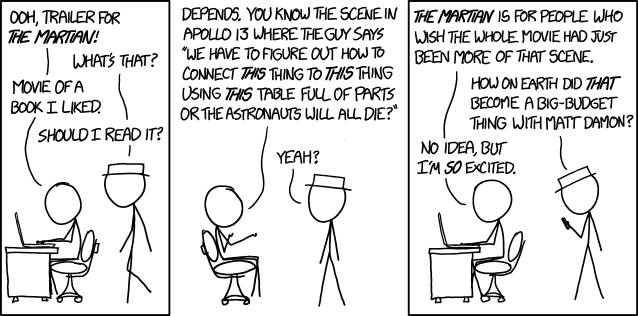
The book was a page turning joy to read, an old fashioned Science Fiction problem solver story of the near future which XKCD summed up as follows:


Apollo 13 is also a movie I very much enjoyed, indeed I think I'd rate it as a bit better than The Martian.

The book's fun is that it takes the problem of a Mars mission -- and of an astronaut accidentally left for dead trying to survive until rescue -- seriously, and spends a lot of time coming up with realistic solutions to these problems. The other thing that maintains the book is its humor. The characterization is not deep by any stretch, and for someone with a couple of years of solitude, Mark Watney does curiously little thinking about the eternal verities. However, Watney is an inveterate smartass and he is an entertaining voice to listen to even when he's just working out how to solve an engineering problem the reader might not normally have a lot of expertise in. He's cheerful and self effacing and sarcastic and you keep turning the pages to see what he'll say next. The earth-bound characters trying to make contact with him and bring him back safely are also pretty shallow characters, but they are fun -- particularly the foul-mouthed, abrasive, but ultimately right-thinking and heroic NASA PR chief Annie Montrose.

The movie scales back on the humor, in part because it scaled back quite a bit on the profanity in order to keep the rating at a PG-13, and in part because sarcasm works better in the more leisurely pace of a book than in the 141 minutes of the movie. (They also cut a lot of plot details; Watney has to solve a lot more problems in a lot more detail in the book.)

However, the movie format taketh away, but it also giveth. The writing of the movie isn't deep either, but having real flesh and blood actors playing the characters end up providing significantly more emotional depth in some scenes than you get in the book. While I enjoyed the book a lot, there were times when I found myself thinking "this is a problem solving character, not a rounded person facing these problems" and the performances by Matt Damon and the rest of the cast provide some of that emotional depth, even if it's just in the way that he looks at the Martian landscape at certain points.

I was a little disappointed in the technical aspects of the production design. Weir made huge efforts to be accurate in his portrayal of a near future Mars mission, with consideration given to how everything would be designed. The movie keeps the basically realistic plot, but it clearly cares about the details less. When it's convenient for the plot, the nearly 30 minutes round trip between sending a radio message from Mars and getting the reply vanishes and Watney and NASA type messages back and forth in near real time, but at other times the wait is maintained. Weir put a lot of thought into the Hab in which Watney lives, and which he has to repair at some key points, including the special "hab canvas" material which it is made out of and the resins which could be used to seam it. In the movie, we get what looks like plastic sheeting and duct tape to make repairs. And while one plot point involves taking weight out of a ascent vehicle to make it lighter, a lot of the sets in the movie seem to completely ignore the weight considerations which would have ruled all design aspects of stuff sent to Mars -- something the book spent a fair amount of time on.

Still, these are minor things, and the movie itself is honestly a lot of fun. Two space-suited thumbs up.

Friday, October 02, 2015

Most People Have Tribes, Not Beliefs

There's been one of those media dances in the last few days which would be hilarious were it not so very sad.

First there was the news that Kim Davis, the county clerk from Kentucky who was sent to was sent to jail for refusing to issue marriage licenses in the wake of the Supreme Court decision imposing same sex marriage on the country, had met briefly with Pope Francis. This provoked howls of rage from many on the secular and religious left, and accusations that the pope had betrayed them and erased all of the good words that he'd said on issues that they'd cared about, because apparently it's impossible to listen to a pope's words on helping the poor or some such issue if he's had the temerity to meet with someone you don't like for a few minutes.

Then the Vatican press office put out a statement that "The pope, the statement added, did not enter into the details of the situation of Davis, and his meeting with her should not be considered a form of support of her position in all of its particular and complex aspects." and social media erupted again, this time claiming that Davis and her supporters had lied, that the pope had been fooled into meeting with her, etc.

And as if to cap off the tower of silliness, CNN now trumpets an exclusive report that Pope Francis met with an old student of his from Argentina, who is an atheist in a same sex relationship.

Apparently, the pope is a trophy, and the big cultural contest is to figure out which team is holding the trophy.

Two things seem to be at play here.

One is that Pope Francis, while widely admired for his holiness, also seems to serve as a blank canvas onto which many people project their beliefs. Case in point, a recent survey found that 63% of Catholics who oppose same sex marriage believe that Pope Francis opposes it too, while only 36% of Catholics who support same sex marriage think that Pope Francis opposes it.  (The correct answer is that he opposes same sex marriage.)

[source]

The second is that for a lot of people, beliefs seem to matter a lot less than tribal identification. Good people are on your side, bad people are on the other side. Thus, the logic goes, if Pope Francis appears to be a good person, he must be on your side and share your believes, because THERE ARE NO GOOD PEOPLE ON THE OTHER SIDE!

My cynicism seems to be kicking into higher gear as I enter middle age. I used to be kind of inspired by how societies in Late Antiquity could be torn apart by Christological heresies, with mobs fighting in the street over issues like whether Christ had a single nature which was Divine, a single nature which was human, two natures, or one nature which was both human and divine. How wonderful it must have been to live in an age when people cared so much about theological truths!

Now, I find myself wondering if many people on the ground actually could have described the theological positions at stake, or were there a few theologians fighting about the actual issue while everyone else argued based on "this guy is on my side" types of tribal identification?

Half Life

Last night in bed, Darwin was telling me about a discussion he'd had in the car with Julia (12) and Jack (7) about why Isabel (9) was being so moody lately.

Julia: "I think it's because she's getting older."
Jack: "I think it's because she's a chicken sandwich."

I laughed myself stupid over this, and every time I stopped, the phrase "chicken sandwich" would pop up in my head again, and I'd start shaking again.

And suddenly, in the midst of my laughter, I remembered that it was our half life. Actually, that I'd forgotten our half life -- on Sept. 16/17, Darwin and I (and family) were on vacation and not remembering that 18 years earlier, we'd started dating, two weeks after we met. So we've known each other for half of our 36 years.

"We missed our half life!" I said to Darwin as we huddled under our feather comforter against the chill breeze blowing in the perpetually open window. "Have we really known each other 18 years? That seems like a really long time somehow. How is that possible? Let's see -- we've been married almost 15 years; Eleanor is 13... Oh my gosh, we are so old." I pondered for a moment. "We really ought to have sex in honor of the occasion, but my toes are cold."

"We ought to have sex, but your toes are too cold," Darwin murmured, mostly sleepily. "Some excuse."

"Also, the cats are stupid, and there are two boys in the crib."

"Well, I guess that's not going in the blog post."

"Only if we don't have sex. And there's a cat on my pillow."

The cat judged me.

Darwin dropped off to sleep, after we'd realized again that there is no ideal position for two people who want to snuggle, because, perhaps to remind us that true happiness is only found in heaven, an elbow or an arm or a knee was always jabbing in the wrong place. I stayed awake a little longer, offering prayers of gratitude for 18 years of companionship, and every now and then trying to stifle my laughter at the chicken sandwich.

Tuesday, September 29, 2015

The Great War, Vol 1, Chapter 13-3

It's been three weeks since the last installment: eight days of writing and two weeks of being on vacation and finding myself unable to get the time to put words on the page. Sorry for the long delay.

This installment completes Chapter 13. The next chapter will go back to Jozef, now training for the Austro-Hungarian cavalry. The total novel is now a hair under 180,000 words. Four more full length chapters to go and then three short concluding ones. I'm still hoping to put some serious work in and wrap up by the end of the calendar year.


Kiev, Russian Ukraine. September 30th, 1914. Breakfast in the Luterek household was not subject to genteel pretensions. Doctor Luterek was a believer in a hearty breakfast, as he often did not have time for a midday meal, and he insisted that it be served early so that he could be at the hospital by eight.

On Tuesday, the morning after Konrad’s memorial mass, Natalie has been hesitant to join the family at table, not sure what kind of greeting would await her. Instead she had taken a currant roll and a flask of tea from the kitchen to consume on the way to the hospital. That night it seemed that peace had returned to the household, and so she joined the family for breakfast Wednesday morning in time to see that peace shattered again.

Natalie was at the sideboard loading her plate with kanapki -- little open-faced sandwiches made of buttered toast set with either fresh cheese curds and a slice of tomato or else several paper thin slices of dry sausage -- when Borys entered the dining room.

“I just got news yesterday,” he announced. All eyes were immediately upon him. “I’ve received my temporary commission as a cadet and orders to report for training as an artillery officer.”

For a moment there was silence, then Madame Luterek burst into tears while the doctor and his daughters all began to talk at once.

[continue reading]

Monday, September 28, 2015

Hamilton

"How does a bastard orphan son of a whore
and a Scotman, dropped in the middle of a forgotten
spot in the Caribbean, by providence impoverished, in squalor,
grow up to be a hero and a scholar?

The ten-dollar founding father without a father
got a lot farther
by working a lot harder
by being a self-starter
By fourteen they placed him in charge of a trading charter
and every day while slaves were being slaughtered
and carted away across the waves
he struggled and kept his guard up.
Inside he was longing for something to be a part of
the brother was ready to beg, steal, borrow, or barter.

Then a hurricane came and devastation reigned.
Our man saw his future drip dripping down the drain.
Put a pencil to his temple, connected to his brain,
and wrote his first refrain, a testament to his pain.

Well, the word got around, said, 'This kid is insane, man!'
Took up a collection just to send him to the mainland
Get your education, don't forget from whence you came,
and the world's gonna know your name!
What's your name, man?

Alexander Hamilton..."


Perhaps you haven't heard of Hamilton, the new hip-hopera with a rare spate of unanimously glowing reviews, but like the man himself, it's making some history. The show, sold out before it even transferred to Broadway, is a hip-hop musical about Alexander Hamilton, treasury secretary and famously killed in a duel with Aaron Burr. And in a post-modern casting decision, most of the lead roles are played by decidedly non-white, non-dead men. Hamilton is played by the show's creator, Lin-Manuel Miranda, son of Puerto Rican immigrants, and the other founding fathers are played by actors and singers cast for their ability to rap, regardless of ethnicity. (Well, that's debatable, actually: the casting listings for the show, for the most part, specifically call out for actors of every ethnicity except white, which does present the question of whether there's some reverse stereotyping going on.)

Here's the genesis of the show, performed at the White House in 2009:


And now NPR is streaming the whole cast recording. (EDIT: NPR isn't streaming the soundtrack anymore since it's now out on CD, but they link to a Spotify playlist where you can hear it.)

Tickets are getting scarce, but Darwin and I are planning to roll together Christmas, our birthdays, and 15th anniversary into one big event and go to New York next year to see this.

Saturday, September 26, 2015

Grace in Action

If there is anything that places me squarely on the introvert side of the spectrum, it is that for eight days I traveled the country (four of them in the car) and ate fast food and consumed ungodly amounts of chips and salsa and guacamole, and pan dulce and breakfast tacos, and had several servings of alcohol for several days in a row, and when I came home I found that I'd lost a pound or two. Sure, you can chalk that up to muscles atrophying in the car, but I have to think that it has something to do with the sheer amount of energy I burn up in being "on" when I am in society. Being "on" isn't performance mode or anything. It's a social awareness, a mental filter which keeps me from running my mouth too much, graciousness as an activity as much as an attitude -- none of which are all that difficult, and most of which are second nature, and yet which consume strange quantities of energy. I recently realized that my preference for doing nothing at all militates against the fact that I am my best self when I have to shake off lethargy and live for other people. It gets me out of the house, it seems to be more effective than diet and exercise for my health, and it keeps me from sloth. But oh, I am so tired when I get home.

While driving, we read the gospel passage about the two men forgiven their respective debts of 500 pounds and 50 pounds. Although neither could pay, the man forgiven more was more grateful, perhaps because the man forgiven the lesser debt figured that his benefactor really hadn't put himself out all that much. It was just 50 pounds, right? No big deal for a rich guy. But every kind of deal to someone who can't pay. I'm that 50-pound debtor. In the grand historical sense, my faults are pretty pedestrian. I can't get organized. I do what I want, to the exclusion of what I ought. I can't be bothered. I find it easier to create interesting fictions in my head than to do the boring grunt work of reality. Minor stuff, maybe, but I can't seem to break free on my own. It doesn't matter if the trap is big or small if you can't get out of it. I have to have grace, or I cannot die to myself. Do you understand how easy it is to be inspired by spiritual reading or scripture, and how hard it is to start dinner on time or to speak mildly to a whiny, provoking child? And yet the fruit of the former is in how I deal with the latter, and it avails me nothing to have deep thoughts if I cannot walk the tedious walk. I must have grace, or I perish, and I drag little souls down with me.

To that end, I've been thinking about the rosary. Again. It's time to dispense with the idea that I can consult my own tastes and simply go with the style of prayer I prefer. Every time I come across a saint talking about the value of simply living the Christian life, it turns out that the saint is already saying the rosary and having a regular prayer time. Heh. I think that the way to approach the rosary, for myself, is as if it and I were in an arranged marriage. Not a sexy arranged marriage, like the kind in books, where, as an outside observer, you already know that the characters are made for one another and that love will blossom around page 300. This is an awkward arranged marriage in which I need to make my peace with this prayer and do my best to treat it with civility and respect because I'm going to have to live with it for a long time whether I find it interesting or not. As I find that more and more of the saints have said the rosary and had a great devotion to it, I begin to suspect that the problem here might be me, and not the prayer.

What helps is to break it up into bite-sized chunks, and lo, it comes in convenient decades. Right now my decade is the second sorrowful mystery, The Scourging. When I find myself assailed by temptation, I pray this one because of Isaiah 53:5, "By his stripes we are healed." Scourging is the kind of visceral brutality I hate to think about, but when I consider that each rent in Jesus's body actually heals a rent in my soul, I find more courage to face it headlong. His body is disfigured so that the scars of my sin can be softened and transformed by the blood dripping onto them. I do take a mild comfort in fact that I too have given life through the literal disfigurement and tearing and scarring of my body. (Still not watching The Passion of the Christ again, though.)

And yet, here's a lot of talk about how great prayer is, but the proof will be if I actually say the rosary tonight when I get into bed. Talk is so stupidly, ridiculously easy -- I could extemporize about praying the mysteries of the rosary all day. But the doing of it is stupidly, ridiculously hard. Lord, help me to act rather than talk. Without your grace, I can, and will, do nothing at all.

Thursday, September 24, 2015

Why Is Consumerism a Problem?


At this particular moment in our culture, there seems no difficulty in finding voices, both secular and religious, eager to condemn consumerism. When I did a quick image search on "consumerism" (which Google helpfully defined for me via Wikipedia as "a social and economic order and ideology [that] encourages the acquisition of goods and services in ever-increasing amounts") to illustrate this post I found pieces of original artwork ranging from a metallic dinosaur covered in corporate logos devouring people and pieces of great artwork to an image of Christ crucified on shopping bags.

However, while many are eager to condemn consumerism, there seems to be less agreement on precisely why it is bad.

One line of thought seems to be simply that consumerism often focuses its acquisitive energies on crass merchandise: too many Mickey Mouse ear hats and not enough reproductions of Renaissance artwork and hand made furniture. It's easy to mock bad taste, at least when sitting with other people who share our own preferences, but this isn't really a critique of the acquisition of goods and services, but a complaint that people aren't choosing the goods and services that we would like them to.

Another accusation is that the focus on buying things means that people spend too much time making money which will allow them to buy the merchandise they covet, and not enough time spent in leisure. However, this too seems a little odd, in that much consumerism, from theme park visits to pay-per-view TV, is focused around leisure time. Even virtuously active leisure activities come with large helpings of consumerism, as I've discovered this year while training for a half marathon. You'd think that running, a sport which involves putting one foot in front of another on a public road, would be a no-frills hobby, but it is indeed heavily accessorized: running shoes, running socks, running clothes, hydration systems (this is the fancy word for a water bottle that clips on a belt), gels, chews, GPS devices... The list goes on. Nor are these strictly vain items. I can attest that having a good running shirt makes all the difference between miserable chafing and feeling comfortable throughout a 10+ mile run, and whatever odd ingredients may go into them (the two I care about are carbs and caffeine, the rest is delivery system) eating a little packet of energy gel during the middle of a long run certainly makes it easier to keep up energy during a run which my iPhone running app (another consumer product) tells me consumes about as many calories as I normally eat in a whole day. And even if we ignore the ways in which leisure time and activities are often tied to consumer products and services, the complaint that we should focus less on goods and services and more on time is really just a claim that we should be allocating our enjoyment differently than we are.

Other times, the assertion is that consumerism eats up valuable resources which could be used to make us better off. But when we boil this down to its basic argument, this amounts to saying that our consumption of stuff keeps us from having more stuff, which is not really all that persuasive. A variation on this is that consumerism focuses too much on variety, and that this variety results in inefficiency, thus making us all poorer. Bernie Sanders recently took this line in arguing, "You don't necessarily need a choice of 23 underarm spray deodorants or of 18 different pairs of sneakers when children are hungry in this country." However, I don't think that many serious students of the economy believe that reducing the number of brands of deodorant would produce large amounts of excess wealth to redistribute.

You may be wondering by now if I'm coming around to arguing that there's nothing wrong with consumerism, that it's a productive and enjoyable desire. I'm not. No, I think that people are right to react against the excessive focus on acquiring things, whether those things are mass consumer goods or the artisan handcrafted thing-of-the-moment. However, as is often the case, modernity can have a certain instinct for what is wrong without having any clue as to why. Why is "the acquisition of goods and services in ever-increasing amounts" a problem?

Not because it's bad for us to have things that we want. Not even necessarily because the things we want are bad or crass or chosen instead of some other thing which maybe we should have desired instead.

The problem is moral. Often, feeling a lack of completeness and fulfillment in ourselves, we seek that which we think will fill that lack. If your problem is that your running shoes are falling apart, perhaps buying a new pair will fill that running shoe shaped whole in your life. But often the things we buy are not direct solutions for our problems, but rather a substitution. I'm sure we've all experienced examples of this in strictly material terms, where buying serves as a shortcut to get around our real problem. You wish that you were in better shape, so you shell out money at the New Years sales for that expensive piece of exercise equipment, sure that now you will be able to achieve that buff body in just ten minutes a day and enjoy doing it. Often what you realize come April or May is that you're still not spending even that ten minutes. Spending money was easier than actually doing the daily work to get in shape.

But the turtles go down further than that. Why do you want to get in shape? Because if you have that buff beach body by next summer, you will feel better about yourself and win the love of that person who will complete and perfect your life. Nothing against getting into better shape, but really: will getting more fit really make you more lovable in the eyes of either yourself or others? Getting in shape is worthy in its own right, a way of taking care of the body which you have been given, but although this gives fitness goals a certain veneer of virtue, these too are often in their way a substitute for some deeper problem.

It is said that every sin is, at root, the sin of idolatry. When we follow consumerism down to its root, we find the same basic sin. We substitute one material pleasure for another, but then below that we believe that some material pleasure will give us happiness, give us peace, give us the sense of purpose fulfilled. In the short term it sometimes can. But our hearts are restless, Lord, until they rest in You. The problem with consumerism is not that we desire the wrong stuff, nor that we desire stuff instead of time, nor that by satisfying our desire for the things we want we somehow sap our overall economy of efficiency and riches. The problem with consumerism is that we constantly tell ourselves that if we could have just the one more thing -- the right piece of clothing, the hot new electronic device, the right organizational system, the perfect vacation -- we would have purpose, peace and happiness. And so we devote ourselves to pursing these intermediate ends, these things which may be good in themselves but are not the ultimate good, while neglecting the one thing which will in fact bring use these things: God. We ignore that thing larger than ourselves, the thing that gives us purpose and promises eternal happiness. We turn in on ourselves in the constant search for that one next thing which will make everything perfect, and we fail to see that happiness is not inside ourselves but outside. We must follow not our latest hunger for novelty but rather understand that true happiness is to be found in union with the ultimate Good: to know, love and serve Him and to be happy with Him forever in heaven.

Saturday, September 12, 2015

Fifty Essential SF Authors

As we head into a busy weekend, here's a meme for you, courtesy of Brandon: Fifty Essential SF Authors. Just for reference, the last SF book we read here was The Martian, but before that it's hard to say because SF is a genre that's mostly dropped off our radar.

%Darwin has read
#MrsDarwin has read
On our shelves

(1) Mary Shelley: FRANKENSTEIN# 
(2) A Square (Edwin Abbott) FLATLAND
(3) Jules Verne:
TWENTY THOUSAND LEAGUES UNDER THE SEA#
FROM EARTH TO MOON
MASTER OF THE WORLD
(4) H.G. Wells:
THE WAR OF THE WORLDS
THE TIME MACHINE
THE ISLAND OF DR MOREAU
THE FIRST MEN IN THE MOON.
(5) E.M. Forster ‘The Machine Stops’
(6) David Lindsay VOYAGE TO ARCTURUS.
(7) Olaf Stapledon:
LAST AND FIRST MEN
STARMAKER.
(8) Jorge Luis Borges “Tlön, Uqbar, Orbis Tertius”
(9) George Orwell NINETEEN EIGHTY-FOUR#%
(10) Aldous Huxley A BRAVE NEW WORLD
(11) A Merritt
THE MOON POOL
THE METAL MONSTER.
(12) Edgar Rice Burroughs
A PRINCESS OF MARS#%
GODS OF MARS#
WARLORD OF MARS#

(13) E.E. ‘Doc’ Smith
SKYLARK OF SPACE
SKYLARK DUQUESNE
THE GALACTIC PATROL,
THE GRAY LENSMAN,
SECOND STAGE LENSMAN
CHILDREN OF THE LENS.
(14) Stanley G. Weinbaum ‘A Martian Odyssey’
(15) Jack Williamson:
‘With Folded Hands’
LEGION OF SPACE
LEGION OF TIME.
‘The Moon Era.’
(16) H.P. Lovecraft:
‘The Call of Cthulhu’#
‘A Whisperer in Darkness’#
‘Shadow Out of Time’#

(17) A.E. van Vogt:
‘The Black Destroyer’
SLAN
WORLD OF NULL-A
PLAYERS OF NULL-A.
THE WEAPON SHOPS OF ISHER.
(18) Isaac Asimov:
FOUNDATION#%
FOUNDATION AND EMPIRE#%
SECOND FOUNDATION#%

CAVES OF STEEL
THE NAKED SUN
(19) Robert Heinlein
“The Man Who Sold the Moon”%
“Requiem”%
“Green Hills of Earth”%

ORPHANS OF THE SKY%
HAVE SPACE SUIT WILL TRAVEL%
CITIZEN OF THE GALAXY#%
STARMAN JONES
STRANGER IN A STRANGE LAND#
STARSHIP TROOPERS#%

(20) Joe Haldeman FOREVER WAR
(21) C.S. Lewis:
OUT OF THE SILENT PLANET #%
PERELENDRA #%
THAT HIDEOUS STRENGTH #%

(22) Arthur C Clarke:
CHILDHOOD’S END #%
2001 A SPACE ODYSSEY #

‘Against the Fall of Night’ aka CITY AND THE STARS %
RENDEZVOUS WITH RAMA %

(23) Clifford Simak:
CITY
WAY STATION
(24)Hal Clement MISSION OF GRAVITY %
(25) Poul Anderson:
‘The Man Who Counts’
‘The Queen of Air and Darkness ‘
BRAINWAVE,
TAU ZERO
HARVEST OF STARS.
(26) Alfred Bester
THE STARS MY DESTINATION
THE DEMOLISHED MAN.
(27) Keith Laumer DINOSAUR BEACH
(28) Fritz Leiber THE BIG TIME .
(29) Robert Silverberg ‘Nightwings’
(30) Philip Jose Farmer:
RIVERWORLD
WORLD OF TIERS
(31) Tom Godwin ‘The Cold Equations’
(32) Harlan Ellison ‘Repent Harlequin Said the Ticktockman’
(33) Philip K Dick THE MAN IN THE HIGH CASTLE
(34) Roger Zelazny:
LORD OF LIGHT
NINE PRINCES IN AMBER.
(35) Ray Bradbury
FAHRENHEIT 451 #%
THE MARTIAN CHRONICLES #%

I SING THE BODY ELECTRIC
SOMETHING WICKED THIS WAY COMES %
(36) John Brunner STAND ON ZANZIBAR
(37) Michael Moorcock
THE JEWEL IN THE SKULL
ELRIC OF MELNIBONÉ
THE KNIGHT OF THE SWORDS.
(38) Daniel Keyes ‘Flowers for Algernon’
(39) Walter M. Miller A CANTICLE FOR LEIBOWITZ %
(40) Frank Herbert DUNE #
(41) Cordwainer Smith
‘Scanners Live in Vain’ #
‘The Dead Lady of Clown Town’ #
‘Alpha Ralpha Boulevard.’ #

(42) Ursula K LeGuin:
LEFT HAND OF DARKNESS
THE DISPOSSESSED.
(43) Jack Vance
‘The Dragon Masters’
‘The Last Castle.’
THE LANGUAGES OF PAO
EMPHYRIO.
THE DYING EARTH.
(44) Larry Niven and Jerry Pournelle MOTE IN GOD’S EYE %
(45) Larry Niven
RINGWORLD
'Neutron Star'
(46) Gene Wolfe:
THE SHADOW OF THE TORTURER
THE SWORD OF THE LICTOR
THE CLAW OF THE CONCILIATOR
THE CITADEL OF THE AUTARCH
URTH OF THE NEW SUN
‘Fifth Head of Cerberus’.
(47) Walter Gibson NEUROMANCER
(48) Neal Stephenson
SNOWCRASH
THE DIAMOND AGE.
(49) Dan Simmons HYPERION
(50) Alan Moore and Dave Gibbons THE WATCHMAN

Thursday, September 10, 2015

Book Report 2: The Gift of the Magi, again

Three Paragraphs (on a story I read)
by A nonny mouse

1.
Yesterday I was asked to read a short story about Cristmas, for school. This story was about a charming couple shopping for Cristmas gifts. The story was told from the wife's point of veiw. She fancied a set of combs the porpose of witch was to draw attention to and decorate one's hair. However there is till the problem of her present to her husband.

2.
Shopping is, alltogether, a tedious buissness, espeasealy when one is short of money. Even so the wife cuts and sells her long brown hair for twenty dollars. With her newly earned money she buys, for her husband, a beautiful watch-chain for his treasured watch. Upon returning home, her husband is shocked at his wife's short hair. He has sold his watch to buy her the set of combs.

3.
For some people, morals are hard to spot. So I shall present of of mine. Firstly the answer is neither to  (a) not give preasants or (b) to find out what you are reciving. These are very bad solutions. Nowadays, twenty dollars is a reasonable price for a nice gift. Back then twenty dollars was expensive, but you must remember that a gold watch-chain is a very nice gift. I belive that these two went a little overboard. The meaning of Christmas is not giving preasents. (Here I add that, however expensive, please don't pay for a gift with your own hair. It is not wise.) It is a day for going to mass and honoring our lord.

P.S. I think it would have been better for the wife to give a home-made gift instead.

Are People Obligated to Have As Many Children As Possible?

Apparently there is a philosophical paradox known as the "repugnant conclusion" which goes something like this: If you accept the conclusion that the best world is one with the maximum amount of human happiness (which is one way way in which people try to make secular arguments for "goodness") then a world in which there are more people who are less happy could be better than a world in which there are fewer people who are less happy. So if you had to choose between a world in which 1 billion people are 100% happy and a world in which 20 billion people are only 10% happy, you should choose the world with twenty billion people who are unhappy most of the time because there is more total happiness in that big world than in the smaller, universally happy world.

Now, most people who are inclined to judge morality in terms of the net amount of global happiness are not the sort of people used to advocating a world with huge numbers of mostly unhappy people, so the paradox provides an interesting mental puzzle for them. This bubbled up to my notice a couple weeks ago because a philosophy blog called Leiter Reports got a lot of attention running a post about how the (mostly liberal) explainer site Vox had commissioned a piece by philosopher Torbjörn Tännsjö at Stockholm University advocating the Repugnant Conclusion, a piece which Vox later rejected (among other reasons) because Ezra Klein was worried it would give the impression that birth control and abortion were wrong. You can read the submitted piece here.

Personally, I don't think the submitted article makes a very good case. The author is trying to write in an accessible, easy to understand way, and I think it mostly comes off as a bit sloppy. Here's his opening, which lays out the paradox itself:

You should have kids. Not because it’s fun, or rewarding, or in your evolutionary self-interest. You should have kids because it’s your moral duty to do so.

My argument is simple. Most people live lives that are, on net, happy. For them to never exist, then, would be to deny them that happiness. And because I think we have a moral duty to maximize the amount of happiness in the world, that means that we all have an obligation to make the world as populated as can be.

Of course, we should see to it that we do not overpopulate the planet in a manner that threatens the future existence of mankind. But we’re nowhere near that point yet, at least not if we also see to it that we solve pressing problems such as the one with global warming. In the mean time, we’re ethically obligated to make as many people as possible.

This idea, that having children is a moral obligation, is controversial, so much so that it’s known in philosophy as the “repugnant conclusion.” But I don’t think it’s repugnant at all.

What I thought was the most interesting part was where he's trying to justify the idea that we have obligations to people who do not yet exist:

You might be thinking at this point, “Sure, more happiness sounds good. But morality is about helping people, and creating more people helps ‘people’ who don’t exist, not yet anyway.” This view is known as actualism. Only actual individuals have rights. We have not done anything wrong, unless there is an actual person who has a legitimate complaint to make against our action.

This means that, if I do not create a happy individual, even if I can do so, I do nothing wrong. A merely hypothetical individual has no legitimate complaint to make. This is the great appeal of actualism: it means that people have total freedom in choosing whether to reproduce or not. My view suggests that we have a moral obligation to keep having children; actualism lets people do as they like.

I can’t help finding all this problematic. Imagine for a second that the Genesis story is actually true. Under the actualist view, Adam and Eve could have morally refrained from having children, even if, had they decided differently, billions of billions of happy persons would have been around!

Here is another consequence of the theory. Suppose I have a choice as to whether to have a baby at 15 or at 35. If I have the baby at 15, I’ll earn much less money in my career, the baby will go to worse schools and live in a worse neighborhood, and generally her life will be much tougher. If I have her at 35, I’ll be able to adequately provide for the baby, pay for college, and so forth. If I have the baby at 15, then, did I do anything wrong? I did not, by actualist reasoning. There is no one there to complain about what I did. The baby is, after all, happy to be around. By creating her, I did not violate her rights. And the hypothetical baby I would’ve had at 35 isn’t around to complain. But this cannot be right. If these are the options I have, I ought to wait. The world where I have a baby at 35 is just happier than the one where I have a baby at 15.

Now, I'm not a philosopher, and I don't play one on TV, but part of what interests me here is that there's a similar argument one sometimes hears from devout Catholics about obligations to those not yet existing which goes something like this: "Think how much our world is suffering because people are too selfish to have more children! St. Therese of Lisieux was the fifth of five children. St. Thomas Aquinas was the eighth of eight children. How many people even have five children today, much less eight? By refusing to have all of the children that God wants to give them, people are refusing to give birth to saints!"

This rests on what I think of as the "bubble gum ball theory of the soul" in which there is a sort of spiritual gum ball machine in heaven with lots of babies waiting to be born. If people don't conceive as often as they are "meant to" then they are refusing to give life to some number of those intended people. By this theory, people are somehow failing in their obligations to these future people when they fail to conceive them.

First off, this strikes me as falling afoul of traditional Christian doctrine. The Second Council of Constantinople (5th ecumenical council: 553 A.D.) condemned the doctrine of the pre-existence of souls, so from a Catholic point of view there clearly aren't actual people failing to exist because their parents never conceive them. Now, it's true that if parents overall have fewer children, then all other things being equal this means that there will be fewer saints, but there will also be fewer murderers, fewer insurance salesmen, etc.

It's also problematic to think of us as having an obligation to give life to the person who would be conceived should we go conceive them right now, in that the number of people who could be conceived far exceeds the number that can be or should be. A man produces millions of sperm a day. A woman usually drops one egg per month. So in theory, there are millions of different people who theoretically could exist if I ran out right now and had sex with some passing woman, depending on which sperm and which egg happened to get together. But that doesn't mean that I and some woman I don't even know have an obligation to give those possible people life. Even with my own lovely MrsDarwin, there are millions of different children we might conceive in a given month, and yet clearly, we can't give life to all of them. We don't wrong some child denied existence while giving existence to another depending on what day or hour or minute out of the fertile window in a month we conceived on. And of course, if we conceive one child in a month, that means that all the other children we could have conceived if a different sperm had met the egg, or if we have conceived the month after with a different egg, or the month after -- all of these other people would be denied existence by the existence of the one.

I think that this kind of reasoning would quickly become absurd. It doesn't seem reasonable to try to decide when to try to conceive and how often to try to conceive based on a perceived obligation to the person who would be given life as a result of that conception, when it's clearly impossible to give life to any more than a tiny fraction of the millions of different possible people one could be the parent of.

I'm not completely clear whether Tännsjö pictures the obligation to people who don't exist yet as being to individual people (you have an obligation to give life to some specific person so that that person can experience the happiness of life) or to people in general (you have an obligation to have children because they will experience happiness). His example about deciding what age to have a child at is doubly odd, since he phrases it concretely: "If I have the baby at 15... her life will be much tougher. If I have her at 35..."

Clearly, you can't choose to have the same child either at 15 or at 35, so it's not as if she will be happier if she is born later. If he doesn't have a child at 15, that child will never exist. If he has a child at 35 instead, that will be a different child than he would have had at 15.

Saying that we have responsibilities towards people who do not yet exist in a general sense (as opposed to saying that we have responsibilities to specific people who could exist) seems far less controversial. Clearly, we the current generation of people have a responsibility to produce the next generation of people. To decide that we would be happier in the short term to focus strictly on ourselves and not go through the work and trials (and joys) of having children would in some sense be selfish. I don't know if it makes more sense to look at the wrongness of that selfishness in terms of us failing in our responsibilities to the generation net yet conceived, or if it makes more sense to talk about us as a current generation not living up to our purpose as human beings (though I lean towards this later rationale), but if all those currently alive decided to be "child free" from here on out, I think there's clearly something very wrong about what we'd be doing. Similarly, I think it makes sense to talk about our duty to care for certain resources in terms of making sure that they are still there for the good of future generations.

However, it seems very problematic to me to envision a moral obligation we could have towards some specific person not yet in existence, such as an obligation to conceive that person.

As for the "repugnant conclusion" itself: It seems to me that it serves mostly to underline that "maximizing global happiness" is a bad way to do moral analysis. Fortunately, as Christians, we have other options.

Book Report: The Gift of the Magi


Three paragraphed book report of The Gift of the Magi
by she who must not be named

TOPIC

The "TOPIC" is unclear. Is it: Christmas, or shoping, Giving, or presents. Whatever it is they lose there top most treasured Item's.

PLOT

The Plot is that the girl is sad because she only has $1.25 to get a present for her love. So she cuts her hair of so she has more money. She Ends up getting her love a chain for his watch but he sold his watch so she will have to work together to save up for the watch, but he bought hair combs for her hair, but she choped it off, but alls well that Ends well just not in this case.

MORAL

The moral of the story is ask your love what they want for christmas. Simple presents can be the best so she could have given him a kiss instead or something grown up like that.

THE END

Saturday, September 05, 2015

The Great War, Vol 1, Chapter 13-2

I've still got to pick up the pace a bit more, but with the three day weekend I hope to have the next installment (the last of this chapter) out a lot more quickly than this one was.

***


Kiev, Russian Ukraine. September 22nd, 1914. For the next several days a state of dazed paralysis descended on the Luterek household. Madame Luterek seldom left her room where she refused food and was prone to sudden bouts of loud despair. Doctor Luterek divided his time between the hospital -- where he could forget, for a time, the tragedy in his own life while immersing himself in the difficult operations which the influx of wounded required -- and the house, where what little time he did not spend in his wife’s room, he passed in solitude in his library.

After the shock of the first day, the staff made sure that the house was cleaned and meals were put upon the table at the usual intervals, but this background of normality provided only a limited degree of comfort. The young people were left mostly to each other’s care. During hours spent in the nursery, sitting on the faded rug and armchairs which had come from the old nursery back in Warsaw, the scene of many leisure hours spent with Konrad before he had left to become a cadet, Borys, Sara and Lena told stories of their lost brother, and learned to think of him again without the choking ache of grief taking complete hold of their words.

On Sunday, Natalie encouraged Sara and Lena to accompany her and Mrs. Sowka to church. They did so gladly. This, on the third day after the news of Konrad’s death had reached the family, provided a turning point, at least for the young people. On Monday Borys left the house early on business of his own, Natalie returned to her usual schedule at the hospital, and the girls even ventured out to an aid society tea. Only Madame Luterek kept to her room and made no move towards returning to everyday life.

Thus it was that on Tuesday afternoon Madame Luterek was the only member of the family at home when a package was delivered, addressed to the family in Konrad’s handwriting.

Something in her had stirred that day. The house was quiet. The grief which had curled its soft, suffocating self around her chest, making even the smallest action which hinted at normality seem exhausting and futile, seemed to have decreased slightly in its weight. She had got out of bed, dressed, and come downstairs to have a cup of tea.

Natalie returned home at three-thirty, along with Sara and Lena who had spent the last few hours rolling bandages for the new hospital train being funded by Princess Mikhailov. They found Madame Luterek at the table in the sitting room, staring at the package, afraid to open it yet unable to leave it even for a moment.

“It’s from Konrad,” Madame Luterek told them. “He’s not dead.” The words brought a heartbreaking smile to her face.

[Continue Reading]

Thursday, September 03, 2015

The Summer of my Dishcontent

On Saturday we are getting a new dishwasher. It's only been three months since the repairman looked at the old one and shook his head over the numerous costly problems it had. At first it wasn't that bad standing over the steaming sink washing dishes for eight people by hand. The pioneers, right? Solidarity with the poor, hey? And then the glow wore off, and night after sticky night I scrubbed dishes, sweat dripping down my face and my hair plastered to my neck, and the glow of virtue degraded to a stinky flush.

We are the richest people I know, and we wash dishes by hand in an un-air-conditioned house. This isn't a boast or a complaint. It's just how it is. There was no time to go together to look at dishwashers, and the more we researched, the more we bogged down in the minutiae of noise levels and third racks and hard food grinders. Dishwashing by hand became a form of inertia, of inaction being easier than action.

Meanwhile, the rest of the house languishes too. The front bedroom, where the big girls are supposed to sleep, has been primed for a year. I primed it, in a fit of virtue. Perhaps the virtue wore off, or perhaps now I have a twenty-month-old who is not to be trusted, and big kids who are still of the age to think that I have the answer to every question that starts with, "Moooommm?" For whatever reason, the bedroom is still unpainted, and everything seems on hold until that project is completed.

The paint in the princess bedroom bathroom, the one that Darwin and I shower in because the shower in our bathroom has a leak in some yet-to-be-determined location, is peeling so badly that the plaster is exposed in several places. That too has been primed (in places) for a year. One of the pull-chain lights has gone on the fritz, so now it's badly lit too. The place would benefit from a ceiling light, if only we would buy one and schedule an electrician.

Meanwhile, in Europe, refugees are stuck in the Budapest train station (one of the loveliest I saw in my time over there) and children are washing up on the shore of Turkey. An unpainted, unlit, unimproved house is a very small worry in the grand scheme of things, and yet it's the responsibility that I've been given, right now. I cannot stop the war in Syria. I cannot feed the refugees, except indirectly through donations. I can, however, finally hire someone to rewire the lights and the electrical outlets and paint the bedroom and bathroom, and although it doesn't do anything for the children in war-torn parts of the world, it does provide work for my neighbors and allow them to provide food for their families.

I don't know. Would it be better if we lived a life of radical poverty and sent every spare dollar to feed the hungry and shelter the homeless? And yet, how are we to maintain this home for our family without spending money on it? How are we to keep our home safe from the risk of fire without spending money to replace 85-year-old wiring? How are we going to maintain the integrity of the house without doing the maintenance work that requires? Would it be better if this house sunk into even more disrepair, as long as I sent money off to a charity that assures me that of course the overhead is low and the bulk of the money helps those in need? These aren't either/or questions. Of course we have to make a return to the Lord for all he has done for us. It's not a question of should we give, but how much should we give, and how much should we spend on ourselves?

And then there is the matter of beauty. Several months ago I was driving along a road lined with strip malls, and meditating on Psalm 19: "The heavens declare the glory of God; the firmament proclaims the works of his hands." That means that every element of creation proclaims God in some way. Trees, grass, rocks: all these in some way reflect God's goodness and beauty. And man, when he creates, has an obligation to use his creative powers to reflect God's goodness and beauty too. Some buildings do this better than others. Strip malls are poor reflections of God. They are ugly and utilitarian, bland and interchangeable. My own house is a good, if shabby, reflection of God's beauty. And in owning it, I have a responsibility to ensure that I keep reflecting God's beauty and goodness through the choices I make. Some of these choices are inexpensive, but some require more thought, effort, and money. Should I buy a ceiling light for the bathroom off the Home Depot clearance rack, or should I search for something more beautiful, more in keeping with the design and age of our house, and commensurately more expensive? It would be a moot point if I couldn't afford anything better than the Home Depot special, but I can. Do I have an obligation to buy ugly, cheap fixtures for my house so that others can eat? Put that way it seems a convicting contrast with an obvious answer, and yet one of the Catholic issues du jour is the status and dignity of the craftsman. How will the craftsman be able to keep crafting if no one employs him? How do smaller companies stay in business if no one buys their products?

In a sense, this is a purely intellectual quandary. I already know that I'm not going to buy a cheap light for the bathroom. I grew up in some ugly, cheap houses, and I don't want to live in one as an adult. More to the point, we have the luxury of being able to give to charity and to afford beauty, and a dishwasher too, if not air-conditioned comfort. Something has to give somewhere.

But the widow's mite still haunts me. We give out of our excess, and we're buying a pretty nice dishwasher after all the dithering. We buy beauty, and we get an earthly return in being able to live with beauty. The widow gave all she had, and looked for no return. And Jesus commended her.  I think, "How can this dishwasher, or this light fixture, or this paint job, help me to love and serve God better?" And I'm reminded of the section in The Name of the Rose in which the abbot pontificates on how the beauty of his jewels turn his mind to things divine. And then I remind myself that our house bitter cold in parts of winter and oppressive in parts of the summer, and even some of the poor live a bit more comfortably than we do, climate-wise. And then I remember that other people are at this very moment starving, dying, watching their children die, living in terror, being exploited or abused, and my comfort level seems unbearably luxurious.

Yet God has willed that I live here, in this place and at this time, with the responsibilities and obligations that he's given me right now. There's no virtue in being Mrs. Jellyby, so obsessed with the African missions that her own children lived in squalor and ignorance. Just something else to ponder as I do the dishes next week. Death, taxes, and the dishes, here with us always.