Because most philosophies that frown on reproduction don't survive.

Tuesday, January 08, 2013

Five Books I'll Read This Year

It seems like most years I read somewhere between 20 and 30 books. At any given time, I have a more than that many books on my "to read" shelf, and only a few of the books I actually read each year seem to come off that shelf, the rest are more a matter of impulse. Admitting that, I thought I'd try to come up with a list of just five books that I've been wanting to read for at least some time which I'll commit to reading this year, somewhere among the others that are more impulsive reads.

Of course, while I like to be alone while reading, there's nothing I like more than talking about books, so please feel free (indeed, encouraged!) to provide your own short "will definitely read" list in the comments or in a post linking back here.

Darwin
The Last Lion: Winston Spencer Churchill: Defender of the Realm, 1940-1965
 I read the first two volumes of William Manchester's magisterial biography of Churchill a while back, and I was saddened to read that his health (and later death) had made finishing the final volume impossible. Paul Reid, to whom the project was left by Manchester, has now brought forth the third and final volume and I'm very eager to read it.

Five for Sorrow, Ten for Joy
I read another of Rumer Godden's novels this last year (Kingfisher's Catch Fire) and although I found the main character somewhat frustrating, it reminded me how much I enjoy Godden's adult writing (This House of Brede, China Court, etc.) I couldn't quite bring myself to order the new Loyola Classics edition since it features an introduction by Joan Chittister, so I ordered a used hardcover copy.

Lord of the Rings (surely no one needs a link to this one)
 I've read LotR at least half a dozen times over the years, but I think it's been a good five years since I last read it. Each time I've re-read it, I've felt like I've come away with new things.  I've been feeling more and more lately a need to re-read it again as I feel like I've changed a fair amount over the last five years (in my reading tastes, among other things) and so I want to experience it again.

Dance of the Furies: Europe and the Outbreak of World War I
 I've had a number of books relating to the Great War (whose hundredth anniversary is upon us next year) on my "to read" list for a while, and this one dealing with the outbreak of the war is one of them.

France and the Great War
Another from the Great War list: Leanard Smith has emerged as one of the key modern scholars writing in English about France in the Great War, helping to overturn a too-long-held consensus view about the French in the war which has arguably been formed more by 1920s and '30s anti-war writing than by the actual history of France in the war.

MrsDarwin

Les Miserables
When I was young, my mother had a slender antique volume of Les Miserables -- the second volume. I read it, of course. Years later, while babysitting, I started the first half, and was surprised to learn that 100 pages in, we hadn't moved past the good bishop. I used to know large portions of the Les Mis soundtrack by heart, but until seeing the movie last week I hadn't heard the music for years. Now it's time to go to the source and get the original story from start to finish.

Five for Sorrow, Ten for Joy
When Darwin said that he was going to include a Rumer Godden novel on his list, this was the title that immediately leapt to my mind, because I'd been wanting to read it too.

The Lion Sleeps Tonight
South African journalist Rian Malan's essays on the state of his country. I received this for Christmas and was grabbed immediately by Malan's fierce, funny, and scathing writing about his beloved and infuriating homeland. The piece referenced by the title is a masterpiece of investigative journalism in which Malan unravels the tortuous history of the song "The Lion Sleeps Tonight" and its prodigious royalties, almost none of which made it back to its original South African singer Solomon Linda and his family.

Jesus of Nazareth
To which of Pope Benedict's three volumes of this name am I referring? Any of them. I'd like to finish at least one of them this year. His writing is so rich, I find it hard to digest more than a paragraph or two at a time.

The Book of the City of Ladies
Once I was walking through a bookstore when a display of the Penguin Great Idea series caught my eye. The thick paper covers were so aesthetically appealing, so beautifully embossed, that even in my straitened circumstances I snapped up the two least expensive. I've tried several times to make it through Thorstein Veblen's Conspicuous Consumption and been drained by the dryness of his prose, so now it's time to turn to the other lovely volume, Christine de Pizan's The City of Ladies. Written in 1405, this work features the author in dialogue with Reason, Rectitude, and Justice about a city where women are free from the slander and prejudices of envious men. I am already captivated by a book which begins, "One day, I was sitting in my study surrounded by many books of different kinds, for it has long been my habit to engage in the pursuit of knowledge."

Assault Weapons Part 2: Assault Rifles vs. "Assault Weapons"

In Part 1 I discussed the history of military service rifles and the development of the "assault rifle" during and after World War II. To briefly review (especially for those who got tired of all the technical detail and skipped most of it): A military assault rifle is a rifle with a selective fire feature (the ability to shoot in semi-automatic, burst or fully automatic mode) which fires a smaller, lower power rifle cartridge suitable for battlefield confrontations out to 300 yards. Assault rifles are so named in contrast to full size "battle rifles" which fired a larger, higher powered rifle cartridge similar to those used by most modern hunters, and also in contrast to submachine guns, hand-held fully automatic weapons (usually with some kind of stock) that fired a pistol cartridge rather than a rifle cartridge. These were accurate only at very short ranges. The assault rifle, with its compact size, selective fire and small rifle cartridge combined the best features of the battle rifle and the submachine gun and thus made a far more versatile all around military weapon.

In this post, I'm going to discuss the civilian rifles based on military assault rifles. I'll discuss how these civilian rifles are similar to their military cousins and how they differ, why they have become so popular with shooters (the AR-15, the civilian rifle based on the M16 design, is reported to be the highest selling rifle design in the country with models being produced by over a dozen gun manufacturers), and finally I'll discuss the legal definition of "assault weapons" as found in the 1994 federal assault weapon ban (now expired). I'll specifically tackle the merits of additional legal restrictions on civilian "assault weapons" in a third post.

Military to Civilian

As I described in my previous post, the military purpose of the assault rifle had two basic components: selective fire and a smaller rifle cartridge which was accurate out to 300 yards yet was easier to shoot in burst or full auto mode than a full size high power rifle cartridge. Military and civilian gun technology have always advanced hand in hand. Lever action, cartridge repeating rifles and revolvers were introduced for military use during the Civil War and proceeded to become wildly popular on the civilian market during the following 50 years. After World War One, bolt action rifles (mainly based on military designs) became the standard civilian rifles and semi-automatic pistols (many of them based on the military versions like the Colt .45 and the German 9mm Luger) became increasingly popular. After World War II, rifles from the war or based on designs used during the war (including millions of M1 Garands and M1903 Springfields sold off as military surplus for civilian use as well as German K98 Mausers which were confiscated from conquered Germany and sold on the civilian market) became popular for civilian use. However, assault rifles were, by definition, excluded from the US civilian market because the 1934 Firearms Act had banned civilian ownership of machine guns in the US. Thus, any rifle with selective fire was automatically illegal for civilian US ownership. As early assault rifles began to make their way onto the US market (either as military surplus or with civilian models of military weapons) any assault rifle intended for the US market had to be modified in order to permanently remove any burst fire or automatic fire features. This means that any gun sold legally to civilians in the US (with a few rare exceptions for collectors with very special licenses issued by the federal government) does not fit the military definition of an assault rifle, since it lacks a selective fire feature. It is simply a "military-style" rifle which shoots a lower power rifle cartridge the same as the cartridges used by real military assault rifles.

When Colt got the contract to build the M16 for the US military, it also released a civilian model, the AR-15. (AR stands for Armalite Rifle, Armalite having been the manufacturer which originally developed the design and sold it to Colt.) The AR-15 was different from its military cousin the M16 in that it did not have a selective fire feature, and several internal components of the rifle were modified in order to make it harder for enterprising owners to modify the gun in order to make it into a fully automatic machine gun. A few other manufacturers offered civilian rifles based on the M16 design (and all civilian rifles based on this design are loosely referred to by shooters as "AR" rifles, even though "AR-15" is a trademark of Colt) but these guns were not widely popular. Other civilian rifles based on modern military rifle designs (or surplus military rifles from other countries which had been modified to disable selective fire features) were also available for sale in the US, but again, sales of them were not particularly high.

Arguably, the main reason for this is that civilian rifles based on military designs fired cartridges which most hunters considered to be too light for hunting. Indeed, the .223 Remington cartridge which is fired by the AR-15 is not allowed for hunting deer and other full size game in some states, because it is believed that it is too small and low powered to kill humanely. The primary hunting use of the .223 (for which it was popular prior to its adoption by the military as the 5.56x45 NATO) was "varmint hunting" at long ranges. Ranchers used these high velocity, highly accurate but small cartridges to shoot pests like prairie dogs, coyotes and the like at long distances.

There were, of course, exceptions to this. The Civilian Marksmanship Program (originally set up in 1903 as a government program but spun off as a semi-private organization in 1996) holds national target shooting matches in which the US service rifles (the M1 Garand, and the civilian versions of the M14 and M16) are the only allowed rifles.  The original purpose of the CMP was to improve the marksmanship of the general population in preparation for wartime service, thus the emphasis on military rifles.  And, of course, some shooters simply enjoyed using the civilian version of the US service rifle for sport shooting.

How "Assault Weapons" Became Popular

Civilian versions of military assault rifles were available on the US market ever since the development of assault rifles, however, it wasn't until several factors came into alignment in the early 1990s that they began to become highly popular.

As the Cold War wound to a close and the iron curtain came down, the governments of Eastern Europe found themselves pressed for cash and sitting on huge arsenals of aging military rifles, not just assault rifles but even millions of bolt action Mausers and Mosin-Nagants dating back to World War II and before. They began to sell these rifles on the international market. Western-made civilian versions of military rifles (such as the Colt SP-1, the AR-15 sold during the 70s and 80s) had been fairly expensive. These communist block guns, however, were far cheaper, and there was also dirt cheap surplus ammunition being sold for them.

At the same time, AR-15 type rifles benefited from the popularity of the Gulf War. In the 70s and 80s the M16 had been closely associated with Vietnam, and many gun owners derided it as under powered, unreliable, over priced, made of plastic, etc. The M16 (and its civilian cousins) had been gradually improved in the 25 years since its adoption by the military and so Gulf War era M16s were genuinely higher quality than their Vietnam era ancestors. At the same time, the M16 had arguably been unfairly derided in the wake of an unpopular war and the low military morale that followed it. After the Gulf War, respect for the military was far higher and respect for its standard rifle rose as well.

Sport shooting culture was changing during this period as well. Rather than being solely devoted to hunting, an increasing number of shooters were interested primarily in sport shooting at gun ranges and being prepared for potential self defense use of guns. For those who shot almost exclusively at gun ranges, the fact that the cartridges fired by civilian versions of military assault rifles were fairly light for hunting game didn't matter, and the fact that cheap military surplus ammunition was available made civilian versions of military rifles much cheaper to shoot than standard hunting rifles. Further, for gun owners concerned about self defense, military style rifles offered intimidating looks more likely to cause an assailant to flee while also being compact and light. The lower power cartridges fired by military style rifles also made them more suitable for home defense than a full size hunting rifle.

Arguably the biggest boost to the popularity of military style rifles, however, were the attempts to ban them. Little regulatory attention had been paid to military style rifles until the Stockton Shooting in 1989, in which an alcoholic drifter and frequent criminal named Patrick Purdy bought an AK-47, decorated it and his tactical jacket with legends such as "Freedom", "Victory", "Hezbollah", "PLO", and "death to the Great Satin"[sic] and opened fire on elementary school children at Cleveland Elementary School in Stockton, CA, which he had himself attended sixteen years before. Five children were killed and twenty-nine wounded before Purdy took his own life. California passed a ban on military style rifles which it termed "assault weapons" later that year, and President George H. W. Bush signed an executive order restricting the importation of military style rifles from outside the country. These efforts culminated in the passing of the Federal Assault Weapons Ban in 1994, which banned the import or manufacture of rifles which certain military style features.

Gun rights organizations pointed out (rightly) that the features banned by the AWB were in the main cosmetic. The controversy focused huge amounts of attention on military style rifles. Shooters who had never thought about trying a military style rifle before tried them, and often found they enjoyed them. And anyone who had vaguely thought of buying one at some point snapped one up before the ban was put in effect. As the passage of the ban (which only banned the manufacture and importation of new guns with certain features but did not seek to restrict those which were already made prior to the ban) loomed, sales of the rifles it would ban skyrocketed. Once the ban did pass, many of the less expensive foreign competitors to the American-made AR-15 models became much harder to get while makers of AR-15s quickly modified their designs to be compliant with the ban and continued selling rifles. Thus, due to publicity and the proudly contrarian tendencies of shooters, sales of military style rifles actually went up rather than down after the Assault Weapon Ban. When the ban expired in 2004, sales expanded even more rapidly as the "evil" features became legal again on new rifles. The AR-15 platform is now the best selling type of rifle in the US with so many models available on the market that Field & Stream ran an article back in 2009 listing the "25 Best AR-Style Rifles".

The Legal Definition of "Assault Weapons"

When legislators sought to ban military style rifles, they faced a problem: Since military assault rifle designs already had to be modified in order to remove selective fire features in order to be sold in the US civilian market, there was not actually a functional different between the military style rifles which gun control advocates sought to ban and "normal" sporting rifles. The result was a checklist of what gun rights advocates jestingly referred to as "evil" features.  Any rifle that had two or more of these features was legally defined as an "assault weapon".


However, since these were minor cosmetic features (with the exception of the pistol grip which does have superior ergonomics to the more traditional stock comb grip) the solution was simply to remove the other offending features. Thus, while the above AR-15 could not have been manufactured under the AWB, the one below would not:


As the re-design of the rifles during the ban made clear, the features banned were in no way essential to the operation of the rifle. A flash suppressor may be useful for Navy SEALS conducting a night attack, but it makes no difference one way or another on the gun range or in committing a crime. A folding stock may make a carbine slightly more compact, but it certainly doesn't make it small enough to stuff down one's pants when going to hold up a liquor store. And the last time there was a deadly bayonet attack on US soil was probably during the Civil War. The only element of the law (one which applied to all guns, not just to "assault weapons") which might arguably make a gun "less deadly" was the ban on detachable magazines holding more than ten rounds of ammunition. Though as crimes such as Columbine show, it's still quite possible to have a deadly mass shooting in which high capacity magazines play no part. Regardless of what one may think about the need to ban or regulate military style rifles, the 1994 ban clearly achieved virtually nothing.

In the final post in this series, I'll look in more depth at the arguments for gun control laws banning or limiting "assault weapons".

Monday, January 07, 2013

Assault Weapons Part 1: Battle Rifle to Assault Rifle

This is part one of a series on "assault weapons", a topic likely to be in the news a great deal as the new congress tackles the possibility of new gun control measures. The term "assault weapon" is itself a frequently disputed one, having come in to currency with the "assault weapons" ban of 1994 (which expired to little fanfare in 2004.) It is based on the term "assault rifle" though the weapons legally defined as "assault weapons" by the ban were not technically assault rifles. Thus I am going to start out by examining the development of the "assault rifle" as a piece of military technology.

Looking back to the early days of our country, muzzle loading black powder muskets and rifles hurled large pieces of lead at comparatively low velocities (under 1000 feet per second). Muskets in the Revolutionary War shot .75 caliber musket balls. Caliber refers to the diameter of the bullet and it's normally a fractional number of inches. Thus, the musket balls of the Revolutionary War were three quarters of an inch in diameter. By the Civil War, musket balls were replaced by bullet-shaped .58 caliber "minie-balls". Although they were smaller in diameter, they were longer, so the actual mass was similar: 500-600 grains which translates to 1.1 to 1.4 ounces. (If you want a way to think about this, a quarter weights .2 ounces or 87 grains, so a Revolutionary or Civil War bullet weighed about as much as a stack of six quarters.)

Trapdoor Springfield

After the Civil War, the army adopted cartridge-based rifles. First the black powder .45 caliber "trapdoor" Springfield, a single shot cartridge rifle whose breech flipped open to load. Then, in 1892, the five shot .30 caliber Krag-Jørgensen bolt action rifle, which was the first US military rifle to use smokeless powder, shooting the .30-40 Government cartridge.

M1903 Springfield Bolt Action

Although each of these developments in military technology featured a lighter bullet with a smaller diameter, each also fired the bullet at higher velocity. Energy is calculated as mass times velocity squared times a constant of 1/2. By this calculation, the .30-06 bullets which World War I and II US Soldiers used packed more than twice as much energy as a Civil War era minie-ball, despite weighting only 150 grains (a bit less than the weight of two quarters.)

Improvements in weapons technology had consistently made rifles both faster to shoot and accurate to longer distances. Muzzle loading muskets and later rifles, from the time of the Revolutionary War to the Civil War could be fired at a rate of three shots per minute by trained soldiers, but while the smoothbore muskets of the Revolution were accurate, at best, to a hundred yards, the Civil War era rifles could be accurate out to 300 yards or more. This drastic increase in the accurate range of small arms was one of the factors that significantly changed battle tactics from those of the Napoleonic era. Several decades before, a mass infantry charge such as Picket's famous charge at Gettysburg could have been a decisive means of victory. With the longer range rifled muskets of the Civil War, it led to mass slaughter.

While muzzle loading technology had imposed a fairly strict limit on the rate of fire that infantry soldiers could deliver, the introduction of cartridge rifles allowed significant increases . While a Civil War era rifled musket could only be fired three time a minute even by soldiers well trained in speed drill, the single shot, cartridge loading "trapdoor" Springfield could get off ten shots a minute. The bolt action, five shot M1903 Springfields used during World War One allowed a soldier to get off fifteen aimed shots a minute.

Technological improvements had continued to increase the accuracy of battle rifles as well. By the first world war, the rifles carried by all of the major combatants were no longer limited by the technical specifications of the rifle but by the ability of their users. All of the battle rifles used in the Great War fired bullets of roughly .30 caliber from high powered cartridges and could hit a man-sized target at distances of 800-1000 yards. The issue was: Although the rifles were technically capable of hitting a target at such extreme distances, none but the most skilled snipers had either the eyesight or the steadiness to hit targets at that distance. Indeed, the majority of battlefield fire was exchanged at distances of less than 300 yards.

In the 1920s, the US military began to search for a new standard service rifle, which was to be the first semi-automatic service rifle. A number of designs were tested, and the one eventually selected was the M1 Garand, named after its designer John Garand. Throughout much of its development, the military planned to have the M1 chambered for a lighter cartridge in .276 caliber, however at a late date it had the rifle re-engineered to shoot the same .30-06 as the M1903 Springfield because so much .30-06 ammunition was already on hand. The M1 was adopted as the standard US infantry rifle in 1936, and the US was thus the only major power in World War II whose primary battle rifle was not a bolt action. However, the M1 shot the same kind of high powered .30 caliber cartridge which all of the other battle rifles of the war shot.

US Service Rifles: Two M1903 Sprinfields, an M1 Garant, an M1 Carbine,
an M14 and an M16 (Click to See Larger)
It was in World War II that the need for a lighter gun suitable for rapid fire became increasingly obvious. For most of the war this was achieved through specialization. Most infantry soldiers carried full size battle rifles and a smaller number were issued sub machine guns -- lighter weapons which could shoot in fully automatic (firing continuously as long as the trigger was held down) or burst mode (firing bursts of 3-5 shots every time the trigger was pulled.)  To make then easy to handle (and allow them to carry more rounds) sub machine guns shot smaller, pistol cartridges rather than a full size rifle cartridge and was thus suitable only for short range.
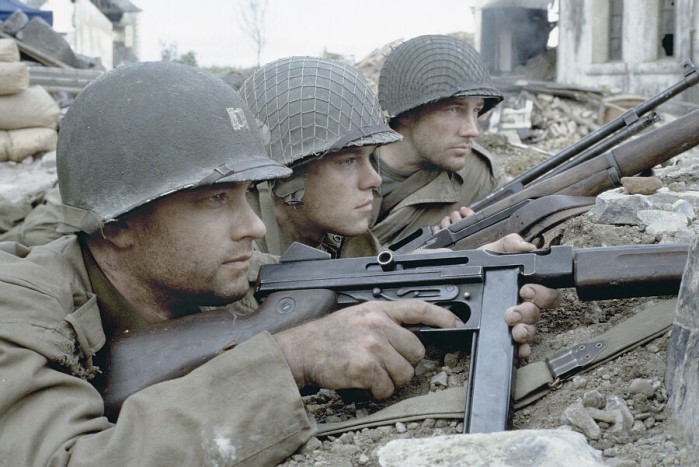
Tom Hanks holding a Thompson
Sub Machine Gun in Saving Private Ryan

Military technologists were convinced that a cross between a full sized battle rifle and a sub machine gun was needed. Such a gun would shoot a rifle cartridge, but a lighter one which would not have as much recoil as a high power .30 round. It should also be capable of shooting in burst or fully automatic mode as well as semi-automatic mode (one shot for each pull of the trigger.)

Germany produced what is often regarded as the first true "assault rifle" near the end of World War II, the Sturmgewehr 44. It shot a shortened .30 caliber bullet with a lighter charge of powder behind it, making the recoil lighter and the ammunition cheaper to produce and lighter to carry, and it could shoot either in semi-auto or full-auto mode. By late 1943, however, the tide was already turning against Germany and its manufacturing capacity was waning. Only half a million were ever produced (compared to over 14 million of their full size K98 Mauser bolt action battle rifle.) However, it provided the inspiration for Mikhail Kalashnikov's development of the AK-47 in Russia after the war. The AK-47 also used a light .30 caliber cartridge and selective fire (the ability to fire either semi-auto or full-auto.) The design became the standard Russian infantry rifle in 1949 and went on to become perhaps the most widely produced rifle design in history.
Sturmgewehr 44

AK-47

The 5.56x45mm round shot by the M16 (left)
next to the 7.62x51mm shot by the M14.
The United States was comparatively late to the game in adopting an assault rifle for its armed forces. After World War II the US sought to improve on the M1 Garand and in 1959 adopted the M14. The M14 did have selective fire and accepted a large detachable magazine.  (The Garand had a unique loading mechanism: it's magazine was fixed but clips of eight shots were loaded in from the top.  Those eight shots could then be fired as fast as the shooter could pull the trigger.  After the last shot, the rifle ejected the metal clip out the top and the bolt locked open.  The shooter then loaded a new clip in from the top and released the bolt to load the next cartridge.)

However, the M14 still fired a full size .30 cartridge, the 7.62×51mm NATO which fired a bullet of the same size as the .30-06 at the same speed. The rifle had many fans and continues to be used to this day by US soldiers and marines who are designated marksmen, but the 7.62×51mm NATO proved too high powered a cartridge to be practically shot in burst or full auto mode, and the rifle itself was heavy. As a result, the US Army adopted the M16 for jungle combat in 1963 and in 1969 made the M16 the standard service rifle. The M16, made with an aluminum receiver and a plastic stock, was five inches shorter and three pounds lighter than the M14 and it shot a much smaller cartridge, the 5.56×45mm NATO, with a .22 caliber bullet weighting about a third as much as the .30 caliber bullet of the 7.62×51mm NATO.

Because the bullet is so light and travels at such high velocity, it is extremely accurate even at long distances. However, due to its light weight it packs only half as much energy as full size .30 caliber rounds. This makes the M16 much more comfortable to fire, especially rapidly, which is the purpose of the "assault rifle" concept, however troops have in some conditions complained that it lacks "stopping power" and in Iraq and Afghanistan many units have a designated marksman with an M14 for situations in which a heavier weapon is needed. For the same reason, many hunters shun the civilian version of the round (the .223 Remington), believing that it is too small to humanely kill deer and other full size game. The round is often found, however, in the "modern sporting rifles" which are similar appearance to military designs. For the recreational shooter, the light rounds fired by military assault rifles are often preferred because they have fairly light recoil, are highly accurate at the 100-200 yard distances found at most rifle ranges, and because ammunition is far less expensive than the larger high powered hunting rounds.

Military technology has continued to develop, but all standard service rifles since the 1960's have been variations on the assault rifle concept.  The standard US service rifle is the M4 Carbine, a slightly modernized version of the M16 design.
M4 Carbine
More recent assault rifles adopted by other nations all have the basic features of selective fire and smaller rifle cartridges. More modern innovations generally relate either to compactness (a number place the action in the stock, behind the trigger, allowing for a shorter overall length of the rifle even while keeping the same length barrel) or modularity.
French FAMAS

German G36

British SA-80

Next in Part 2: Civilian weapons based on assault rifle designs, how they differ from their military cousins, and what the Federal Assault Weapons Ban actually outlawed.

Advance planning

All right! It's almost 11:30 the night before we start up lessons again, so it's prime time for me to start my lesson planning. This is how I roll. This afternoon at 2:30 I was feverishly printing out Epiphany coloring sheets and vocations crosswords for my religion class at 4:00. Tomorrow I'll be writing out details of the children's schola I'm leading for someone's co-op on Tuesdays. I'll be planning a day in advance for that because they're paying me a bit.

I'm flipping through our Core Knowledge books at the appropriate grade level to see what we've covered so far for each child. I'm pleasantly surprised to learn that we've already covered (and demonstrated some mastery) of all of the first grade math topics. Fifth grade? Not so much. I'm not too worried about fractions because I've overheard the girls dividing up cookies or portions of candy with a methodical care and accuracy that they rarely put into their math worksheets. Still, we're going to start our math time with ten minutes of quick drill, carefully timed and not a minute over.

Drill? Yes. I'm beginning to see just how crucial constantly pounding certain facts can be, if you actually want the kids to learn them. How much time did we spend last year talking about the Revolution? How much time on the Founding Fathers and the Declaration of Independence? I asked Eleanor (age 10) this evening, "Eleanor, when was the Declaration of Independence written?"

She paused. "1556?"

"Nooo. Try again."

"1992?"

It was to laugh, or weep, take your pick.

I've been beta-testing a spelling program this year, one that involves learning words by copying paragraphs from a model, provided right there in the workbook. It's okay. The first grader likes it just fine, copying out lines from nursery rhymes and finding the vowel chunks and silent-e words. The fifth grader puts up with it -- it's only ten minutes a day, and at the end of the week, she copies her paragraph from dictation instead of the model, and counts up the words she's spelled right. The paragraphs all have to do with stories from American history, and the words aren't too difficult.  But Julia, in fourth grade, has taken against it, and when Julia takes against something, let it be anathema. She says it is too easy and tells me so in angry, misspelled notes. She wants tests and crossword puzzles and little varying exercises. Back to the MCP workbooks for her, I guess.

Speaking of taking against, it's pulling teeth this year to get anyone to read anything that smacks of sneaky education. I remember devouring biographies, novels, easy science books, that "day in the life of" series about different careers, anything, at this age. Then I re-read them. The big girls moan and sigh if I demand they read a chapter about the Transcontinental Railroad (it was an interesting book, I thought) or begin Hans Brinker, or the Silver Skates. I liked that book. Something I wonder on occasion is whether my children are spoiled by living in a houseful of books. It's as if the books are so commonplace, they've lost their allure. When I was little, we didn't have a lot of books, and I read and re-read ours until they fell apart. I remember the glory of receiving a box of books from my great-aunt when I was nine or ten. It contained Anne of Green Gables and Anne of Avonlea, a set of old encyclopedias with synopses of great world lit alphabetically arranged at the end of each volume, a Mary Renault novel, and a bunch of children's books the titles of which I can't remember even though the plots have stuck with me, in detail. (Anyone ever read the one about four children, one of whom was named Ham and one who might have been named Dorry, who vandalize an old house and are made to clean it up, and in the process they discover lots of great historical detail about it and see the error of their stupid prank, and then learn that the crochety owner is going to have it torn down because he can't afford to keep it up?) I still read almost anything that comes into my hands, but these ones, although they will do their school reading when required, are in a phase in which they only want to read books called "The Spy Princess" or involving Harry Potter or fairy tales.

We were conveniently between readalouds over Christmas break, so I've been perusing the shelves looking for our next book. At the beginning of the year I'd resolved to add more poetry into our diet, and one of the authors on my list was Longfellow. I'm considering Evangeline. As a warm-up, I read the last section of The Song of Hiawatha tonight ("By the shore of Gitche Gumee,/ By the shining Big-Sea-Water...). Eleanor started improvising a tap dance to the drum-like rhythm, weaving increasingly intricate and faster patterns around the ONE-two-three-four of the lines. It was like being part of a  minor number in a mid-century musical.

A college friend of mine, Bill Powell, recently wrote a book called Christmas by Heart: How to Memorize the Christmas Stories from Matthew and Lukewhich we started using over the break.  Although the book includes schedules for memorizing the stories either on an Advent or Christmas track, we're a few days behind and it doesn't make a difference in how we use the daily prompts. It's full of good advice and tips for effective memorization, so I read those myself and then incorporate them into our memory sessions, which are usually after evening prayers when the girls are in bed. We'll continue this almost until Lent. Anyone who's interested in learning more about what we're doing can find lots of detail and sample chapters at Christmas By Heart.
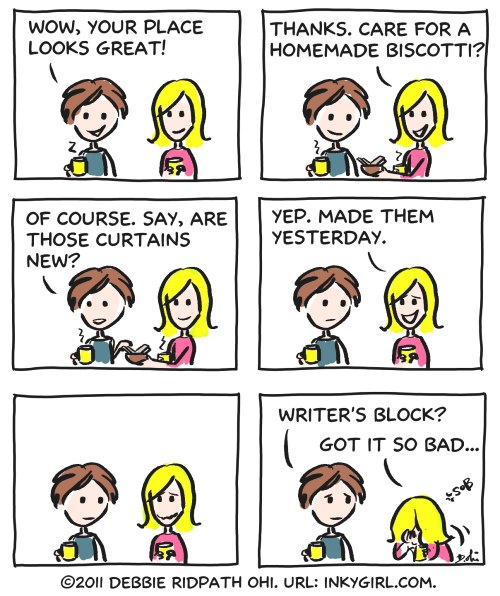
And that's about as much planning as I can handle tonight. I don't know how the real teachers do it. I admire you mightily for your developed curriculums and your fine lesson plans. You can admire me for my... well, the way I... for my ability to make it up as I go along, I guess.

Sunday, January 06, 2013

20 C + M + B 13

This is one of those lovely years where the date of Epiphany, January 6, twelve days after Christmas, lines up with Sunday, ensuring that the feast receives its full due.

From Darwin's Epiphany 2009 post:

For those of us who are gentile Christians, the feast of the Epiphany holds a special meaning, as it recalls that Christ was done homage as a king by Magi from the East at the time of his birth. Though Matthew's gospel provides few details, the Magi are traditionally recalled as three, with the names Caspar, Melchior and Balthasar. 


I first encountered this classic orchestration of We Three Kings by Eugene Ormandy when I was a child, watching my dad give the annual Christmas Star Show up at the Griffith Observatory. Since the recording is hard to find, and there too it the music provided background to a montage of artistic representations of the Three Kings, I took the liberty of putting together a YouTube video for the occasion.

Saturday, January 05, 2013

Saturday night

What I'm drinking.

What I'm watching.


How I'm feeling.


What Is Truth?

The opening of this piece really struck me:
Lance Armstrong, the former professional cyclist who was recently stripped of his seven Tour de France titles, has told his associates that he is weighing his options for making a public acknowledgment that he had doped during his cycling career, according to a person familiar with the matter.

His possible confession, if he goes forth with one, could enable Mr. Armstrong to begin the process of restoring his public reputation, which has been badly damaged in recent months.
This Kabuki theater of publicly considering whether to admit to something (thus making it absolutely clear, were it not so already, that the thing was done) underlines how low our expectations for truth telling have become in our culture.  The question of "what is the truth" seems to have taken a permanent back seat to "how shall we manage communication?"

Friday, January 04, 2013

Prayers for Jennifer Fulwiler

Our friend from Austin, Jennifer Fulwiler of Conversion Diary, went into the hospital yesterday with pulmonary embolisms in both lungs. She's on heavy blood thinners, but it's risky to get too aggressive with the treatment since she's five months pregnant. Although she was discharged last night, she took a turn for the worse today and was just readmitted.

Please keep her and her family in your prayers. For the fastest updates, you can follow Hallie Lord's Twitter stream.

Thursday, January 03, 2013

The Holy Name of Jesus

Today is the feast of the Holy Name of Jesus, one of my favorite devotions. There are so many feasts devoted to Jesus in his various manifestations: The Sacred Heart, Christ the King, Christmas. Yet the richness of this devotion is that it is almost a celebration of Jesus as beloved. The Litany of the Holy Name of Jesus is the tenderest prayer I know. It is simply whispering the loved one's name over and over, with various endearments and praises and cataloging of virtues.

Jesus, most amiable.
Jesus, most admirable.
Jesus, the mighty God.
Jesus, Father of the world to come.
Jesus, angel of great counsel.
Jesus, most powerful.
Jesus, most patient.
Jesus, most obedient.
Jesus, meek and humble of heart.
Jesus, lover of chastity.
Jesus, lover of us.
Jesus, God of peace.
Jesus, author of life.
Jesus, example of virtues.
Jesus, zealous lover of souls.
Jesus, our God.


This is a time when names have gained a great deal of prominence. No longer are Mary and John the top ranking monikers -- parents put much time and thought into finding just the perfect expression of their baby's potential personality and ambition. Everyone has a chance to reinvent himself or herself with an online handle or three. We allow names to define us in one little mouthful. The devotion to the Holy Name, therefore, ought to be the ideal devotion now. The name of Jesus is not arbitrary -- it was divinely revealed to Mary as the right name for God's son. It means "God saves", and "God saves" means Jesus. The name itself has power to bind demons and to give strength. The name itself is lovable.

Brandon has posted a lovely poem by George Herbert on the Holy Name.

For more meditation on Jesus, head over to The Wine-Dark Sea, where I have a guest post today on "True God from True God" as part of Melanie's series on Professing the Creed for the Year of Faith.

This is Your Hobbit on Steroids

or, An Over-long Expected Movie

[Yes, there will be some spoilers.]

All joking aside, I enjoyed the first part of Peter Jackson's three movie Hobbit adaptation. Yes, it's a deeply flawed movie, and I'll get to some of those flaws in a moment, but Martin Freeman is brilliant as Biblo and there are some truly brilliant visuals at times. The riddle game scene in particular was very, very good. I've probably read The Hobbit a dozen times over the years, and as a child I watched the terrible 1970's Hobbit movie numerous times, so I both love the story and am tremendously glad to see it done better than the old version. Further, my beefs with Jackson as in some sense enabled by his own work. While there are parts of the Lord of the Rings movies that make me cringe these days, the fact remains that they significantly raised the (previously shockingly low) bar for Fantasy on the big screen.

The biggest problem, I think, with the Hobbit movie is that it is too long. Having given himself three three hour movies in which to tell a story whose original is far shorter than even one volume of The Lord of the Rings, Jackson finds himself more able to insert his own content (loosely based on the appendices of The Lord of the Rings) and most of this is pretty inferior. The sheer quantity of story in The Lord of the Rings kept Jackson's instincts more in check. I think the movie would have been significantly stronger is much of the "extra" material had simply been cut: The execrable (literally) sections with Radagast, the White Orc (it's a bad sign when the story slows down whenever the extra antagonist who's been added to increase tension appears), the White Council.

Other over-long portions resulted from Jackson's need to expand anything resembling an action scene to the Nth degree. The scene of Smaug's arrival is okay as a prequel if one wants to start that way, but shoehorning in a battle at the gates of Moria did nothing for the story. The stone giant battle added nothing to the story and simply added an extra scene of action so unbelievable as to pull one out of the story. And the gimmicky escape-from-the-goblin-kingdom scene seemed like a scene from the video game that somehow made its way into the movie.

What's good in the movie is, in the main, quite good. But I felt that by simply cutting it down to about two hours it would have been a much stronger film.

The main thematic change which concerns me, especially as it gives me pause as to what will occur in the later movies, is a subtle shift in the character of Bilbo and his relationship with the dwarves. In the book, Biblo has an adventurous streak which is offended when he's describes as being "more like a grocer than a burglar", but he remains very much a hobbit, if an adventurous one. As such, he is never a warrior. He is courageous and loyal, yes, and the dwarves come to respect him deeply for these qualities, but he remains inherently peaceful.

The movie can't quite stand to leave this alone. Thus, in one of the last scenes of this movie we see Thorin wade into battle against a band of orcs while the rest of the dwarves seek shelter in a tree. Thorin looks like he's about to be killed when Bilbo, who till now has been scorned by Thorin as so much baggage, draws his little sword and rushes into battle. Bilbo's fierce defense of the wounded Thorin against a crowd of wargs and orcs inspires the other dwarves who then raise their battle cry and charge into battle after him.

Bilbo having saved Thorin's life in battle, and the whole company having been rescued by eagles, Thorin sheds man-tears and embraces Bilbo, declaring that he had never been more wrong than when he had questioned Bilbo.

In other words, rather than the dwarves coming to respect Bilbo for being a courageous yet non-warlike hobbit, in the movie Bilbo wins respect by becoming a warrior, by becoming more like the dwarves. (Actually, I think Jackson way overemphasizes the warrior element of the dwarves. But they are, at least, capable of being warriors in the book, even if that isn't their primary character.) In addition to not being like the book, it seems to me that this is a weaker and less interestingly character choice, and a concession to the unstated but frequent trope that worth in adventure stories is wholly synonymous with martial prowess.

Tuesday, January 01, 2013

Les Mis, The Musical Movie: More "Less", More "Mis"; Less Movie, Less Musical


I had a chance to see not one, but two movies over the holidays. (In regards to the frequency of my movie-going, this is a statement somewhat akin to saying that I had the chance to grow not one, but two, extra heads.) I think Darwin might write about seeing The Hobbit, so my one-sentence assessment is: trim all the fat, but leave me my Martin Freeman. Alas, Darwin didn't get to see Les Mis with me, which was a loss because a) I missed him, and b) he doesn't know the musical at all, so I would have been very interested in his take. As it is, you're stuck with mine.

I didn't read the WSJ review before seeing the movie, because by the time I went out to get the paper on Wednesday it was under six inches of snow, and no amount of excavating in the yard could bring it to light, and I refused to just get online to check the review when I already had the stupid paper in my yard. (I did get hit on for the first time in a good ten years, by some oddball out jogging, when I was out shoveling for it. I'm still trying to assess whether this means that I'm so completely hot that someone would try to pick me up while I'm wearing Darwin's big coat and my nose is running, and my hair is hanging in matted snowy tangles in my face, or whether it's a judgment on my ordinary appearance that I only get hit on when I am thus concealed.)

Oh, but you wanted to hear about the movie. You know the plot. Everyone knows the plot: revolution and redemption. Barricades rise; deathbed scenes jerk tears, love is lost and found, some cute kids steal the show. It's all here, and it's good to see. Even when the movie disappoints, it disappoints affectingly.

The big buzz on Les Mis was the ground-breaking filming technique of having the actors sing live, as opposed to lip-syncing over a pre-recorded soundtrack. This is huge. In theory, it should give performances an immediacy and an emotional resonance that is unprecedented in big screen musicals. In practice, it mostly worked. The acting was fabulous, and everyone's talking Oscars for Anne Hathaway and her shorn head. She sang emotionally.  So did Hugh Jackman. They emoted just fine to the accompaniment of the piano coming through their hidden earpieces.

The only problem with this was the fact that, well, Les Mis is a musical. There's more to the show than acting, and more than singing as well. There's melodic line, there's the tempo of the whole piece, there's virtuosity. I missed that. An aspect of this new immediate style of emotional singing -- musical cabaret, if you will -- was that there was a strange disconnect between the very personalized, sometimes harsh singing, and the underscored orchestrations. In the beginning of the movie, it was almost as if the tempo of the singing didn't match the tempo of the music -- almost as if the editors had not been able to sync up the vocal soundtrack and the musical soundtrack. It threw me out from the start, and although things managed to come together fairly quickly, that dissonance stayed with me throughout the movie.

Perhaps that speaks to the difficulty of filming musicals. There's an interplay between live orchestra and live singing that requires a wonderful discipline from the actor to be able to match the pace and the musicality and the volume of the orchestra. Actor Eddie Redmayne said in a video interview that the set pianist would follow the actors' singing and interpretation, and it that was obvious in the way the actors felt able to indulge in quirks of dramatic timing.  Another effect of the immediacy of filmed live singing: almost every scene involved whispery singing and half spoken lines. Again: fabulous acting; very hard on the musical flow of the song.

Now, when it worked, it worked beautifully. Eddie Redmayne, who played Marius, was a standout, a true singer who was able to maintain a virtuosic beauty of tone both in his intimate passages and in the big show-stoppers. The best moment in the movie, to my mind, was his rendition of "Empty Chairs at Empty Tables", a gloriously melodic outpouring of grief for lost friends in which, for all the emotion, the actor never lost sight of the fact that he was not just acting, but also singing a song. Here, the live singing was a true boon -- watching Mr. Redmayne belt it out, you could tell by his breathing, by his projection, that this was no mere lip-sync job. I feared, at the beginning of the song, that the director was going to film the whole thing in closeup, again (he forebore, thank God); by the end, I was lost in the music. That moment was the closest I came during the movie to tears.

More than honorary mention has to go to Aaron Tveit as Enjolras, the smoldering leader of the student revolutionaries, and to the band of students themselves. These guys were the real deal, true Broadway-class singers, and they never let the movie drag by losing the beat. Their scenes were the closest the movie came to matching the real excitement of a stage performance -- and I say this as one who hasn't seen Les Mis live.

My sister-in-law and I disagreed on Amanda's Seyfried's Cosette -- she disliked her small, high vibrato; I thought her voice was sweet and ethereal and very much in character.

The sets were wonderful -- what we were able to see of them blurred behind the extreme closeups of the actors. I missed the cinematic aspect of the cinema. Rarely did the camera pull back, but when it did, the payoff was big and lush, and the music was truer. "One Day More", always a showstopper, was a marvelous example of the magic that could be made when Tom Hooper, the director, allowed himself to treat the movie as a movie, while allowing for the natural lull in action that applause provides in live theater.

Why don't I mention the big stars -- Jackman, Hathaway, Crowe? No one can quarrel with these people as actors, of course, and the camera lingered on Hugh Jackman and Anne Hathaway in particular, picking up every Oscar-worthy nuance and grimace and tear, to the detriment of the cinematic element of the film. A bold move, yes, to film Anne Hathaway singing "I Dreamed a Dream" entirely in one close shot, as an effective monologue, but you know what? That's not a technique that serves monologues well, as I've noticed in the low-budget BBC Shakespeare adaptations. It's hard to focus on someone's face for five minutes, even if she's crying her eyes out (or, a more effective technique that every actor knows, trying hard not to cry her eyes out). And again, something that was lost in the tears and the emoting was the song itself. Anne Hathaway has a pretty voice, and perhaps a fine voice, but although she may have been directed to act her heart out, she never sang her heart out. And that's a bit of a problem, in a musical.  Hugh Jackman -- excellent, yes, yes, and yet, he did not often seem to allow the song to guide him instead of vice versa. Russell Crowe is a great actor, but he often had the faintest hint of the deer-in-the-headlights terror of someone who finds himself in front of a lot of people, singing something just beyond his capabilities. (We've all been there, Russell.) The strain of keeping up with the technical demands of the role seemed to prevent him from truly delving into the character of Javert and putting his own unique twist on it, but the director did some interesting character work with camera angles and with the recurring motif of Javert confidently pacing the extreme edge of very high ledges.

Do I sound like I didn't enjoy the show? I did, very much. But I found myself oddly unmoved and slightly removed from a lot of the action, when I thought likely that even I, generally reserved audience member than I am, would be affected. I didn't expect to sob through the show (Lord have mercy!), but I had hoped to be more invested in more scenes. As it was, the actors poured out so much raw emotion that there wasn't that much left for me to do. And the ending did make me raise my eyebrows, wondering why poor Fantine couldn't get her hair back in heaven, and for that matter, questioning the theology of heaven as one big fraternal barricade. (I half expected the camera to pull away from the vast chorus inside the barricade to reveal the single figure of Javert standing outside the wall.)

Still, go see it.

Monday, December 31, 2012

Gun Insurance as Gun Control

I have a some more substantive posts on guns and gun control brewing, but this struck me as an interesting quick topic. Megan McArdle has an interesting post up where she discusses the merits (and demerits) of the idea being bandied about that gun owners be required to pay for liability insurance on their guns. The idea is that this would allow insurance companies to effectively price the deadliness of various types of guns into the price of the insurance, and that people would thus be deterred from buying more deadly guns without having to actually ban any guns.

Megan is highly skeptical of the idea. She points out a number of practical problems, notable the question of how you would get people most likely to misuse guns (criminals) to pay insurance premiums in the first place. Even if you could extract one premium at the time that a gun was first legally purchased, the owner could then stop paying.

I'm not sure this is actually the biggest practical obstacle (let me just say now I'm against the proposal, but I'm looking at it's plausibility because I think that it helps dissect some of the illusions that gun control advocates are under.) You could require that any time a gun is sold that the buyer undergo an insurance check and pay a one time insurance fee which would cover liability if that gun were used to kill anyone any time in the next 10 years. Sure, guns can sit around a long time, but it would take a lot of pre-planning to buy a gun more than ten years before committing a crime. This would probably the cover the majority of guns that undergo a legal sale prior to being used in a crime.

Of course, a lot of guns used in crimes aren't purchased legally or are never traced. If not traced, there's obviously no way to assign liability. If it was bought legally by one or more people within the last ten years, then you could make the most recent insurance company pay out.

There are currently about 300 million guns in private hands in the US. There are about 12,000 people who are killed with guns each year (obviously it wouldn't make sense to pay out for suicides as it would allow one to provide for one's family by committing suicide.) That means the chance that any one gun will be used to kill someone in a given year is 1 in 25,000. In ten years, that's a 1 in 2,500 chance. If we assume a payout of $1million to anyone killed with a gun, the average cost of ten years of liability insurance would be $400. Once you take into account the fact that often murder weapons aren't recovered, insurance companies would come up with a (probably lower) figure based on the characteristics of the buyer and the gun which would quantify the actual chance of liability with any given gun.

Now, $400 is a fair amount of money, but for ten years coverage it's honestly not very much. Moreover, I suspect that the result of applying actuarial probabilities would not be what the advocates of this idea expect.

Proponent John Wasic writes:

When you buy a car, your insurer underwrites the risk according to your age, driving/arrest/ticket record, type of car, amount of use and other factors. A teenage driver behind the wheel of a Porsche is going to pay a lot more than a 50-year-old house wife. A driver with DUI convictions may not get insurance at all. Like vehicles, you should be required to have a policy before you even applied for a gun permit. Every seller would have to follow this rule before making a transaction.

This is where social economics goes beyond theory. Those most at risk to commit a gun crime would be known to the actuaries doing the research for insurers. They would be underwritten according to age, mental health, place of residence, credit/bankruptcy record and marital status. Keep in mind that insurance companies have mountains of data and know how to use it to price policies, or in industry parlance, to reduce the risk/loss ratio.

Who pays the least for gun insurance would be least likely to commit a crime with it. An 80-year-old married woman in Fort Lauderdale would get a great rate. A 20-year-old in inner-city Chicago wouldn’t be able to afford it. A 32-year-old man with a record of drunk driving and domestic violence would have a similar problem.
...
Want to buy a single-shot World War II rifle? You’d pay much less than a semi-automatic handgun with a multi-round clip.

I'm certainly willing to bet that my bolt action WW2 rifles would have a very low statistical chance of being used in a crime. (Come to that, so would my semi-automatic WW2 era M1 Garand.) But here's the thing: The AR-15 "assault weapon" which was used at Newton is also a gun that is very seldom used in crimes. Sure, they're occasionally used in very spectacular crimes, but given that AR platform rifles are some of the highest selling rifles in the US, the ratio of people killed to number available is actually quite low. Further, the upper middle class middle aged woman who bought the AR-15 used at Newton would probably show as a very low risk profile. I'd be surprised if such a law would have tacked on more than one or two hundred dollar to the price of the gun -- and that's on a gun that already costs $700+.

The guns that would be most impacted by a law like this would be relatively inexpensive handguns. The last data I saw listed .38 Special revolvers as the most frequently used for crimes in the US. Also, cheap models are far more often used than expensive ones. The result of such a law would simply be to raise the price of less expensive (often, less "scary" from the point of view of gun control advocates) guns while leaving many of the ones that scare people most (so called "assault weapons") untouched. Cheap semi-auto pistols would become more expensive while the much derided Glock would not be impacted as much. As when it comes to profiling gun owners as opposed to weapons, let's be clear: The main thing would would be done by such a regime would be making it much harder for young male minorities living in poor neighborhoods to buy guns. That might be effective in a certain sense, but if advocates of such a law want to ban gun ownership by Black and Hispanic men, maybe they should just admit it.

Thursday, December 27, 2012

When Your Taxes Go Up

With it looking increasingly likely that we will "go over the fiscal cliff" at least temporarily (once everyone's tax rates have already gone up, a whole different set of factors may come into play and make Congress want to reduce some people's taxes back down again) it's not a bad time to think about what effect we feel when our taxes go up. The obvious answer is "pain". As Megan McArdle points out, the best way to quantify this is not how much your taxes go up, but rather how much your take home income goes down:
[W]hen we're talking about policy, we tend to look at tax increases as a fraction of total taxable income, or as a fraction of the current tax rate. To see what I mean, think about two cases: one where the tax rate is going from 5% to 10%, and one where it is going from 50% to 55%.

If you look at this as a percentage of total income, these two tax increases are the same.

If you look at it as a percentage of the tax rate, then the first increase is much larger: it is doubling your taxes! While the second increase is only upping them by 10%.

But in terms of behavior, the percentage increase in the rate, or the percentage decrease in total income, is much less important than a third figure: the percentage decrease in your after-tax dollar. Most people think less about their nominal annual salary than about how much they bring home in each paycheck. And if you look at it this way, the second tax increase is much, much larger than the first.

Taking your tax rate from 5% to 10% decreases your after tax income by 5.26%. But by the time your tax rate is 50%, you're only keeping half of your income. So increasing the tax rate by 5% decreases your after-tax income by 10%: you used to take home 50 cents out of every dollar, but now you only take home 45 cents.

If you were surprised that Gerard Depardieu decided to leave France rather than pay the new 70% top rate, think of it this way: the rate increase was only 30%, but it was going to cut his income in half. Yes, that would still leave him with more money than you and I live on. But people don't think this way: if the government came and took half your after-tax income away, that would still leave you with more money than a middle-class family in Bangalore lives on, and you would still be hopping mad, not to mention panicking about how the mortgage was going to get paid.

On the Third Day of Christmas

I'm back in the office today, getting in some much needed time on a couple of big projects and saving my vacation days for later. However, the household is still pretty much on a holiday footing. Yesterday we had Erin of Bearing Blog and her family over for dinner and to stay the night. This brought the household total up to nine children and with six inches of fresh snow having just fallen the kids had a blast building snow men and sledding. MrsDarwin and I had a great time with Erin and Mark: we sampled beer, we managed to get all the kids down with relative peace, and we talked by candle light for an hour when the power inexplicably when out.

Things are likely to continue rather low key around here for the new couple days, as we have family visiting. However, more posting and more Stillwater are coming. We hope you are all having a happy and blessed Christmas.


Saturday, December 22, 2012

The Fantasy Lives of Wives with Beehives


Just when you think trends, and the television shows about them, couldn't get any more vapid, here we have Wives with Beehives, a program about women who want to party like it's always 1959.
One place this breezy portrait of such women doesn't lead is to the sight of hair done in a beehive. There are other stand-out hairdos, to be sure, some clearly the product of fevered fantasies about the '50s, but nothing approaching the style the title mentions. That should have been the first sign that this TLC production about a group of Los Angeles housewives who pride themselves on adherence to the manners, morals and dress of the 1950s might be a bit short in the authenticity department. There would be others in regular succession.  
...That clothing plays a central role in the concerns of the four women introduced here, whose reasons for their choice of lifestyle are all roughly similar. Dollie, who had a difficult childhood, wants order, and also a world like the one she connects with the '50s, when men were men and women were women. Unlike today—when, she charges, men have surrendered their masculinity. As she speaks a scene unfolds in her living room by way of illustration, showing her husband striding purposefully to a table lamp to change the bulb—presumably an example of male assertiveness. How many manly husbands does it take to screw in a light bulb?... 
Amber, who also wants a stable and peaceful life, wants no children and may, it's suggested, be trying to overcome memories of her strict religious upbringing. Fifties fashion of all kinds is central to her life, if this report is to be believed. She prides herself on her cocktail parties featuring appropriate taste treats of the era: deviled eggs and cheese puffs. The dressing room that holds her huge vintage wardrobe is the largest room in the house—a fact that would likely have been incomprehensible to an American homemaker of the '50s. 
Shelby, married to a U.S. Navy man, is proud to feed her husband what she considers 1950s meals when he's home on leave. Potato-chip casserole, freezer-box pie and blue Jello, etc. She believes, as does the elegant Leslie, that the values of the '50s will keep her family intact.
As it happens, I know some women who were housewives in the Fifties -- my grandmothers and Darwin's. Strangely enough, what they've told me of their lives has very little to do with girdles and bullet bras, and more do to with raising children and trying to manage a household. By 1959, the total fertility rate in the United States was 3.7 children per women. At the end of the decade, my paternal grandmother had four; my maternal grandmother had 11. Of course these were times before easy, reliable birth control (that part of the morals of the 50s seems to be lost), but my grandmothers -- and Darwin's grandmothers too -- were all faithful Catholics, a demographic that transcends passing fashion and architectural trends.

Darwin and I lived for eight months in his grandmother's home, built in 1952. It had the formica table and the tile countertops and the vintage stove and ancient carpet. It also had a microwave, from a later period -- an innovation that Grandma H loved, because contrary to TLC's stereotype of the 50s housewife, she didn't love to cook. She also spent a great deal of time caring for a disabled child in an era in which many criticized her for not institutionalizing the little girl.

His other grandmother, Grandma R, was a Navy wife and moved seven children around the country. When her children put together a cookbook for Grandma and Grandpa's 50th anniversary, what they remembered were not her potato-chip casseroles and freezer-box pie but her meatball soup, her beans, her mole, her fideo, her tamales, her salsa, her pork and green chiles.

My Grandma D didn't spend her days crafting jello molds or bundt cakes for her husband; she had eleven children to raise, and, living in Baton Rouge, the family had a black cook who made great regional dishes like red beans and rice. She stayed petite and slim and elegant into her eighties, and though she is lovely in the old family photos, it has less to do with the styles of the time than with her own ladylike grace.

Grandma E was a thrifty Irish homemaker who raised her family near first Boston and then Philadelphia, who battled a hereditary blood disease before the advent of modern medicines that could keep it under control. She had no extra room in her house for a "huge vintage wardrobe", and she never threw cocktail parties. She still brooks no nonsense, and would find the idea of living a fantasy life based on the accoutrements of a certain decade ridiculous.

And this doesn't take into account the lives of other women in the period -- single working girls, WWII widows, women who crammed large families into small apartments, women who didn't have husbands who would keep them safely insulated from the cares of the world. Women who couldn't afford the latest styles, and didn't have the time or servants to wash and drip dry huge wardrobes. Women who knew that magazines such as Vogue and Good Housekeeping and Mademoiselle and TV shows such as I Love Lucy and The Adventures of Ozzie and Harriet crafted just as whitewashed and unrealistic an image of contemporary life as Martha Stewart Living and The Real Housewives of Orange County do now.

Do you want to know who lives the life of a stereotypical 1950s housewife? I do. I raise lots of children, keep a welcoming (if not always neat) home for my husband, go to church every Sunday, and have the occasional cocktail. I also, like my grandmothers before me, wear what's current because that's what I can find without going out of my way. Like my grandmothers before me, I'd give my eyeteeth for a some better household technology (although for me, "having eyeteeth pulled" is just an expression -- it was far more literal for them and their children).  Like my grandmothers before me, I don't have time to carefully build up a pretty fantasy life in order to have a stable family -- I'm too busy actually living and caring for the real thing.

Anyone who's interested in a reality show depicting a family life that would have been more familiar to women of the 1950s should check out Jennifer Fulwiler's new show, Minor Revisions.


Apocalyptic Counter-Indications

People, please. You knew the world wasn't going to end yesterday when this didn't happen.

Thursday, December 20, 2012

Stillwater - 26


Refreshed and completely meditated out, Esther roared back into Stillwater like a gathering hurricane, ready to whisk up everything in her path and spit it out transformed into a complete Stillwater Fellowship Ball. The scheduling of the Ball was left to Esther, and for a number of years she had chosen to hold it in late August — a miserable time of the year to dress up in voluminous layers of antebellum costume in Louisiana, but also a time when few other big society events competed for attention. 

Her big concern this year was vacant role of Queen of the Fellowship Ball. The eldest Spencer daughter at home usually filled the post, and for a number of years Sophia had reigned uncontested. Now that she was married, Olivia should have acceded to the throne, and indeed, Olivia had long dreamed of the day when she would supplant Sophia in the spotlight and descend the curved staircase in a rustling gown to greet her subjects gathered in the grand rooms below. 

Now that the great occasion was at hand, however, Olivia was strangely recalcitrant. She’d signed up to be an exchange student in Brazil this semester. She wasn’t going to fly home just for the Stillwater Ball. She had better things to do than worry about who would be Queen of the Fellowship Ball — Esther could do it for all she cared. This was exactly what Esther wanted to hear. Technically the naming of the Queen fell to Richard Spencer, but he had always paid little attention to the finer details of the Ball, preferring to let Esther manage the whole thing as long as she didn’t bother Cheryl to make any decisions, which suited them both admirably. It was certain that Cheryl had no desire to be the Queen — she could barely stay up for the entire length of the Ball. There was only one obvious contender, and that was Esther herself. Her seamstress friend in Plaquemine was making her a lavish dress, and she had secretly commissioned Alys to design a new tiara for this year’s Queen, “whoever that may be”.


As Alys had been invited to this year’s Ball, she had, in turn, given Melly a commission to alter one of the old dresses for her. Together they climbed up the tightly spiraling attic stairs, nestled against a tall window in a back service corridor, and emerged into a hot, dusty, cavernous space. Even in the middle of the day, the low windows barely illuminated all the way to the high rafters. Melly pulled the chain of the light fixture near the neat racks of garment bags, but the naked bulb made little impact on the dimness. 

“I can think of a few that might fit you fairly well,” she said, sorting through the bags and holding the tags to the light to read the labels. “My mother made these for Sophia when she was younger, so maybe they’ll fit you now.”

“Because I have a figure like a little girl?” 

“No!” Melly protested. “I didn’t mean that… It’s just that Sophia is taller than you, and has more… It’s just that she’s bigger,” she finished lamely.

“I know I’m not busty,” Alys laughed. “You won’t hurt my feelings by saying so. You pick the one you think will be best for me.”

Melly considered for a moment. There was no question that Alys would be attractive in anything short of a burlap sack, but it was hard to have to pick the dress in which she would captivate Malcolm at the Ball. Yet she knew exactly which dress would suit Alys perfectly, and with a small sigh, she lifted it carefully from its bag and held it up for her to inspect. It was an off-the-shoulder gown of ice blue taffeta, trimmed with pointed lace along the low neckline and the waist of the bodice. A ruched overskirt of a slightly deeper blue fitted trimly over the hips, and the full underskirt had three tiers of gathered pleats at the hem. The whole effect of the dress was one of alluring innocence. Alys was delighted. 

“Oh, this is so authentic!” she gushed, holding the dress to herself and admiring the effect.

“Well, not exactly,” said Melly. “These aren’t exact reproductions, and this dress is a melange of different styles. This overskirt is a look from the 1870s, but it’s not as snug as dresses then would have been. Ladies used to wear pretty tight corsets — even though you’re supposed to wear a corset under this dress, the modern ones won’t squeeze you nearly as much as an authentic corset would. But if you want something truly historical, there are some much older dresses in the way back.”

“I’m not even going to look at another one,” Alys declared.  “I wonder what shoes I should wear?”

“The next question is actually what you should wear under it,” said Melly, pawing through the racks in search of the right bustles, corsets, and hoopskirts. “Let’s find that, and then we’re done up here.”

“But what about you? Do you already have a dress?”

“Well…” The truth was that Melly had been avoiding the very thought of the Fellowship Ball. Ordinarily it was a joyful occasion for her, since it brought her beloved brother Reńe, the current Stillwater Fellow, back to her for a whole weekend. However, this year the prospect of Malcolm and Alys whirling gracefully around the floor, gazing soulfully into one another’s eyes (or sardonically, as the case might be) had been weighing heavily on her, and she’d considered just skipping the whole thing. Her hesitation was answer enough for Alys.

“Oh no, we are not leaving this attic until we find you a dress,” she said, taking charge. “And since I find it totally creepy up here, we’re going to do it pronto. Come on.”

Alys threw herself into the racks with purpose, gathering up whatever garment bags were in reach preparatory to examining each one.

“Stop! Stop!” cried Melly, unable to countenance the havoc being wrought on her carefully constructed organizational scheme. “You’re looking in the wrong area. Even Sophia’s old dresses are too big for me.”

“Then you show me where to look.”

Melly carefully hung up all the bags while Alys, on Melly’s advice, looked through a far rack, repository of an older selection of ball gowns made for a some more petite woman than the current crop of Spencer girls. Melly had always selected the most basic dresses for her costumes on the theory that the attention of the ball should be directed toward Sophia and Olivia, and away from herself, as much as possible. Alys had no such qualms. She emerged grinning and victorious, waving a half-zipped bag.

“Okay, I think this should be it. At least, it seemed ideal in the dark back there — let’s see it in the light.”

By the window, Alys displayed a gown of ivory silk woven with subtle stripes.

“I think you’re tiny enough to pull this off. I’m betting on you having pretty shoulders, though.”
Melly fingered the beautiful fabric. The wide neckline stretched to short tight sleeves of lace, and the tiny waist tapered down to a narrow point above the full skirt. Cascading bands of trim and silk dipped in a V across the bodice and swept close along the shoulders. Would Malcolm notice her shoulders? Would he think they were pretty?

“Oh, check it out!” Alys was examining the other side. “The back laces up. I call that sexy.”

“Do you know, I… I think this was someone’s wedding dress,” Melly murmured, blushing at her thoughts of Malcolm and putting him resolutely from her mind.

“Well, the bride is hardly going to ask for it back now, is she?” asked Alys reasonably. “Let’s grab our unmentionables and go try these things on.”


 The Ball was fast approaching when Melly received an unwelcome surprise. 

She and Malcolm had barely been driving together during the summer — the heat added an extra layer of discomfort to the whole awkward process for Melly, so Malcolm took Alys out instead. With her natural adaptability, Alys made the car her own when she drove, and her gleefully conspiratorial grins at Malcolm as she roared down River Road made that gentleman feel more reckless and liberated than his naturally serious nature had allowed before. Anything seemed possible when she was driving. They might tear up the miles to New Orleans and buy a suit of armor or an elephant’s foot in one of the venerable antique emporiums off Bourbon Street. They might head out at twilight across the endless bridge over the Atchafalaya Basin and find themselves in Mexico by sunrise. They might trace the Mississippi north and wind up in godforsaken Minnesota. None of these wild whims had indulged as yet, but with her, it seemed like excitement was just around the corner.

However, one afternoon a few weeks before the Fellowship Ball, Alys wasn’t in, and as Malcolm entered the basement door to head upstairs, he saw Melly in the family room, her head bent over Alys’s dress. She looked tired and pale, and he reflected guiltily that he had not even tried to get her out of the house in some time. She was always so quiet and patient and uncomplaining that he hadn’t kept as much of an eye on her health as he should have done. Surely it wasn’t good even for her to spend all day shut up in the house sewing.

“Hey, Melly,” he called. At the sound of his voice she immediately looked up, and her welcoming smile banished some of the wanness from her face.

“You’re always in here sewing,” he said, sitting on the arm of the couch.

“I have to finish this before the ball.”

“No, I mean you’re always in the family room. You have to carry everything downstairs to work on your projects. Do you like it better down here than in your room?”

She looked back at her work. “It’s warm up there sometimes.”

Somehow he didn’t like to see her shrinking back to her sewing. “Come on,” he said, taking the dress and putting it aside, “you need to get out. It’s not good for your eyes to spend so long staring at tiny stitches. Let’s go driving. It’s time to get you on bigger roads. We’re going to go up the highway instead of River Road.”

“Just let me get my hat and sunglasses.” Ordinarily she might have protested this new route, but now she was galvanized by the thought that perhaps it was because she was so resistant to stepping out of her comfort zone that he now turned to Alys for companionship. And she was tired of sitting alone in the house without him, and today his concern for her health, fraternal though it might be, was enough to make the dread prospect of driving less onerous. 

Her technical driving skills in the big Morgan had improved, and she was able to start the car without stalling now. But she still did not enjoy being behind the wheel. There was no affection between her and the Morgan, nor even the respect one has for a worthy adversary. She still feared that the car had yet another trick hidden away, and she felt deeply its treachery in purring like a kitten for Alys while balking under her command.

“There’s nothing wrong with your driving, Melly, except that you’re not confident behind the wheel,” said Malcolm, confidently. “You know what you have to do, but you’re tentative.”

“Yes,” said Melly tightly. “I’m tentative because I’m steering a huge pile of metal down a road toward other huge piles of metal, and if we collide, there will be one super-huge metal pile and no more me and you.”

“At the speed you’re going, the only metal we’d damage in a collision is our fender, maybe.” He regarded her from the front seat. “You could go faster, Melly. You know how to drive now. You could probably even get your license if you wanted to.”

“I don’t want to.”

“But you could. Think of all the things you could do if you could drive yourself.”

“If someone would lend me a car, you mean.”

“You could get your own car.”

“My own car?” Melly took her eyes off the road for a moment to see if he was teasing, but his face wasn’t twisted in amusement. “How would I get a car?”

“Buy it. How many dresses have you sewn or altered over the years? People pay good money for that. Start charging for the work you do — you deserve it. Then save up for a used car.” This time he did smile. “An automatic if you’re tired of dealing with the clutch.” 

The possibility of making money from sewing had never seriously occurred to Melly. She thought of her mother and the years she’d spent at various bridal shops. Of course she must have been paid, but it had always seemed like the family had barely scraped by on that money. Come to that, her mother had been paid for sewing at Stillwater — five years’ worth of Stillwater Fellowship Ball gowns in the attic were testaments to her skill. Had Esther been in charge of paying her? Yet Esther had never offered Melly any money for any of the gowns she’d sewn or altered for the Fellowship Ball. And Sophia’s wedding dress had cost her hours upon hours of wearisome work, yet neither Sophia nor Esther had seemed to think her time was worth very much. But perhaps she had owed them that work; perhaps that was the price of staying at Stillwater.

“At least Alys is paying me,” she murmured.

“Is she?” Malcolm’s eyes glowed, and Melly realized that she’d spoken aloud. “I’m not surprised. She has a lot of respect for your talents, Melly — she’s told me so several times. And she really believes that talent should be recognized and developed. Goodness knows she’s told me that often enough when we talk about the school.” He settled confidentially, and Melly tried to look as encouraging as two-way traffic would allow. “I can’t always understand her, though. I’m really starting to believe that she likes me. She practically told me the other day that the reason she took a second six-month lease was because she liked being near me.”

“She seriously said that?”

“Well, as seriously as she says anything. And that’s the issue. She’s so…” Malcolm surveyed the humid landscape, searching the levee, the cane fields, and the wisps of cloud drifting in the blue sky for words to describe Alys’s ineffable qualities. Melly waited patiently for inspiration to strike.

“We’re so… different, almost completely opposite. She’s so funny and bright and she sees everything so sharply. When I’m with her I feel free, and all my worries and obligations come off my shoulders for a while. But that’s the thing — it’s so easy to laugh at everything when I’m with her that I don’t know how seriously she takes our relationship, or if she even thinks we have a relationship. I feel like I weigh things down enough as it is — the last thing I want to do is ruin everything like always because I just can’t lighten up.”

Melly seethed at the unjustness of this self-assessment. “You don’t ruin anything by being sincere and responsible, Malcolm. That’s called being mature. You shouldn’t ever let anyone make you feel ashamed of it.”

He gave her shoulder a grateful squeeze. “You’re such a good friend, Melly. I’m so glad I have you to talk to. You always say the kindest things, and you’re always right.”

Melly was torn between exhilaration at his words and despondency at his intentions, and her conflicting emotions might have brought tears to her eyes if at that moment the car behind them had not honked with lengthy insistence. She jumped and looked at the speedometer — sure enough, she had let her foot slip while listening to Malcolm, and was tooling along at a leisurely 40 miles an hour. Her pulse began to race as she took her eyes from the road long enough to glimpse at the rearview mirror and saw that the car behind her was right up on her back bumper. Clutching the wheel, she jabbed at the accelerator. The Morgan, glad of this chance to roar, leapt ahead with a speed that alarmed her. Again the horn blared, still immediately behind her. Panic twisted her stomach. Should she go faster? She was driving the speed limit now. 

“Why won’t they pass me?” she hissed.

Malcolm squeezed her shoulder again, and his voice was oddly light. “I wouldn’t worry too much about it. They’re just teasing you.”

The car had pulled up alongside the Morgan, and the driver leaned on the horn. Melly risked a sidewise glance and saw Alys waving at her from the passenger seat of her own car. The driver gave her a comic salute, and much to her dismay, she recognized Ian. She glared at him for a moment before remembering that between the sunglasses and hat, he was hardly likely to discern the nuances of her disapproval. Staring straight ahead, she held the Morgan exactly at the speed limit. Ian charged ahead and maneuvered in front of her, and settled down to exactly the limit as well. With a sigh, she realized that she was going to have to follow him all the way home.

“So she was picking up Ian at the airport today!” Malcolm said. “I didn’t know he was coming in. That’s like her to want to surprise us all. Now we will have some fun.”

Melly’s reaction to this development was so exactly opposite his that she felt it hardly worthwhile to say anything. Was there no way to rid themselves of Winters for good?


Ian, in his turn, glanced in the mirror at the sedate Morgan and its primly upright driver. “How on earth does Malcolm Spencer end up in a classic roadster driven by Audrey Hepburn? I didn’t know he had it in him.”

Alys rolled her eyes. “You know it’s his own car, and of course that’s Melly, idiot.”

“Melly?” Ian scrutinized the face in the mirror more intensely. There was indeed a resemblance to the quiet little girl who had always seemed to be underfoot whenever he’d tried to sneak off with Sophia, but now he noticed her finely modeled face and the pretty mouth pursed with irritated concentration. “When did she grow up?”

“She looks the same as she always did, only now you notice it because you didn’t expect to see any good-looking girls this time around,” scoffed Alys.

“But how can she be old enough to drive?”

“I think she’s almost twenty, dumbass.”

“Sweet nineteen and never been kissed.” 

Alys looked at him sharply. “You leave her alone. I like her. She’s a good kid.”

“But she doesn’t like me. And I want her to like me. I want everyone to like me.”

“You’re so vain,” said Alys indulgently. “You have to be loved by everyone. I guess she could use a little something to bring her out of herself, but don’t you dare break her heart, or I’ll be mad at you. She’s not Sophia, you know. She’s a nice girl, not that you’d know the type.”

“I wouldn’t break her heart,” he protested, grinning. “I just want to soften it up a little. Make her smile at me, see her light up when I come into the room, have her cry a little when I go away again. That sort of thing.”

“Oh, that’s all, is it? You must be developing some restraint in your old age.”

“See? I’m already working hard on my nice guy cred.” 

Alys shrugged. “I wash my hands of you. With this big ball coming up, you’ll probably have a chance or two to make a good impression if you behave yourself.”

Ian’s boyish face could hardly have been more compliant. “That’s all I ask.”