Because most philosophies that frown on reproduction don't survive.

Saturday, August 14, 2021

COVID Hospitalization Trends for Kids

There's been a lot of coverage lately about kids getting COVID, in particular due to the fact school is about to start and kids under twelve are the main group of people who are not able to get vaccinated at this time.  Last week I took a look at data on deaths of children, and there the data shows that we are not in fact seeing an unusual number of children dying.  Indeed, since the pandemic started, child deaths have been lower than on average.

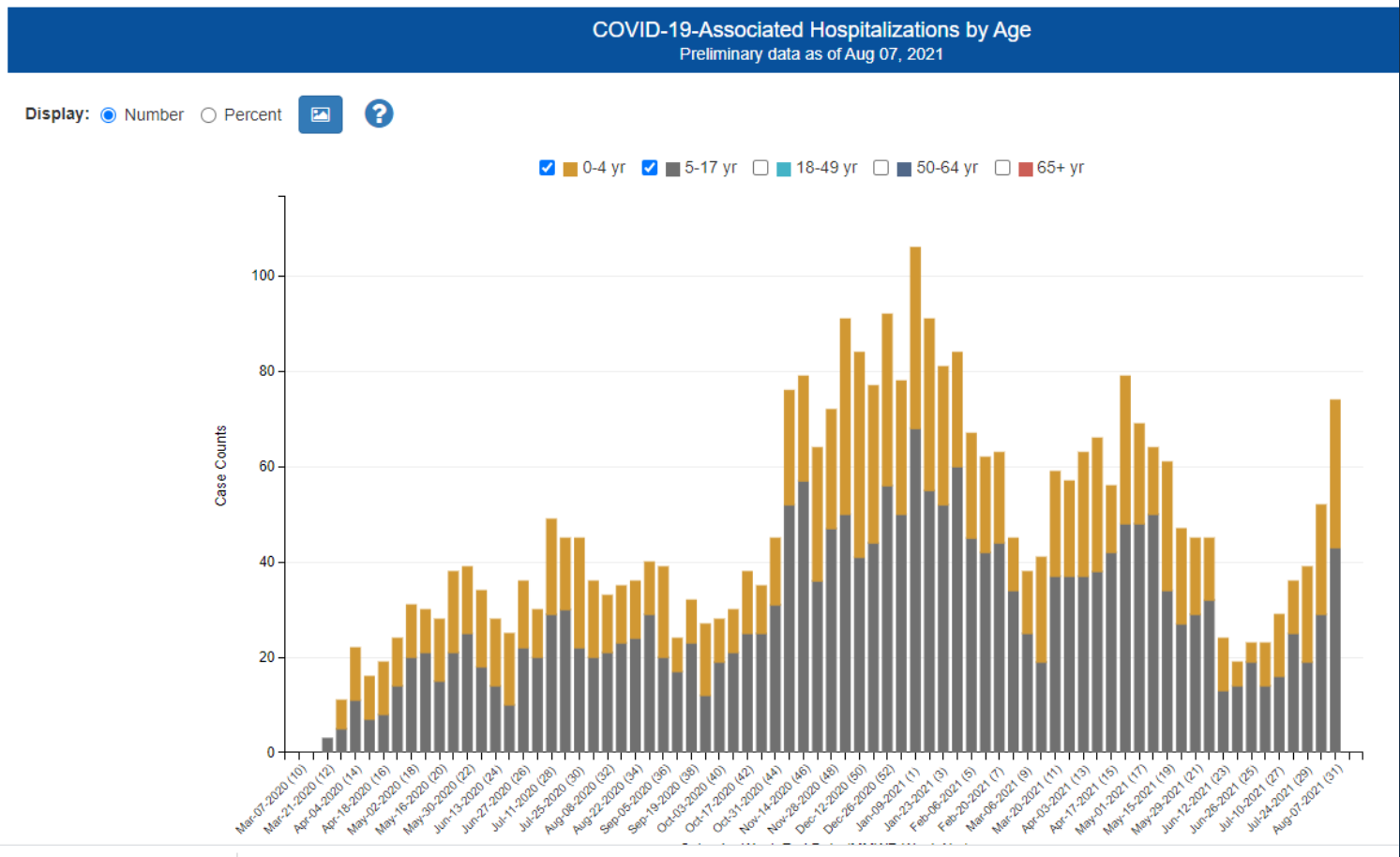
But of course, you can still have a pretty bad time of it without dying, so I wanted to see if it was possible to see what the risks of children getting seriously sick with COVID are.  The best that I was able to do in that regard is to look at hospitalization data from the CDC.  This tells us how many children under 18 with COVID are admitted to hospitals, though it does not tell us how sick they are or what lasting effects may stay with them.  Still, I think any parent would agree, any day when you have to take your kid to the hospital is a bad day, so I think it's a pretty reasonable way to look at the risk of serious COVID.

The short takeaway

Kids are still the least likely to be hospitalized with COVID (about 1/10th the average rate for Americans) but kids are being hospitalized at the highest rates of the pandemic: 263 per day last week


The full details

In the most recent day of data, .36 kids per 100,000 were admitted to the hospital. How do we think about what that means? There are 73M kids under 17 in the US. If this went on for 30 days 7890 or 0.01% would be hospitalized.

That 0.36 per 100k rate is the lowest rate for any age group.  Among 18-29 year olds, 1.29 per 100k of  were hospitalized per day last week. 2.52 per 100k of people in their 30s. The overall US average is 3.12 per 100k. People who are 70+ have the highest admission rate with 6.96 per 100k.

On a given day from Aug 5 to Aug 11, 9,863 people were admitted to hospitals for COVID.  Of those, 263 or 2.6% were kids under 18.


So why are we talking about kids being hit so hard?

Because although kids are still the smallest group of COVID hospitalizations, many more are getting hospitalized than in the Dec-Jan peak when 219 kids per day were being hospitalized.

This is actually true for all age groups under 50.
0-17: 263 per day now, 219 at Jan peak
18-29: 694 now, 608 at Jan peak
30-39: 1,113 now, 883 at Jan peak
40-49: 1,422 now, 1,265 at Jan peak

So while overall hospitalizations are down compared to the January peak, that's entirely driven by older people who (with their higher vaccination rates) are not getting COVID as much or as badly.  Among young people, who are less likely to have bad cases of COVID, the vaccination rate is lower and the number of hospitalizations is up. 

There's variation by region in all this.  The southern regions of the country (CDC Region 6 which includes Texas and CDC Region 4 which includes Florida) are seeing hospitalizations of children up more versus the winter than the rest of the country, with Region 6 seeing kids hospitalized at 1.5x the rate they were in January and Region 4 seeing them hospitalized at 1.8 the January rate.  Other parts of the country are seeing fewer child hospitalizations than the winter peak.  In Region 5 (which includes my home state of Ohio) child hospitalizations are at less than half the winter rate.


Nowhere are kids being hospitalized at higher rate than other age groups.  The rate at which people under 18 are being hospitalized is 1/5 to 1/10 the average rate by region.  Kids are actually a higher percentage of the hospital admissions in NY than TX or FL.

So in conclusion: Compared to older people, kids are less likely to have COVID bad enough to be admitted to the hospital, even though no kids under 12 are vaccinated. But kids are a larger percentage of hospital admissions than before.  There's some hype to the discussion of kids being hospitalized with COVID, in that it's still quite rate for kids to get it that badly compared to adults.  But when there's more COVID around, more kids will get it.


You can look at the data yourself here.  One note, if you explore the data yourself, do not use the COVID-NET data set to try to get national numbers.  The way it's labeled, you may not realize it at first, but that's data based on a sample of ten large counties around the nation, and it doesn't include FL or TX, so it's not very representative right now.  This is what the COVID net sample report looks like.  Don't be fooled (I was briefly and embarrassingly.)


Sunday, August 08, 2021

COVID Death Trends: The Young and the Old Are Okay Now

 It's been a while since I pulled CDC death statistics to see the effect of COVID on US deaths, but I was inspired to do so again because I'd seen several people talk recently lately about their fears that lot of kids will die due to the surge in the Delta variant (a surge which is mostly being fueled by the reservoir of unvaccinated people, although some vaccinated people are suffering breakthrough infections as well.)

Once again, I looked at the data on total deaths available from the CDC FluView website.  Although this website is designed to provide info on deaths due to influenza, COVID, and pneumonia, it also provides data on total deaths so that you can see the percent of total deaths resulting from respiratory ailments.  

Since some people have questioned whether other deaths "with COVID" are being classified as deaths from COVID, I've considered it most objective to look at the changes in the total number of deaths.  

So let's start by looking at the cause for concern that I've heard lately: that a lot of kids under 12 will be dying because they're too young to be vaccinated.  The good news is that at no point during the pandemic have the deaths of people under 18 been higher than we would expect in an average year.  Indeed, kids have been dying slightly less than they would on average during 2020 and 2021.  Over the last year and a half, 2,800 fewer children than we would normally expect have died.

Obviously, this doesn't mean that COVID is harmless.  Although young children are less likely to get COVID than people in their teens or older, and when they do get it they often get more mild cases, there have been instances of lasting effects which are concerning.  But when it comes to the specific concern that "lots of kids are going to die" as a result of in person schooling or lack of mask mandates or what have you in the face of continuing COVID rates, it does not appear that at any point during the pandemic kids have been dying at elevated levels.

Now let's look at the vulnerable group which is talked about most in relation to COVID, those over 65.


This was really fascinated to me.  From the start of the pandemic through February of 2021, mortality for those who are 65 or older has averaged 25% above normal rates.  Half a million more people in that age category died from March 2020 to Feb 2021 than you would have otherwise expected.  However, in March of 2021, the death rates for people in that age range fell back to average.  After being 25% higher than expected, since March they are 2% higher than expected.  I suspect that what we are seeing here is the effect of the big vaccine push this spring.  Older people were given first priority in getting vaccinated, and during March we passed a hundred million doses administered.  Nationally, just over 80% of people 65 and older have now been vaccinated, and that seems to have had an effect.

So how about everyone else, adults between 18 and 65?  This is the group which, in relative terms, continues to suffer the most.  From March 2020 to Feb 2021, the deaths per week among Americans aged 18 to 65 were 25% above normal, just like for those over 65.  During the period, 160,000 more adults under 65 died than we would otherwise expect.  This is a smaller absolute number than for those over 65, but remember: people under 65 are just less likely to die overall.  So although a given person under 65 may be less likely to die of COVID than a person over 65, they're also less likely to die of old age, heart attack, cancer, etc.  It's more unusual for people under 65 to die, and an average of 3,352 more have died each week the first twelve months of the pandemic than you would otherwise expect.

Have things gotten better for adults under 65?


A bit.  In April and May of 2020, deaths for adults under 65 averaged 28% higher than average.  During those same months this year, they averaged 16% above average.  (I'm excluding the last seven calendar weeks from all of this analysis because it takes a while for the CDC to get death data updated, so the recent weeks always look unusually low and get revised later.)  But that 16% above average mortality is a lot higher than the 2% above average which we're seeing for those over 65.  We're seeing about 2,100 more deaths of adults under 65 every week since March than we would normally expect to see based on previous years.  That's more than 20,000 extra dead people.  

Why? 

I think it has to do with vaccination rates.  According to the CDC, 80.4% of those over 65 are fully vaccinated.  61.1% of those over 18 are fully vaccinated.  From the absolute numbers and percentages, it's easy to calculate that only 56% of those between 18 and 65 are vaccinated.  

The vaccines for COVID are impressively effective.  And although those over 65 are more likely to die of COVID, all other things being equal, than those under 65, 80% of the 65+ population is vaccinated while only 56% of the 18-65 population is vaccinated.  The result is that from April to mid June, those over 65 suffered 10,718 more deaths than you would expect based on the 2016 to 2019 baseline, while those between 18 and 65 suffered 19,454 excess deaths.

Kids are doing mostly okay because pre-pubescent kids are physically less susceptible to the virus. People over 65 are doing okay because they're pretty heavily vaccinated and many are taking precautions. People 18-65 are dying at higher rates than they need to and should go ahead and get the shot.


Saturday, August 07, 2021

It's the Vocation, Stupid

I did not set an alarm for this morning, because it's Saturday and I didn't have any morning commitments.  It seemed like it would be nice to wake up gradually together and spend some relaxing time in our room before the kids needed us. But it's still a workday for our second eldest, who dropped in to say hi before she left for work.  And the younger kids were rioting downstairs.  And the cat had decided that some laundry waiting in front of the washing machine was probably an exciting new kind of alternate litter box for when she didn't feel like walking the six feet to her actual waste facilities. So we dragged ourselves out of bed and made coffee and fed small boys and got out the bleach spray to clean up after the cat.

And one of the little boys has taken to wearing his sister's outgrown converse, and so he needs shoe tying lessons, as all boys do when they move on from velcro sneakers.  

It seems lately like I keep bouncing back and forth between what I'd like to be doing and what I remind myself it's my vocation to do.

I'd really like to be reading some books today.  I've started a couple of really interesting ones that I'm both learning from and that are making me want to write.

But when I actually get to sit down and do desk work this afternoon what I need to do is plan out school assignments for the coming year for the 12th, 10th, and 8th graders.  

I'd like to work on some writing while I'm fresh this morning.

But what I actually need to do is get the yardwork done before it gets too hot and then finish installing the lighting in the basement and then once the basement is lighted get things put away down there and then come upstairs and help with the house cleaning and then do some grocery shopping and make dinner while MrsDarwin is off singing the 4:30 mass because another cantor couldn't make it.

And the upstairs bathroom is waiting in half demolished state, needing the second round of demolition and then the rebuilding -- which right now as demolition becomes more complicated is seeming like surely it must be the easier part but probably won't seem easier when the time comes.

The fact is that we have seven children, ranging from near adults who need to talk about jobs and college courses to a four year old who really needs to get going with toilet training so we can stop buying diapers for the first time in nineteen years. And we chose to house them in a beautiful old house that needs constant work rather than a new one which can sit for a decade or two before it needs serious renovation.

A lot of other things seem just so important.  It would be important to write that article.  It would be important to finish a book.  It would be important to read and think about important things.  And maybe that would matter if I hadn't taken on a lot of other obligations which are, to be clear, good obligations, and things I would not want to look back and realize I hadn't done. 

But you cannot do everything, even though I can never fully admit this to myself.  Although I could, for sure, do a better job as a parent and a worker and a writer and reader and all those things I want to do if I break my time up into organized chunks and put the phone away and never get distracted -- even should I manage to pull off such superhuman feats of organization the fact is that you cannot have it all.  You can't chase all the dreams.  You have to decide what's important.  And sometimes you don't even have to decide because you actually decided a long time ago so there's not much point in thinking about it now.

So now my timer tells me that I've been writing this post for twenty minutes, and it's time to move on to the yard work.  Vocation is calling.  

Wednesday, August 04, 2021

Antonio Garcia-Martinez on App Analysis at The Pillar

It can be fascinating when things you know about from different worlds meet.

I had heard of Antonio Garcia-Martinez from some of the science/tech people I read, because he's the tech entrepreneur and author of Chaos Monkeys: Obscene Fortune and Random Failure in Silicon Valley who was hired and then immediately fired/canceled by Apple because a group of Apple employees felt some of his commentary in Chaos Monkeys was misogynistic. Matt Taibbi writes about what went down at with Garcia-Martinez at Apple, and it's the sort of disingenuous "we are in danger" which cancellation flashmobs have become famous for.
 
Once it was said that there were no second acts in American life, but now there's substack. Garcia-Martinez has one called The Pull Request, and I was fascinated to discover that he'd just written a piece looking at the data elements of the pieces run by The Pillar, which resulted in the resignation of the USCCB general secretary, Msgr Burrill, when it was revealed that he appeared to be using his phone to access the hookup app Grindr numerous times over a period of years.

Per a post that originally appeared at The Pillar, a shadowy figure used mobile app data from 2018 through 2020 to show that Monsignor Jeffrey Burrill, the general secretary of the United States Conference of Catholic Bishops, was a regular user of dating app Grindr and frequenter of alleged gay bars.1 Msgr. Burrill subsequently resigned his position as general secretary, and the original Pillar piece has been (re)reported in that usual dogpiled media fast-follow, but without much in the way of technical specifics.

Grindr claimed in a statement that they were not the source of the data, and that such a data breach would be “infeasible from a technical standpoint and incredibly unlikely to occur.” I agree it’s unlikely that the data leaked directly from the app or Msgr. Burrill’s device, but it’s not quite true that data that Grindr generated could not have been used to reconstruct Burrill’s past behavior. I’m going to engage in some informed speculation below on how some lone crusader, armed with data and some hacking skills, could have zeroed in on one man’s behavior over years of time with commercially-available information.

By way of self-introduction: I’ve spent 13 years turning data into money via digital advertising. I built a real-time exchange (like the one involved here) for Facebook, and I’ve even built the bidding machine for the exact ads exchange in question while employed at a large ads buyer. I’ve also worked at Branch Metrics, one of the world’s biggest mobile attribution data companies and warehouses of third-party user data. Which is a long and self-glorifying way of saying, I know this world very well, so I’m telling you how an ad tech insider (or just someone with technical skills and a willingness to read dev docs) could hunt down someone using advertising data. It’s hard, but not impossible. It’ll almost certainly happen again.

The challenge has three steps:
  1. Getting the data
  2. Finding the target
  3. Constructing a behavioral profile based on geographic data

Continue reading here. It's a detailed piece focused primarily on how this kind of data and analysis works, so read it's worth reading primarily for an understanding of privacy and the loss of it in our modern world.

Garcia-Martinez's piece is interesting for a couple reasons:
  • He sounds to be an outsider to the Catholic world, so he's addressing this strictly from a technology point of view
  • He describes how the cell phone app data works, how it gets sold, and how processing it would be done
  • He discusses the things that make this difficult under current data availability, and the changes to how apps work which Apple and Google are currently making that would make this kind of work impossible in the future.  He notes:
This is also all a bit moot: Apple has deprecated IDFA, and Google will surely do the same with its analogous GAID. Even after Apple forces exchanges like MoPub to use vendor-specific IDs like IDFV, the data will still be joinable within that vendor’s bid stream. That said, cross-vendor and publisher joining of data (like we did in this attack) will be impossible, save for in the fuzziest of ways. We will indeed be in a more privacy-safe future as the incumbents retire the ability to identify and track individual users, but at the expense of any non-incumbent competition. Whoever was hellbent on ruining Burrill will not be able to do so as easily in the future; that said, any entrepreneurs who venture to undermine the Google/Apple duopoly will find themselves similarly hamstrung.

When Apple and Google finally go beyond just canceling user-specific IDs, and go all the way to moving all targeting data on-device, this debate becomes even more moot as nobody outside those two companies will have much in the way of user data. In a fully on-device world, even Google and Apple don’t know much about you, as the user data that leaves the phone couldn’t be used (even in theory) to narrow you down below a coarse segment size.
The main thing that struck me as missing in it is that he's responding strictly to the Msgr Burrill story and doesn't seem to be aware of the followup stories which talked about hookup app usage more generally in the Diocese of Newark and in the Vatican -- reporting which didn't seek to identify individual people but to identify the need for app use standards. That, to me, suggests that Burrill was effectively a surprise caught in the net when whoever was going the data analysis was looking at overall hookup app usage trends in locations associated with the Church.

But the overall tech reporting in Garcia-Martinez's piece is very solid, and the more interesting because its coming from someone outside the bubble.

Friday, July 30, 2021

The Lotus-eater


“For my own part I reckon being ill as one of the great pleasures of life, provided one is not too ill and is not obliged to work till one is better. I remember being ill once in a foreign hotel myself and how much I enjoyed it. To lie there careless of everything, quiet and warm, and with no weight upon the mind, to hear the clinking of the plates in the far-off kitchen as the scullion rinsed them and put them by; to watch the soft shadows come and go upon the ceiling as the sun came out or went behind a cloud; to listen to the pleasant murmuring of the fountain in the court below, and the shaking of the bells on the horses' collars and the clink of their hoofs upon the ground as the flies plagued them; not only to be a lotus-eater but to know that it was one's duty to be a lotus-eater.”

—Samuel Butler, The Way of All Flesh, ch 80

Hearing I was sick in bed, a friend sent me this quote, an apt summation of my Thursday. Hapless and heavy, I lay propped up on pillows wishing I could nap, but at every turn sleep eluded me. Instead the sounds of family life downstairs washed over me, and I let people laugh or fuss without feeling any compulsion to respond.

The majority of my day was spent pleasantly, if fruitlessly, trying to track down a half-remembered phrase in Love and Responsibility. I remembered the wording, and I remembered where on the page it should appear, and at every turn I expected to see it before me. I also hoped Wojtyła's dense prose might put me to sleep at last. Instead I read the whole book from the middle to the end, and then from the beginning to the middle, and never found exactly what I was looking for. But I found much I wasn't looking for, and I count it time well spent. 

By dinner time I slugged downstairs, where the thermometer stubbornly refused to register above 98.1 no matter how hot I felt. But I'd stopped shredding tissues with explosive sneezes, and I was finally hungry. The kids were all ordered to put themselves to bed, which meant that one after another they came and flopped on me and fell asleep in in various configurations of arms and legs. And still I lay awake, after Darwin came and moved the pile of boys, after he'd read his book and drifted off, after the clock rolled 2:30 and I'd been awake for more than 24 hours. I drifted in and out of light maternal sleep, listening for the sounds of my oldest daughter coming in from her night shift. When I opened my eyes again, the hall light was off, and I knew she was home and in bed. And then, at last, once the family was at peace, I too could rest.

It is a strange and happy new world, where I can be an expendable presence for a day. My children are all old enough to scavenge food for themselves and each other. And my daughters were motivated to make the house presentable because someone was expecting a Gentleman Caller, another fun new phase of life. The chaos of a full house is muted for me, literally, because of the pressure in my ears, and so I exist at a slight remove from everyone in my lip-reading bubble. There is nothing on my calendar. And perhaps I will be able to nap this afternoon, and then what can man do against me? Nunc dimittis, Domine, at least for a few hours of repose.

Thursday, July 29, 2021

On My Bed I Remember You

 By 2AM everything had finally kicked in: the Mucinex for the drip and the cough and the Sudafed for the pressure and the breathing, and, mercifully, the Ibuprofen for the stabbing behind my eye. My pillow was finally comfortable, for the most part, and the blankets tucked in just so behind my back and under my rib cage. And freed from the fitful drowsing of the afflicted, my mind has taken flight despite all my weary efforts to recall it to sleep. 

On my bed I remember you, says the Psalmist. On you I muse through the night. He must have known, laying on his cot, the long mental gymnastics between first and second sleep. Last night, as I thought I was reading myself to sleep, I came across this line by St. Pope John Paul II in Love and Responsibility: "Man is a being condemned, so to speak, to create". Yes, I almost sobbed. Who will free me from this life of condemnation? To always be mentally creating: crafting snippets of dialogue into lapidary scenes that will never be played; developing lectures that will never be delivered, imagining futures that will never be lived and pasts that never were, editing blog posts that never make it to the page. When I wrote, I wrote this way, rewriting as I went, always finding a better way to phrase something or a new beat to explore, developing and redeveloping. Does everyone's mind not work this way? Always chipping away at some idea until it's mentally perfected, then setting it aside for the next thought to be tumbled and polished and set on the shelf?

God's very word creates; he speaks, and it is. In his mercy, he has not bestowed this power on us, who are too mentally fickle to always create what is good. Our thoughts are sometimes rich, sometimes petty; full of happy fantasy one moment and cruel speculation the next. But we are condemned, so to speak to create, and when we are most like God our creations are grounded in his reality. The most divine things we co-create are children: stubbornly real things who resist our efforts to mold them into our own image and likeness, being themselves made in the image and likeness of God. Our thoughts, not being humans, are not so graced, and must always be submitted to God. Take this thought from me, Jesus, I have often prayed, and give it back to me perfected in heaven. 

He gives gifts to his beloved in their sleep. How often a problem has yielded an unexpected solution after a night's sleep! And so as morning breaks I settle back down and fluff the pillow and tuck the blankets around me again, and trust that God will send sleep as he sends all blessings. On my bed I remember you. On you I muse through the night.

Wednesday, July 28, 2021

The Kids Are Not All Right

 I've got a new data analysis piece up at The Pillar today looking at the demographics of religious belief and practice in the US based on data from the General Social Survey.

The biggest thing that surprised me as I dug into this data was that it did not primarily suggest individual people falling away from religious beliefs they had held for many years.  Rather, the story of American secularization seems to be a story of younger generations believing less than their parents and grandparents.  Some key stats:

For the last 30 years:
  • Just under 70% of Americans born in the 1920s and 1930s have said that they “know God exists.”
  • For the generations born from the 1940s-70s, the number is slightly lower, but an average of 60% also agree that they know God exists.
  • For those born in the 1980s, however, that number drops to 50%.
  • And for those born in the 1990s to 40% and falling.
  • Only the oldest of those born in the 2000s were old enough to participate in the 2018 GSS survey, but among that group, only 32% said they know God exists.


You can read the whole piece here.


Friday, July 23, 2021

Methods and Reasons in the Pillar Cell Phone Data Story

The Pillar Podcast just put up their latest episode, which provides answers to some of the questions that people have asked about the story which led to the resignation of the USCCB general secretary. Here are my notes from listening to it for those who don’t have the time.

They spend a bit of time explaining for listeners what the nature of the USCCB is and what the role of the General Secretary is in it.  The USCCB is mostly not responsible for setting policy and certainly not doctrine, but it does often issue guidelines and best practices. Recently many of those guidelines have related to how dioceses, parishes, schools, etc. should adopt practices to avoid sexual abuse. The General Secretary is described as being the day-to-day head of the organization, directed by the President, who is a bishop but spends most of his days running his diocese while the General Secretary is in the actual USCCB offices running things.  They compared the office of General Secretary to the CEO of a company, while the President is more like the chairman of the board.

They state that their data analysis was based on a broad dataset provided by a source which had legally purchased the data. The data did not provide names or phone numbers, it just gave locations, apps, and a unique id of sorts. The data included the use of a lot of different apps of different sorts, and whatever the motives of the person who gave them the data, they approached it looking for general trends not hunting for a specific person. 

As an aside (although I have published pieces at The Pillar, I had not involvement in this story and do not have any inside knowledge about its analysis) this is pretty much what I suspected.  Having worked with data vendors and marketing departments at large consumer product companies for much of the last ten years, I'm very familiar with this kind of data.  Most apps sell it (it's what in the terms of service you click to agree to without reading them) and it's used by marketers to do things like target ads towards people who live in Houston and have entered a Home Depot within the last three months. So marketers use it in the aggregate to identify groups of individuals they want to send ads to.  But there's no real reason the same data can't be used to identify a person based on where they've been as the NY Times did after Jan 6 in the story linked below.

After acquiring the data set, they say that their first move was to verify that it was legally acquired by the source and also to determine that the data was complete and what it purported to be. 

Ed pointed out that whenever a source provides information or data or a quote, there is always some reason for doing so. This is normal, and to a great extent not of interest unless it affects the veracity of the information. 

They pointed out this is not the first time journalists have analyzed data like this, a key example being the NYTimes story in which they traced some of the people who were at the storming of the Capitol to their homes.

JD stated that they had started very broadly looking to see what they could determine about the use of apps in the Catholic Church in relation to the Church’s efforts at reform 

As they were analyzing data in relation to Church related events, they noticed that a Grindr user seemed to keep showing up at events and places, the combination of which suggested this was some high USCCB official. 

They indicated that they had not come into this with a tip about the general secretary which they went to verify, but rather that they were looking to assess things in a wider way and saw this pattern jump out at them.

There was also significant discussion of why they believed this was news -- and why the particular nature of the general secretary’s role made this news in a way that the personal immoral behavior of some random priest or Church official would not. 

One thing they noted was that in addition to the fact that this was a very highly ranking cleric, with responsibility for (among many other things) helping to guide the formation of the Church's guidelines on questions such as how app usage by priests should be monitored or curtailed in a parish setting. Another is that Grindr itself has been a locus of a number of recent cases in the US and other countries of priests becoming sexually involved with minors.  In one recent case, the priest was not civilly charged, because the civil authorities determined that he had not known the person he made contact with via Grindr was in fact a minor. Thus, they said it was very much Grindr that was the key concern to them in terms of risk in relation to minors, not homosexuality in general.

There’s a lot of other material, dealing with questions and accusations made against them, but since I was primarily interested in the data questions I’ll direct you to the podcast to find out more about those. 

One other resource I'd direct you to is a very good piece which Brandon wrote over at Siris on the nature of detraction and its relevance to this particular news story.  A number of people have voiced concerns about whether running this story constituted detraction, and I think Brandon, as always, does a good job of looking at what precisely detraction is and how it would and would not apply.


Wednesday, July 21, 2021

We Must Not Be A Church of Lies

 Yesterday, The Pillar published an investigative story about how the general secretary of the US Conference of Catholic Bishops had been actively using the hookup app Grindr for years even while holding positions with responsibility for forming and enforcing regulations for clergy relating to sexual abuse. The priest in question proceeded to resign, which was announced by the USCCB prior to the publication of The Pillar's report.

I would have thought that this would be a fairly straight-forward event. Goodness knows, as Catholics we have become accustomed in recent years to learning about the betrayals committed by our Catholic leaders. It seemed to me like another in a long line of sad cases in which we've learned that some prominent cleric was leading a double life -- advancing in the Church on the one hand, while frequently betraying his vows on the other.

What surprised me was that a number of people were angry not that the highest ranking non-bishop in the USCCB had been betraying his vows, but rather that a Catholic news venue had published it.

It's perhaps not totally surprising that Father James Martin, SJ immediately attacked the story as a "witch hunt" aimed at "vulnerable people working for the church".

It's rather more surprising that the integralist writers Adrian Vermeule and Sohrab Ahmari were in full agreement with him.

And then a Commonweal editor at large was playing the "you won't like where this goes" game:


I'm really kind of shocked by some of these takes.  I would have thought that after the McCarrick report, in which it was utterly clear that many, many people knew that McCarrick was constantly breaking his vows, but they all remained quiet about it because they didn't want the negative publicity and didn't know with certainty yet that he had done something which was technically illegal according to civil law -- I would have thought we as a Church were done with this conspiracy of silence. 

It would sadden but not at all shock me if it turned out that some prominent Catholic priest or bishop who's speaking or writing I like was living a double life.  I am under no illusion that sin and deception are an issue only with "progressive" clergy. And indeed, I have no idea what the politics or liturgical preferences of the former general secretary are. 

I do not understand the attitude of someone who would argue that Catholics should knowingly keep this kind of thing under wraps.  If (as some progressive Catholics seem to imply) it is impossible to populate the Church's leadership positions with people who do not flagrantly violate their vows by leading double lives, then frankly it is time that we all learned this is true.  Throw the windows open.  Let the air flow in.  For too many years the Church has tried to live on a foundation of comfortable lies.  

The problem is not that "everyone is a sinner".  Of course everyone is a sinner.  The problem is that when we have a Church that makes a habit of covering up for people who have a deeply ingrained habit of leading double lives, no one tells what they know.  Everyone believes everything is just a little bit fake.  No one knows who to trust.  And because everyone is covering up for everyone else's secrets, no one puts all the pieces together.  So the secrets of the priest with a wife and children on the side get kept.  The secrets of the priest cruising gay bars get kept.  And the secrets of the priest abusing children get kept.  No one wants their secrets revealed, and so all the secrets become a web of deception and it festers and destroys more lives.

The coverups have to stop.  The old boys network needs to stop deciding what gets shared and what gets swept quietly under the rug with a resignation or reassignment.  If the institutional church was going to police itself, it had the chance in 2018 and 2002 and so many times in the decades before.  

Friendship, in Perfectly Unpolished Harmony

 First, C.S. Lewis on Friendship: 

Lamb says somewhere that if, of three friends (A, B, and C), A should die, then B loses not only A but "A's part in C", while C loses not only A but "A's part in B". In each of my friends there is something that only some other friend can fully bring out. By myself I am not large enough to call the whole man into activity; I want other lights than my own to show all his facets. Now that Charles is dead, I shall never again see Ronald's reaction to a specifically Caroline joke. Far from having more of Ronald, having him "to myself" now that Charles is away, I have less of Ronald. Hence true Friendship is the least jealous of loves. Two friends delight to be joined by a third, and three by a fourth, if only the newcomer is qualified to become a real friend. They can they say, as the blessed souls say in Dante, "Here comes one who will augment our loves." For in this love "to divide is not to take away." Of course the scarcity of kindred souls -- not to mention practical considerations about the size of rooms and the audibility of voices -- set limits to the enlargement of the circle, but within those limits we possess each friend not less but more as the number of those with whom we share him increases. In this, Friendship exhibits a glorious "nearness by resemblance" to Heaven itself where the very multitude of the blessed (which no man can number) increases the fruition which each has of God. For every soul, seeing Him in her own way, doubtless communicates that unique vision to all the rest. That, says an old author, is why the Seraphim in Isaiah's vision are crying, "Holy, Holy, Holy" to one another (Isaiah VI, 3). The more we thus share the Heavenly Bread between us, the more we shall all have.

...We think we have chosen our peers. In reality, a few years' difference in the dates of our births, a few more miles between certain houses, the choice of one university instead of another, posting to different regiments, the accident of a topic being raised or not raised at a first meeting -- any of these chances might have kept us apart. But, for a Christian, there are, strictly speaking, no chances. A secret Master of the Ceremonies has been at work. Christ, who said to the disciples "Ye have not chose me, but I have chose you," can truly say to every group of Christian friends "You have not chosen one another but I have chosen you for one another." The friendship is not a reward for our discrimination and good taste in finding one another out. It is the instrument by which God reveals to each the beauties of all the others. They are no greater than the beauties of a thousand other men; by Friendship God opens our eyes to them. They are, like all beauties, derived from Him, and then, in a good Friendship, increased by Him through the Friendship itself, so that is is His instrument for creating as well as for revealing. At this feast it is He who has spread the board and it is He who has chosen the guests. It is He, we may dare to hope, who sometimes does, and always should, preside. Let us not reckon without our Host.

Not that we must always partake of it solemnly. "God who made good laughter" forbid. It is one of the difficult and delightful subtleties of life that we must deeply acknowledge certain things to be serious and yet retain the power and will to treat them often as lightly as a game. ...For the moment I will only quote Dunbar's beautifully balanced advice: 

Man, please thy maker and be merry,/ And give not for this world a cherry. 

--The Four Loves 

This Saturday we had a group over to sing. Only one of us was professional; everyone else just liked making music. Most, but not all, could read music. Everyone had had some experience singing chorally, in various capacities. And we wanted to tackle the Biebl Ave Maria with our limited time. 

Someone pulled out a phone and recorded our last run-through, after an hour's practice. It's not perfect, listening to it objectively, but in the moment it was glorious. If I listen carefully, I can pick out almost every individual voice. There in the soprano of the quartet is Amy, with the teenage girls (Isabel, Clare, Lilliana, Annie). Alto is Mary, Eleanor, and Loriann, each voice unique enough that I can tell them apart. Tenor is Stephen booming away, Ryan holding the phone, and Brandon quietly supporting them. Bass is Will, solid but blending so well that I have to focus to hear his line alone. The trio is Anna, Liz, and Cat -- my sisters and me. Anna is the professional and soars ethereally, but Liz and I blend so well that I have to listen particularly for each line to know whose voice I'm hearing. The antiphons are Will, cut off on his first note; me, looking up from the music in the middle and losing the thread for a second, and Anna, who started on the second antiphon before remembering that we were at the third. Every little mistake and trip and lost harmony is precious, because it was part of the joy of the experience. And we nailed the last chord, which is all that matters. 


Saturday, July 17, 2021

History's Eddying Currents

 At the end of Umberto Eco's novel The Name of the Rose, the main character returns to the monastery which was destroyed by fire, and searching among the ruins he collects a number of scraps of parchment from the books of the library, fragments of writing from the works that were lost.  

Along the return journey and afterward at Melk, I spent many, many hours trying to decipher these remains.  Often from a word or a surviving image I could recognize what the work had been.  When I found, in time, other copies of those books, I studied them with love, as if destiny had left me this bequest, as if having identified the destroyed copy were a sign from heaven that said to me: Tolle et lege.  At the end of my reconstruction, I had before me a kind of lesser library, a symbol of the greater, vanished one: a library made up of fragments, quotations, unfinished sentences, amputated stumps of books.

* * *

The more I reread this list the more I am convinced it is the result of chance and contains no message.  But these incomplete pages have accompanied me through all the life that has been left me to live since then; I have often consulted them like an oracle, and I have almost had the impression that what I have written on these pages, which you will now read, unknown reader, is only a cento, a figured hymn, an immense acrostic that says and repeats nothing, but what those fragments have suggested to me, nor do I know whether thus far I have been speaking of them or they have spoken through my mouth.  But whichever of the two possibilities may be correct, the more I repeat to myself the story that has emerged from them, the less I manage to understand whether in it there is a design that goes beyond the natural sequence of the events and the times that connect them.  And it is a hard thing for this old monk, on the threshold of death, not to know whether the letter he has written contains some hidden meaning, or more than one, or many, or none at all.

But this inability of mine to see is perhaps the effect of the shadow that the great darkness, as it approaches, is casting on the aged world.

Est ubi gloria nune Babyloniae? Where are the snows of yesteryear? The earth is dancing the dance of Macabre; at times it seems to me that the Danube is crowded with ships loaded with fools going toward a dark place.

This passage has been in my mind lately, as on several fronts I have thought about developments in our present world.

I used to have what is perhaps a young man's conviction that there were clear currents and directions to history.  The advent of modernity had released a good deal of error and chaos, but it seemed like institutions and movements I respected, from the Catholic Church to the conservative movement, had come up with answers to these errors and were making steady progress towards bringing goodness and order back to our culture. Sometimes, from a very short trend, it is possible to extrapolate a line in a way that is no longer possible as one sees more data points.  When you're young, you have fewer points, and it is far easier to extrapolate confident lines.

Within the political world, it seemed to me fifteen years ago like the paroxysm of war and dictatorships and communism from 1914 to 1991 (the short 20th century, if you will) had resulted in a wider understanding across the world of how nations should govern themselves.  

Within the Catholic Church, it seemed like the uncertainly and chaos resulting from the cultural and sexual revolutions of the 1960s coinciding with the attempt to prepare the Church to address the modern world via Vatican II, has being brought under control and from the ruins was rising a new and richer understanding and practice from the long papacy of John Paul II and then Benedict XVI.

Neither of these proved to be a trend of any long continuance.  

On the world stage, many old oppressive regimes such as communist China never fell, but transmuted into new forms, while in countries like Russia the initial promise of freedom collapsed into a strongman regime where rampant corruption had kept anything like a real democratic society or market economy from ever coming forth.  Within thirty years of the collapse of communism under its own contradictions, we see the younger generations longing for state socialism. Meanwhile our elites insist sex is only a construct but race is utterly essential to everyone's being and must be worked out through struggle sessions. The conservative movement in which I once placed so much hope has sunk into little more than a self destructive "own the libs" exercise.

Within the Church, the collapse in the broader practice of the faith continues, with fewer people getting married in the church or having their children baptized, while the struggle between aging progressive Catholics and younger orthodox ones has only splintered into more factions and more bitterness rather than fading into the building of a stronger, more missionary, and more beautiful Church.

And as years pass, I am more than ever convinced that this is as it has always been.  It is easy at any moment to imagine that it is clear what direction history is heading, but again and again come the reversals, the unexpected obstacles.

History is a long string of events.  Each has effects that change the course of events after.  But this does not mean that it is some long path leading in one direction.  The arc of history does not bend towards justice.  It just zigzags around.  

I'm sure that in Justinian's Constantinople it looked like, over massive obstacles, the Empire was coming together again.  The code of Roman law newly recodified by the emperor was setting things on a good foundation for the next five hundred years of Roman glory.  But five years after Justinian's death, Muhammad was born, and soon enough the wave of jihad would reduce the empire to a mere regional power.

And such reverses are not the exception but the rule.  

It is not history which is marching towards a clear end but each of us.  Each of our lives has a path, however wandering.  We are born, we grow up, we age, we die, we face our Maker.  There is a clear end to that path and a clear direction.  But history is the sum or countless lives, seething and interacting, helping and hurting, attracting and repelling.  No sooner do people latch on to some truth then they repel others with their enthusiasm.  No sooner is some evil corrected than its opposite evil is embraced.  

The human pendulum swings wildly around the golden mean, managing to miss it on every pass and careen off in some new direction.

The stories are worth knowing.  The way that people and movements and cultures interact and affect each other is worth knowing.  But it is no long march toward anything.

Friday, July 09, 2021

No, COVID Vaccines Are Not Causing First Trimester Babies to Miscarry

There's a meme going around claiming to summarize results from a New England Journal of Medicine study, and warning that receiving the COVID vaccines during the first trimester is causing 90% of pregnant mothers to miscarry.  However, this meme is based on a serious misunderstanding of the data.  I read the study (which you can find here), and here's what it really says.


The study, entitled "Preliminary Findings of mRNA Covid-19 Vaccine Safety in Pregnant Persons" examines data collected about women who both were enrolled in a pregnancy data program called the v-safe pregnancy registry and who also received the Moderna or Pfizer COVID vaccine during the study period of December 14, 2020 to February 28, 2021.  (Seeing as this was very early in the vaccination push, 94% of these were healthcare personnel.  Based on these criteria, the study identified 3958 subjects and then tracked their experiences to see if they had unusual side effects during the study period.

To understand how the meme appears to quote the study and yet is totally deceptive, we turn to Table 4 which records pregnancy loss and other neonatal outcomes.  Here's an image:


In the first line of the table, it notes that 104 out of 827 "completed pregnancies" ended in a miscarriage.  Then in a footnote, it says that 96 of the 104 miscarriages occurred during the first thirteen weeks of pregnancy.  This is where the meme gets the claim "827 women get the jab".  827 is not, however, the number of women who "get the jab" in the study.  827 is the number of women in the study who reached a "completed pregnancy" during the 2.5 month time period of the study.  Recall, a pregnancy lasts nine months, so it's not surprising that in a study lasting 2.5 month, only 827 out of 3958 women completed their pregnancy.  The other 3131 women were still pregnant at the end of the study.

This is also where the meme gets the numbers 104 and 96, but as we shall see, it misattributes what those numbers are.  104 is the total number of women who lost their baby to miscarriage.  It is not the number of women in the study who were in their first trimester when they received their vaccination.  Table 3 shows how many women were in each trimester at the time of vaccination.  The number of women who were in their first trimester when vaccinated was 1132.

The 96 number quoted in the meme is the number of miscarriages which occurred during the first trimester.  So to restate the meme with correctly identified data:

3958 women received a COVID vaccine (I refuse to use the odious phrase "get the jab".)  Of those 1132 were in the first trimester at the time of vaccination.  104 out of 3958 women (2.6%) suffered a miscarriage.  Of those 104, 96 were among the 1132 women vaccinated during their first trimester.  This means that the miscarriage rate for women vaccinated during their first trimester was 8.5%.  According to the Mayo Clinic, 10%-20% of pregnancies end in miscarriage prior to 20 weeks, most of those during the first trimester, so that 8.5% rate is below average.  However, these women were mostly health care professionals, and so it's likely that they were getting better than average care.  I don't thin there's a reason to conclude that the COVID vaccine was associated with lower than average miscarriage, but there's certainly no reason to conclude it was associated with higher than average miscarriage.

And indeed, the study itself states it's conclusion as: 
Preliminary findings did not show obvious safety signals among pregnant persons who received mRNA Covid-19 vaccines. However, more longitudinal follow-up, including follow-up of large numbers of women vaccinated earlier in pregnancy, is necessary to inform maternal, pregnancy, and infant outcomes.

And this points us to the very mischievous thing which has been done by this meme.  It has taken real numbers from a real study that it cites, but it has presented them in a clearly misleading and false way.  I personally find it hard to see how the creator of this meme was not purposefully lying in order to deceive those who would be mislead by the citation of a real NEJM study into believing the alarming  claim that 90%+ of mothers receiving the COVID vaccine while in their first trimester of pregnancy were suffering miscarriages.

This is, to be blunt, a lie.  And if I am right that it was crafted intentionally to deceive others who would share it with only brief checks to see that there was indeed such an article, it is a very wicked lie crafted with the intention of misleading people to fear that the vaccine which is in fact likely to keep mothers and their babies safe would instead kill the baby in 90% of cases.

Please do not be deceived by this lie, and do feel free to share this when people share this deceptive meme.

Thursday, July 01, 2021

Twenty Years and a Day

 Yesterday was our twentieth wedding anniversary.

Twenty years is a huge milestone -- two decades! -- and yet our day was so busy (as has been the week and the month and the year) that it was a real choice to celebrate the occasion. We've talked for years about taking a second honeymoon or even an overnight trip to mark twenty whole years, but now our two oldest girls are working opposite shifts, and the third is at camp this week, and the three middle kids had testing yesterday, and Darwin went in to the office (in the past that would be nothing noteworthy, but in these degenerate days it's an event)... 

The days are sometimes interminable, but the weeks and months and years fly by. The baby is turning four next week. Four! I've never had a four-year-old youngest before. The oldest is nineteen. Nineteen! I've never had a nineteen-year-old before. They are full of activity, and everyone in-between is full of activity. I myself am full of activity, more activity than I've been filled with in a long time. For so many years I was bone-weary with bearing children and caring for lovely little babies. I did not know until now how very tired I was. 

The Lord giveth and the Lord taketh away. With all the good things the Lord has given to me of late (the chiefest being the grace of saying Morning Prayer every morning, something I'd wanted to do for years but never managed to accomplish), the thing that has been taken is my desire and need to write. My inspiration has... not dried up, but turned inward. I am in a stage of germination. Roots grow downward, but as yet no leaf has emerged. I am content to store these energies against the day of their flowering. But it does make for a boring blog. A cleared, plowed, sown field is a sign of work and potential, but it's not very exciting to look at. 

So here's something to look at: Darwins at 20. If our marriage has been a blessing to you in any way, give God glory and offer a prayer for his will always to be accomplished in us. And we pray the same for all of you.


Saturday, June 26, 2021

Reading While Parental

MrsDarwin and I were talking about Brideshead Revisited this morning.  It's one of our favorite novels.  Indeed, a copy of Brideshead was one of the first gifts that I gave MrsD back when were were college freshman.  

Now our eldest child is a college freshman, and we find ourselves in the position of trying guide adult and near-adult children on issues ranging from time management and study skills to romantic relationships and life plans.

I remember my Dad telling me that Brideshead as a deeply middle-aged book, and that perhaps I should not read it till I was older.  Nothing, of course, could make me more eager to read it, and so I read it and loved it in late high school.  I re-read it several times during college (I remember, in those early, slightly lonely days of freshman year when I didn't yet have enough friends or homework to take up all my time, sitting around the air-conditioned student center and reading Donna Tartt's Secret History, then Brideshead Revisited, and then Secret History again.

The reason I was sitting around binging on these novels as a college freshman was the tantalizing sense of a whole world unfolding through college learning and friendships both offered -- never mind the fact that both also focused on dark consequences unfolding from the overindulgence of those college temptations.  Tragic consequences and grand gestures definitely drew me in as themes when I was in my late teens and early twenties.

That element of Brideshead still appeals to me, thought I think it's come home to me much more over the years the extent to which Charles and Sebastian's idyllic college days are an illusion covering pain and emptiness.  But what we were discussing this morning was Lady Marchmain, Sebastian's mother, and a character who as a young reader seemed so obviously and totally misguided as to seem almost unbelievable.  

I have to say, as a parent with children who are now the age of Charles and Sebastian when we first meet them, Lady Marchmain's actions now seem a lot more explicable.  Not that she's right.  Indeed, in addition to her efforts to rein in Sebastian making his disfunctions worse, Waugh rightly sets her up for some savage satire of overly comfortable Christianity.  Her “it’s very unexpected for a camel to go through the eye of a needle, but the gospel is simply a catalogue of unexpected things. It’s not to be expected that an ox and an ass should worship at the crib. Animals are always doing the oddest things in the lives of the saints. It’s all party of the poetry, the Alice-in-Wonderland side, of religion,” monologue is perhaps one of the best send-ups of an attempt to use Chestertonian-style contradiction to justify doing whatever you like that I've ever read.  

But she seems a lot more true to life now.  I can readily understand feeling like you have all the answers to your children's problems if they would just listen.  When Sebastian is clearly in with a bad set at college (how else can one describe a social set that spans from Anthony Blance to Boy Malcaster?) she tries to get him to hang out with the Catholic student group.  When he's constantly cutting class and not doing school work, she tries to get him to become friends with the eagerly friendly don Mr. Samgrass.  When she sees that Charles is close to Sebastian, she tries to draw him into the family and get him to lead Sebastian towards better habits.  

None of these things work, and in many cases they make things worse, but they're the sort of things you can definitely imagine some nice mom in the parish doing.

Why is she so repeatedly unsuccessful in raising her children in the faith that means so much to her?

The bad example of her marriage is definitely a key aspect.  The children have been raised among the long distance tug of war between their separated parents, and that definitely undercuts Lady Marchmain's attempts to pass on her Catholic faith and the comfortable Edwardian lifestyle she sees as fitting so well with it.

That comfort with the union of faith and culture from her own youth is another of the problems.  She and her fondly remembered brother seem to have fit their faith and the template for worldly success together pretty well.  But Lady Marchmain seems to have little idea of how antithetical the world of high society debutantes she launches Julia into is to the life she hopes Julia will live, until the point where Julia is already far estranged from her faith and seeing Rex as the solution to her social status problems.  

Of course, all this involves doing a great deal of reading between the lines.  When we first meet Charles and Sebastian, Lady Marchmain is part of the inexplicable older generation.  And when we see Charles again in his 30s, Lady Marchmain is seen more through the lens of her effect on her children than as a fully rounded character.  

Waugh himself, when writing Brideshead, was 41, married, and had several children.  But he's inhabiting a younger set of characters and as the novel opens, "my theme is memory."  But this interplay between generations seems fascinating to me as I think about stories from my current vantage point.  I'm trying to think if there are any novels which do a particularly good job of  that mixture of insight and helplessness that afflicts the parent of a new adult.

Divisive Visions of Unity in the Catholic Church

 While there's another big data-driven set project that I'm working on for The Pillar, I got a chance this week to do some straight forward news analysis for them on the debate at the recent USCCB meeting over writing a document on the Eucharist.  

As many as a quarter of U.S. bishops, including several cardinals who have positioned themselves as interpreters of Pope Francis, voted against the document, possibly agreeing with Gregory’s assertion that the document will cause division. 

Why? 

Clear to most observers is politics. Even as institutional religion wanes, Americans with increasing frequency treat politics with the zeal previously reserved for faith. Any appearance that the bishops’ conference could be taking sides against the Democrats just feeds passions already burning hot.

But the bishops seem split over what Christian unity really is, and divided by conflicting visions of how to evangelize an increasingly post-Christian culture.

Among the bishops speaking last week against drafting a document, there was often a suggested - and sometimes made explicit - vision of maintaining ecclesial unity by remaining aloof about the aspects of the Church’s sexual and medical morality which are most often expected to present stumbling blocks to non-practicing Catholics.

...

The approach has been a successful means of maintaining visible communion with Catholics who remain attached to some aspects of Catholic devotional and social practice — Grandma’s rosary or her statue of Our Lady, the annual parish golf fundraiser, going to church as a family on Christmas — but who get angry when the Church speaks about contraception or says that Junior’s second marriage isn’t valid.

Indeed, the unity-through-silence tactic appeared to serve bishops well in the waning days of America’s cultural Catholicism. Many Catholics of Joe Biden’s generation wanted to consider themselves members in good standing of the Church well after they had distanced themselves from its doctrine — especially after the 1968 promulgation of Humanae Vitae. They easily found clerics, and even bishops, willing to soft-pedal controversial issues as a kind of compromise with a changing social ethos. 

...

But the compromise has become less viable with the passing decades. Catholic moral doctrine will not reverse itself in order to keep up with the times. And secular morality has come to demand not just silence but ever-more active ally-ship on what it considers matters of justice: easy access to contraception and abortion, recognition and celebration of same-sex marriage and of sexual diversity, etc. The number and breadth of such demands is likely to increase.

During the pontificate of Pope Francis, the advocates of this approach to unity have enthusiastically adopted the terminology of “accompaniment.” But if their approach lacks the missionary element of Pope Francis’ agenda, it might better be described as “accommodation.” 

Accompaniment lacking a missionary orientation toward conversion can devolve easily into what papal nuncio Archbishop Christophe Pierre warned the USCCB against in his introductory remarks last week: “religion a la carte”. 

Quoting Pope Francis, Pierre said, “This is what I believe creates in the end the ‘religion a la carte.’ I believe that one has to recover the religious act as a movement towards an encounter with Jesus Christ.”

Read the rest...

It's been interesting after all these years of blogging to shift over to writing for an actual news outlet.  On the data-driven pieces, I have the clear advantage of having working-world experience with building and analyzing data sets in order to draw conclusions about what's going on.  In a news analysis piece like this, there are a lot of superficial similarities to the blogging that I've done for 15+  years.  However, there's for a style guide to writing for a news site, and also more of an expectation that pieces not only contain an interesting idea but also that they follow certain basic structures: hook out front, clear explanation of thesis with supporting examples, conclusion which sums up.  

Although all writing is good experience, I've been realizing that my habits can be a bit stream of consciousness when it comes to the sort of writing that I would otherwise do in a blog post.  (When it comes to fiction, MrsD and I have long gone over to a highly structure-based approach.)  It's been a good experience and I've very much enjoyed working with the editors (and their tolerance of my learning curve.)

Wednesday, June 16, 2021

Immediate Book Meme

photo by Evan Laurence Bench

There are plenty of memes that want to know all about your book history and your all-time greats and your grand ambitions, but let's focus on something more revealing: the books you're actually reading now, or just read, or are about to read. Let's call it The Immediate Book Meme.

1. What book are you reading now?

Hollow and Home: A History of Self and Place, by E. Fred Carlisle

I picked this up in the architecture section of the library, which has been my current kick, and it turns out that the author spent his boyhood in my own town and lived on the next block over. The local history is interesting, but overall the author seems to have come to some basic insights rather late in life.

1 Corinthians

I've been reading two chapters of the New Testament each evening before bed. The first chapter is the previous evening's second chapter. It's a rich way to meditate on scripture and make new connections.

1a. Readaloud

Fellowship of the Ring, by J.R.R. Tolkien

On a whim, I started The Hobbit as a bedtime readaloud, and it migrated to our main daytime reading session. Now we're working through Lord of the Rings, which I've never read aloud, believe it or not.

2. What book did you just finish?


all by Witold Rybcynski
 
A friend shared a quote from Witold Rybcynski's Home, and the next thing I knew I had a stack of books on architecture and household, a pairing of ideas that always interests me.

3. What do you plan to read next?

Moby-Dick, by Herman Melville

I recently read a striking quote from Moby-Dick, and thought that maybe I'd give it another go-round after my one college slog.

Dare We Hope that All Men Be Saved?, by Hans Urs von Balthasar

Balthasar's name has come up to me lately from a variety of sources, and this particular topic is one that I've been pondering for a while. I thought it was time to encounter him in his own words and not just through other people's articles.


This was on the same library shelf as Hollow and Home, and it looked interesting. I read The Weeping Time, about the largest slave auction in American history, held at the Butler plantation. British actress Fanny Kemble married into the family before visiting the plantation (and later divorced out of it). Her horrified diary and letters and memoir give a window into the appalling culture of the plantation. 

4. What book do you keep meaning to finish?

Queen Lucia, by E.F. Benson

I'm amused while I'm reading it, but it's been sitting on my nightstand forever.

The Broken Road, by Patrick Leigh Fermor

Why is this taking me so long? I love it while I'm reading it, but once I put it down...


See above. I will never finish this book.

5. What book do you keep meaning to start?

I'm sure there's something out there I'm supposed to start, but nothing's leaping to mind right now.

6. What is your current reading trend?

Home architecture.

Monday, June 14, 2021

A Wedding Toast to Mr. Dan-Man

My baby brother got married this weekend. 

It's been our family tradition to adapt some song with lots of harmony into a personalized toast at weddings, so my brother Will tossed out a short parody of "Mister Sandman", and I cleaned it up and wrote the finished lyrics. We all worked on our parts individually, which didn't go so well the first time we got together to sing. But after a few intense pre-wedding rehearsal sessions, we found our groove.

I present to you the sweet stylings of the Egan siblings in our last wedding toast.


Mr. Dan-man, that is our phrase
It's been his nickname since his toddler days.
But let us offer one clarification:
Grown up, he likes to go by Nate or Nathan.
Mr. Dan-man, or should we say Than?
Meri, John, Will, Liz, and Anna command:
Hear the last toast that we'll sing
Now that Dan-man's wearing a ring.

Mr. Dude-man, Jack of all trades,
He goes to Europe for his escapades.
Working with wood, giving drumming instructions,
Directing youth group musical productions.
Mr. Dan-man, don't think it's weird
That we're singing an ode to your beard.
Smooth or whiskered, you look swell,
Now that Cupid's ringing those bells.

Mr. Dan-man, God heard your prayer:
(He sent a) brainy beauty with charm and red hair
(He sent a) fellow chastity educator
Now she's your lifelong collaborator.
(Bum bum) Miss Savannah, you're good as gold. 
You handle Dan now 'cause we're getting old.
You two make a perfect team
Mrs. Dan-man, take him
Wedding cake him,
Mrs. Egan, manage his schemes.

Tuesday, June 08, 2021

Data Journalism on Bishops' Annual Appeals

I've got a new data analysis piece up at The Pillar, looking to see if there is a "McCarrick Effect" on the annual appeals which dioceses conduct.

After the the 2018 scandals of Theodore McCarrick and the Pennsylvania grand jury report on clerical sexual abuse, some Catholics began to say publicly they would no longer support diocesan appeals. Those voices grew louder amid discontent over the Church’s handling of the coronavirus pandemic. But are frustrated Catholics actually scaling back their financial support for their dioceses? We went to the numbers to find out.

The Pillar examined records of annual appeal collections in 25 geographically and demographically diverse dioceses from 2016 to 2020. We found that on average, the collections of diocesan annual appeals have gone down 4% during the last 4-5 years....

 In related news, The Pillar has made me a "contributing editor".  I certainly won't be quitting my day job, but as Pillar editor-in-chief JD Flynn says, while "it comes with no material benefits, no great prestige, and not even a cool watch. It does mean [Brendan] will continue to develop data-driven journalism for The Pillar, and offer a unique perspective on the life of the Church."

I'm honored by their faith in my work, and if you haven't already subscribed, I'd definitely encourage giving them a look.  They have by far the best coverage of the Church that I've seen in recent years.

Thursday, June 03, 2021

Less Strident and Less Tolerant

 Every so often I ask myself why (aside from chronic lack of time to do much of anything other than work, parenting, and mindlessly wasting time) I don't write more.  Then I look back at the numerous posts I wrote in the past and realize that these days I would not write many of them.

Some of this is due to the "I used to have a seven theories and no children, now I have seven children and no theories" phenomenon. Some is due to the cynicism and exhaustion that gradually teaches one that trying to correct everyone who is wrong on the internet is like trying to hold back the tide.  But a lot of it is also that over the years I've come to know and like more people who find various subjects or views upsetting, and so rather than write something which I know will upset people I like, I keep a lot of thoughts that I nonetheless hold to myself.  

In this sense, I probably sound a somewhat less strident than I used to.

However, there's a downside to this constant voluntary self censorship.  It's an unspoken, one-sided bargain, and as such it's one of which others are unaware.  While I may have undertaken these strictures for reasons that seem like they would apply equally to people on the other side of various issues, it is hardly surprising if other people do not feel the same need to keep their opinions under wraps in order to get along.  I know this.  And yet, when one is going to the effort to bottle up a lot of opinion, and others are quite obviously not doing so, it's easy to get angry that others are not following one's own silent code.

The result is that as a direct result of becoming less strident, I think I've become a good deal less tolerant as well. 

I don't know if this is an inevitable result of our current tense cultural conditions, combined with the disorientation and feeling of betrayal that naturally come from the recent scrambling of sides as the right has become more populist and the left has become more illiberal, or if it's an inevitable result of age and weariness, but it definitely one of the key ways that I have changed in the way I think about online opinion over the years.