Because most philosophies that frown on reproduction don't survive.

Wednesday, November 02, 2022

Mrs. Dashwood, 11

It's NaNoWriMo, and a lot has happened since I dropped my project last year. Let's see if I remember how to do this...

***

Previous

There is never a good time to have a cold, but it seemed particularly unfair to be ill now, when everything seemed so promising between Marianne and Willoughby. It was a mother's part to be discreetly present during a courtship, either to discourage inappropriate liaisons, or to prompt amorous suitors to come quickly to the point so as to set a date to be free from supervision. And Willoughby was everything Mrs. Dashwood could have hoped for one of her girls: entirely matched to Marianne's every taste and caprice. So she and Mr. Dashwood had been, in their day, and no marriage could have been happier. 

And now, thanks to this ridiculous cold, caught of gallivanting through the rainy October countryside on one of Sir John's pleasure excursions -- no woman of 40 should be expected to go on a pleasure excursion in the foggy dew!, Mrs. Dashwood ruminated in rheumy petulance -- Elinor was required to shoulder the burden of chaperone, at an age where she should have been requiring a chaperone herself. Mrs. Dashwood fretted under the guilt of relying once again on the strength of her oldest. The guilt ought to have made her more indulgent toward Elinor, but rather it made her defensive. The joy and relief of seeing a daughter likely to be as pleasantly settled as she herself had been, and even more securely tied to an estate and an income, made her quite out of sorts with Elinor's reluctance to enter fully into her sister's raptures. Indeed, Mrs. Dashwood had come across the girls almost quarreling more than once. Both, however, were reluctant to say much about it, and Mrs. Dashwood refused, both on principle and from bitter experience, to force a confidence. 

"Mama, we know so little of him," said Elinor, holding her mending to the window to catch the misty October light. "The acquaintance, though charmingly begun, has been brief. Can a few weeks be enough to reveal a man's character and intentions?"

"A strange question from you, Elinor!" her mother cried, her own mending dropping unheeded. "Did you need long years to study Edward Ferrar's character at Norland? Were his intentions opaque?"

"I am not in possession of any intelligence about Edward's intentions, mama, so there's no point in pumping me," Elinor said with infuriating blandness. "His character I can vouch for as being most admirable, and this I know because of his kindness to Margaret and to all of us at Norland, and his complete dissimilarity to Fanny. Indeed, it took the trial of Fanny's rudeness for his gentleness to be fully displayed." Was Elinor sighing, or just shifting in her chair? "But we have seen Willoughby under no trial worse than weather. His unfortunate propensity to chafe under small burdens of propriety seems of a part with the weaker side of Marianne's character. I would they had something more substantial in common."

"Is taste unsubstantial?" protested her mother, feeling on oddly weak ground against Elinor's . "Is poetry unsubstantial?"

"Bad men have liked good poems."

"Do you have reason then to believe Willoughby bad?" asked Mrs. Dashwood, seized with sudden worry. "My love, if you know anything to his discredit, you must not be afraid to tell me. Your sister's life-long happiness is my desire, and I would not see her robbed of it through a passing fancy. Have you anything definite to lay at Willoughby's door?" Elinor was a deep old file. What difficulties might she try to manage herself, without worrying her mother? Had she witnessed any improprieties that she was covering up so as to keep Mama from distress? Had she overheard some word, some rumor, and now was dropping delicate hints? It was almost impossible to imagine the frank Willoughby in some dark intrigue, but a man was a man, for all that.

Elinor's needlework lay neglected in her lap for a long moment. "No, mama," she said at last. "I have nothing definite to accuse him of. Indeed, I believe him to be, as you suspect, ardently in love with Marianne, and as desirous of her happiness as you are. I only wish that they would be as open with us as with each other."

"That will come in time, my love," said Mrs. Dashwood, in relief. "The openness with each other is all. Their characters are so forthright as to make concealment a burden to them. They will tell us of their engagement soon."

"Then you believe them engaged?" said Elinor, studying her with disconcerting earnestness. "I am glad to hear it."

"Why, yes, my dearest goose," said her mother in surprise. "How can you doubt it? An attachment so quickly, so strongly formed, with no impediment on either side -- I am sure that we will be wishing them joy soon enough. Too soon, perhaps, once we feel the lack of Marianne's sweet presence in our small society."

"Perhaps we already feel that lack," murmumed Elinor, as Marianne entered the room like a clap of thunder and threw herself onto the couch as moodily as her rapidly healing ankle would allow. 

"Where can Willoughby be?" she complained. "Men have so many distractions to amuse them, while women must wait in idleness until such time as men choose to visit them." 

"Only if they so choose," said Elinor with ascerbic mildness. "You see here much distraction in the mending basket, or perhaps you might walk to the kitchen and pick from the amusements on offer there in the broom cupboard or the dishpan." 

"Yes, those who can't ride must walk," snapped Marianne. "What a pity we have no horse, nor no prospect of one."

"Yes, a pity indeed," said Elinor sharply. "A pity that a horse cannot live on air and good intentions, but needs a stable, an extra servant, a groom. Any prudent horseman knows that." 

The girls locked eyes in a battle of wills, but it was Elinor who prevailed. Marianne tossed her tangled curls with what she must have assumed to be careless womanly grace. 

"I myself prefer a generous horseman to a prudent horseman, dearest Elinor."

"Only the prudent horseman can be truly generous, dearest Marianne."

"What is this talk of riding, Marianne?" asked Mrs. Dashwood, disconcerted by the odd discord between her girls. "You know I have no thought of keeping a horse. When you have your own establishment you may keep what accoutrements you will."

"So I have been told," said Marianne, sitting up and reaching for her mending basket beside Elinor's. "Lend me your scissors, Elinor, and let us see if your generosity matches your prudence." 

"Of course, Marianne," said Elinor without inflection. "My scissors are always at your disposal, especially when you have misplaced yours."

Marianne's hand trembled on her basket. "Thank you, Elinor," she said. "I know that you have a generous heart, hide it though you may under your armor of prudence."

And with that, the squall passed and the sisters were once more in cryptic harmony. Their mother, far from feeling relief, was exhausted from trying to navigate the hidden currents of their drama. She sought her handkerchief and tried to blow her nose daintily.

"You must go back to bed, Mama," said Elinor, taking her elbow and steering her, unprotesting, upstairs. "There is no question of you going to dinner with the Middletons tonight."

Nor was there any question of her joining in yet another pleasure excursion conceived by Sir John at the table that night, to see Colonel Brandon's brother-in-law's estate. 

"I am sorry for you, Mama," said Elinor brightly from beneath her shawl, as she brought Mrs. Dashwood an evening cup of tea. "The grounds are said to be lovely. But in this rain...! Colonel Brandon was most solicitous for your health, and begged that you be excused from Sir John's scheme of open carriages and lake excursions in a dinghy. Indeed, I believe that he himself would rather not go, only the plan cannot proceed without him. The steward will not allow visitors without the Colonel himself there."

"I did not not know that Colonel Brandon had a sister," snuffled Mrs. Dashwood. "She must not be at home now. How sad that you will not meet her. I should like to know her."

"I am sure Mrs. Jennings could tell you all about her," said Elinor, turning toward the door. "She wants to know everything about everyone. Goodnight, Mama. Ten to one we shall do nothing more interesting than eat hothouse peaches in a thick mist."

Next

Wednesday, October 26, 2022

Get a Clue!

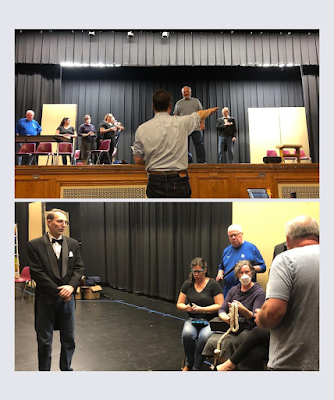
MrsDarwin as Mrs. White; Isabel as Yvette

 We are gearing up for our production of Clue on Stage this weekend. Production week is familiarly known as "Hell Week". While not actually infernal, this week has definitely been purgatorial in the sense of stripping away every extraneous part of our lives not directly geared toward getting the show on the road. Due to various emergencies, we've lost several key people at the very last minute, and so Darwin has built the tech from scratch in two days, while the majority of the set has been thrown together this week. Everything is coming together -- and it will look great! -- but wow, is it intense.

Let me tell you what -- we could not sustain this level of commitment and firefighting if we did not homeschool. The kids are getting a theatrical education, if nothing else. There is also a major life shift that happens when your youngest child is five, and you have older children who can act, tech, and babysit (that's three separate older children, if you're keeping count). Theater is our family hobby. We don't play sports; we don't travel; we don't do marching band. We renovate a money pit, and we put on shows. 

All this is complicated by most of the family recovering from a respiratory illness (not COVID) that has some long falling action. I can speak now, which I couldn't do last week, and I'm beginning to be able to warble a few notes again. The little kids were Down all last week -- they wouldn't have been at school even if they went. When we had rehearsal, I dosed them up with medicine, tucked them on the couch in front of a movie, and left the 12yo in charge while we were at the theater. Then each night we coughed long into the night. Will this schedule of theatrical activity prolong our recovery? Well, the show must go on...

But what a show! If you're in the Central Ohio area, come see us this weekend! As Wadsworth says, let the games begin.

Thursday, October 20, 2022

What I Really Want To Do Is Direct


It's been curiously silent in these pages the last few weeks.  Life has been rather packed around here.  But I do miss writing, so here's a quick rundown.

Fall has come to Ohio, so it's the time of year when I'm desperately trying to finish home improvement projects before it gets too cold outside. I've had scaffolding blocking our driveway for the last couple weeks, as I cut a hole for the bathroom vent fan in the Great Bathroom Remodel.  And since I had a way to stand twenty feet above the ground and work on the, I'm taking the opportunity to reglaze and repaint the windows on that side of the house too.

I'm also learning a new type of data analysis.  As the Church moves into the "continental phase" of the Synod on Synodality, I'm working on a text analysis project for The Pillar looking at how what words and concepts are most discussed in the synodal reports for dioceses, regions, and the US as a whole.  I'm using a program called KH Coder which does quantitative content analysis.  You might find interesting this tutorial I used to get familiar with the software, in which the authors load the full text of Anne of Green Gables into the software and analyze which characters appear together, how they are described, and which verbs are most often associated with which characters.  It's been a slower process than I would like, both due to over-commitment on my part and having to learn a whole new type of data analysis.  And although readers here have probably already heard many times about The Pillar, it's worth noting that it's extraordinary that a startup Catholic news site would invest in having someone put a month or two into this kind of analysis in order to provide a unique view of how the synodal process is going.  They really do deserve your subscription.

Work, of course, has been busy. I imagine no one will be surprised to hear that the levels of inflation that we're seeing around the world leads to lots of work for those of us in the pricing game.  I had the chance to go down to Houston and give a talk at a pricing conference for the first time since the pandemic.  It was good to talk with a bunch of other professional pricers in person again. One of the tough things about being in a specialized field like this is one tends to be a unicorn within one's own company, so if you want to talk with other pricers you need to connect with people in other companies.

And, of course, we're fast approaching performances in the production of Clue On Stage which I'm directing for our community theater. If you're in central Ohio, do get tickets and enjoy it on Oct 28, 29, and 30.  One of the things that's so enjoyable about community theater is that it brings together people from all walks of life who share a love of theater, and give everyone a project which builds a great deal of comradery.  I feel very lucky in our cast and crew, and also lucky to have been given the chance to direct a show (something that I haven't done since college, although I've acted in a half dozen of the group's shows since we moved up here.) Directing requires some artistic and conceptual work, but also a lot of organizational and person-to-person work. In that sense, it combines the kind of things I enjoy about fiction writing with the aspects of my professional life I enjoy. And it really has been a lot of fun.

Though of course, it wouldn't be the week before production week if we didn't have nearly the entire family come down with a respiratory bug (not COVID, but some sort of nastiness that's going around.)  MrsD lost her voice last weekend and is only gradually getting it back, and the kids are all going around hacking like aging smokers.  So far, I've managed to evade it, but we'll see how long my luck holds.


So it's an eventful fall in the Darwin household. Indeed, one could even be happy with a slightly quieter November and December.  But many good (and a few just plain busy) things are happening. Hopefully we'll become more regular writers soon.


Saturday, October 01, 2022

Not Enough Power, Not Enough Ring

We're six episodes into the first season of The Rings of Power, Amazon's foray into the backstory of Lord of the Rings. Each Friday night we log in with Brandon Watson and spend an hour or so gaping in astonishment at how even $500 million dollars is not enough these days to buy half-way competent storytelling. The show is visually compelling (though it often doesn't pay to think too much about the logic, or lack thereof, behind the imagery, which is the perfect example of what Brandon and I have styled Fake Awesome.

Brandon has written about Rings of Power through the lens of Aristotle's elements of drama:

I want to try at least to be nice about it. I think it is good to have Tolkienesque things, and I think the Chestertonian dictum that something genuinely worth doing is worth doing even if done badly is at least often right. The situation underlying the show is unpromising, since they only have the right to use information from the LOTR appendices that are not licensed for other things. This makes it already difficult to build anything coherent, and it is ill-advised, in and of itself, to take a literary work that is famous for its unusual degree of worldbuilding coherence and try to adapt it under circumstances in which you are unlikely to do justice to that coherence. Nonetheless, I think here and there you can see that there was potential, and given that there is so much to complain about, I do want to recognize the potential. Nonetheless, the criticisms very easily crowd very thickly.

Let's take the Aristotelian elements: Plot, Character, Thought, Diction, Melody, and Spectacle. Those are, roughly, from most important to less important, at least for serious drama and epic, and I think one obvious problem with the show is that the importance of its elements are reversed...

And Darwin recently wrote about how he would restructure the beginning of the series to focus on Tolkien's actual mythology, instead of a half-baked modern fantasy narrative

Aside from having a more clear and fast moving plot (it's rather shocking in terms of writing that we are five episodes into an eight episode season and the series plot is only now slowly coming into shape, while the individual episodes themselves do not tend to have a satisfying plot and resolution of their own) my premise here is that the changes the series would most need would be in the themes which drive the Elven and Numenorian parts of the story, and in particular those which drive Galadriel. Morfydd Clark is certainly giving the role her skill, but the writing she's being given doesn't give her much to work with, and it just doesn't seem to fit with a character who is one of the oldest and most powerful elves in Middle Earth at the time of the story.

One of the qualities of mythology is a storytelling that steps out of the everyday into the realm of epic, where every element becomes an archetype. When people retell stories from mythology, they usually humanize them by adding episode, interactions dealing with small moments in the larger plot that show characters grappling with choices, emotions, and the little human moments of life. These moments of episode bring the listener into the myth by giving them the chance to identify with the choices the characters make.

One reason why Lord of the Rings is a far more compelling subject for drama than is the Silmarillion (or the Appendices, which are what the show's creators actually have the rights to use) is that there is a dearth of episode in the ancillary materials to LOTR. What makes The Lord of the Rings a classic of world literature is smallness played against largeness -- the little human moments of humor, terror, and moral choice enacted against a backdrop of danger and grandeur almost too sweeping to comprehend. This little object, a golden ring, bears within it the power to destroy everything Frodo loves. This little hobbit, Frodo, takes on an enormous burden that only he is small enough to carry. The powerful cannot be trusted with the ring precisely because they are powerful and do powerful things. Frodo (and later, Sam) are both humble enough that they have no scope for wielding the ring to the destruction of empires, empires which consist of multitudes of unnamed people and leagues of untamed land. And the hobbits' character arcs are expressed in the small hidden choices that most of us make each day, unnoticed and unapplauded. The pity of Bilbo shall rule the fates of many, says Gandalf -- a small, mundane pity that was expressed in one or two lines in the Hobbit. Bilbo sees the misery of Gollum, understands it, and forbears to strike him when he might have done so with no consequences to himself. It is a little thing in the larger narrative, a little bit of episode that Bilbo himself doesn't dwell on. And yet it is the hook on which the whole saga hangs.

The Silmarillion and Appendices have few small moments. Most of the narrative involves larger-than-life events enacted by larger-than-life characters with larger-than-life motivations. There are few pauses for conversations or deliberations, and what moments do exist are narrated in an elevated style. And so, our show runners must create the small moments of episode which turn the story from documentary to drama. How do they do with this act of sub-creation?

Not especially well, as it turns out. The show comes up short on two fronts:

1. It is poor Tolkien.

2. It is poor writing.

In an act of self-restraint that few will understand but most will appreciate, I will forebear to elaborate on point #1. The writers deviate significantly from Tolkien's mythology, something which I could forgive if by doing so they made the plot more streamlined and the characters more intelligible. They do neither. Every episode is more confounding than the next. Nothing makes more sense as time goes on. No one's motivations become clearer.

Almost no one's. As in many works of fan service, the most compelling characters and episodes are the ones the writers have created themselves. Adar, leader and Father of the Orcs, is not in Tolkien, but not inconsistent with him either. He is, as best we can tell, a fallen Elf, captured and corrupted by Morgoth long ago, and although we don't know his full story, we believe that there is something he wants, and that he knows how to get it. He is dramatically complex and his dialogue resonates. When he is onscreen, I believe. 

He is also emblematic of the problems of this show, which is that the writers have little faith in the power of goodness. They do not know how to write it. Adar is compelling because he is twisted: his compassion and will to heal are expressed in specific cruelties and atrocities. By contrast, the characters who are supposed to represent what is good are mired in a morass of cliché and paint-by-numbers scenes. Everyone except Adar must express conflict through escalating bickering, repetitive and unenlightening. The Elves bicker. The humans bicker. The dwarves bicker. Diplomacy breaks down into bickering. Only Adar is above bickering. He knows other ways to get what he wants, and hence his small moments of episode are dramatically interesting, and their tension earned.

"Unearned" is how a friend described the plot payoffs of Rings of Power, and I think it's fair assessment. Things happen because the writers feel them necessary. Character choices feel rammed into a plot template rather than flowing organically from the motivations of the people making the choices. Gil-Galad, the Elven king, should be a character of power and majesty capable of facing Sauron himself, yet here he is a banal bureaucrat with a strange incuriosity about the major threats facing Middle Earth. Galadriel fights because... because she doesn't know who she is if she puts down her sword. Elrond and Durin, the Dwarf prince, face a breach in their friendship which seems rooted in nothing more than the writers' need for some easy conflict. Celebrimbor, grandson of Fëanor, whose pride in his craftsmanship set the Elves on the destructive course that mars so much of the history of Middle Earth, says a line or two about wanting to equal his grandfather's accomplishments, but his mushy character turns what ought to be an exercise in power and pride and skill into an exercise in construction project management. Numenor, the great island kingdom given to the humans who fought a millenia ago as partners with the Elves against Morgoth the fallen angel, can not gin up any controversy more compelling than labor disputes and guild membership, and every controversy and conversation there seems half-baked. Almost every scene in the series plays better as an outline (X pushes back here; Y demands a decision, X reacts defensively) rather than interactions that specific people would have.

The spectacular elements also feel unearned. A calvary charge, meant to be a eucatastrophe in the finest Tolkien tradition, feels more the show runners knew the fans wanted an echo of the charge of the Rohirrim rather than something that would be plausible, or even possible, in this particular scenario. A victorious battle strategy relies on a Rube Goldbergesque series of manipulations and demolitions, which leads to questions on the part of the viewer -- why would the people who initially constructed this fortress build it in this way in the first place? Nothing makes any sense except as a means to further spectacle or plot machinations. 

If this show has a redeeming aspect, it's that it's allowed for small acts of friendship for us, as we text in indignation and pedantry while watching simultaneously in Ohio and Texas. But how much better would have been to be united in appreciating a good show, Tolkien well told? That's a pleasure that we have yet to know.

Friday, September 30, 2022

If I Ran The Zoo: Rings of Power

 Although the show itself has been unsatisfying in many respects, discussing Rings of Power has been quite an enjoyable pastime for us lately. Brandon provides a very good breakdown of the show's strengths and weaknesses based on the Aristotelian elements (Plot, Character, Thought, Diction, Melody, and Spectacle) which is worth your time.

MrsDarwin and I have been re-reading the Silmarillion and the Unfinished Tales, both seeking a corrective and also discussing amongst ourselves how a prestige TV series based on the Second Age of Middle Earth, and with a plot similar to what the series has provided might have been done more successfully.


Aside from having a more clear and fast moving plot (it's rather shocking in terms of writing that we are five episodes into an eight episode season and the series plot is only now slowly coming into shape, while the individual episodes themselves do not tend to have a satisfying plot and resolution of their own) my premise here is that the changes the series would most need would be in the themes which drive the Elven and Numenorian parts of the story, and in particular those which drive Galadriel. Morfydd Clark is certainly giving the role her skill, but the writing she's being given doesn't give her much to work with, and it just doesn't seem to fit with a character who is one of the oldest and most powerful elves in Middle Earth at the time of the story.


The series begins (as did the movie of Fellowship of the Ring) with a voiceover flashback narrated by Galadriel.  This is a good way to start the series, but the one which the show runners provided is oddly muddled in theme. How might a good one go?

[dark screen]

Galadriel: We are lesser than we were. And fewer. Yet our power is still great.  It began, in the blessed realm, when the world was so young that the sun had not yet risen.

[Scene fades up to Galadriel walking through the hills of Valinor. She crests the hill, and in a sweeping shot we see the two trees, lighting the world before the sun.]

Galadriel: The great powers, whom some mortal men call gods, walked before our very eyes, and taught us of the world and its secrets. And in the clear light of the trees, we learned skill and wisdom. Elvish craftsmen built in wood and stone.

[image of a soaring building of stone, and then zooming in to look at the wooden roof, and a single craftsman who is applying minute detail of gold leaf to carved wooden scrollwork -- the building is a work of art to the tiniest detail]

Galadriel: Our shipwrights learned to harness wind and water from Ulmo, the power that formed the very oceans themselves.

[image of ships]

Galadriel: And our greatest craftsman fashioned jewels which captured the very light of the trees.

[image of Faenor holding aloft the Silmarils, while Galadriel watches with forboding. Faenor places the Silmarils in chest of iron, and High King Finwe rests his hand on it]

Galadriel: But our happiness and our skill stirred envy in Morgoth, the great enemy, who willed to take or destroy all that was beautiful in the world. He stole the very light of our realm

[image of the trees being poisoned and dimmed]

Galadriel: And he stole the greatest work of our skill

[image of Finwe slain, the chest broken open, and Morgoth's hand closing on the Silmarils]

Galadriel: Some among the elves swore revenge, and abandoned the blessed realm, letting none stand in their way.

[image of the taking of the ships and the slaying of the Teleri who attempted to keep the ships from Faenor and his sons]

Galadriel: And even those who did not approve every deed done in the heat of anger, longed to punish Morgoth. To end his dominion over Middle Earth, and guide its peoples as we ourselves had once been guided.

[image of Galadriel and Finrod watching the flames leap up from Alqualonde, but then continuing on anyway.  Now we get the map showing us the way across the seas to Middle Earth.]

Galadriel: But we had chosen a foe beyond our power.

[battle at the gates of Angband, with dragons, balrogs, etc.]

Galadriel: The elves fought many battles against Morgoth, and they did great deeds. We built great fortresses and realms hidden from the eyes of evil. But against his power we could not prevail, until at last the Valar came and overthrew the evil, and banished Morgoth from the world for ever.

[Again the great battle, transitioning to desolation. A glimpse of the great cities of the elves such as Gondolin.  Then Earendil sailing west to Valinor. A brief image of the Valar coming, Ulmo rising from the sea, the breaking of Angband, the land convulsed with fire and earthquakes.]

Galadriel: The very earth was broken. Many of the servants of Morgoth were destroyed -- but not all. Sauron, the greatest of his lieutenants, fled into the east in secret.  

[Sauron followed by orcs and evil men]

Galadriel: The Valar offered pardon to the elves who had abandoned the Blessed Realm to seek revenge on Morgoth, and urged them to return. Many did.  

[elves setting sail into the west]

Galadriel: But some chose rather to travel eastward. 

[Galadriel, Celeborn, Gil Galad, and Elrond with an elven host.]

Galadriel (speaking to the host, not the narrator voice): Angrod, Aegnor, and Felagund are slain. I am the last of Finarfin's children. No wrong has the house of Finarfin done that I should ask pardon of the Valar. And how, after all these great deeds, should we return and serve again as children under instruction in the Blessed Realm?  Here we are mightier. We can lead both elves and men in Middle Earth. And keep watch against the return of the servants of our eternal enemy.

[the elven host led by Galadriel turns away from the ships and the Valar, and travels in montage over broken lands and then high mountains into the as-yet un-fought-over East.]

Narrator Galadriel: There we built mighty kingdoms and taught the lesser peoples and preserved much of beauty in the world.

[elves building and making]

Narrator Galadriel: To those mortal men who had fought against Morgoth in the great war, the Valar offered a different reward. No mortal could set foot upon the shores of the Blessed Realm, but to these men was given an island just within sight of the glittering shores. This island the men called Numenor, and it became the greatest of mortal kingdoms. They were great builders and seafarers. And for many years they were the friends of elves.

[the buildings of Numenor, and their ships sailing across the ocean. Elves and Numenorians speaking and exchanging gifts. Galadriel is seen walking along the outcrop wall of the palace in Numenor with several Numenorians.]


Narrator Galadriel: But as the years turned into centuries, the men of Numenor asked more and more why it is given to them to age and die, while to the elves is given immortality.

[Galadriel is seen walking with a king of Numenor along a peaceful stretch of grass.  She turns, and now he is old, and then she watches his body carried into a great tomb of white stone. Another fade, and the there is now a whole line of tombs, but Galadriel has not aged, unless perhaps in her expression, as she looks at the line of tombs.]

Narrator Galadriel: And so as their power grew, their friendship with the elves waned.  It is now many years of men since I, or any elf, have set foot in Numenor.

[Galadriel sailing away from Numenor in an elven ship.]

Narrator Galadriel: There are other men, who still dwell in Middle Earth. These are descended from those who served Morgoth in the great war, or those who took no part in it. We teach these mortals and guide them. But we watch them also, looking always for the return of the shadow which once was. 

[elves teaching men skills. The king of a mortal kingdom bowing before Gil Galad.]

Narrator Galadriel: And always the elves seek to preserve that which is beautiful in the world. For as the years pass, it seems that life and beauty and all things, save elves, are ever more fleeting.

[The seasons turning. A beautiful tree growing up and spreading its branches, and dying.]

Celebrimbor approaches Galadriel carrying Elessar, the elf stone, a great green jewel set in silver.

We now transition from the intro to "now" in the series. Celebrimbor shows the elf stone to Galadriel, telling her that he has captured within it the very growing and healing power of the trees. If you look through it, you can see thing healed and made new, as they once were.

Galadriel marvels at the stone and tells him that it is his best work yet. But, she says, as precious as it is, it provides only the image of what was. 

Yes, Celebrimbor says. For now. But he believes it is possible that he can forge a stone of such power that it will be able to restore the hurts of the world in truth.

Galadriel doubts this. It is the nature of the all things in Middle Earth to pass.

Until now, says Celebrimbor. Until now.

He leaves Galadriel and returns to his workshop.  It's a beautiful workspace, and it contains much beautiful workmanship he has produced.

A shadowy figure steps moves in the next room.  "Did you tell her?"

Celebrimbor: "Yes. But she does not yet believe that it is possible."

Shadowy figure, "Then you must show her."


What do we get out of this opening? Most important, I think, is we get the theme of pride as Tolkien conceived of it, which is closely allied to the Christian idea of what the sin of pride is. While Galadriel is never tempted to become a cruel tyrant of the model of the dark lord Sauron, she is very much tempted to ignore the just commands of the Valar and the free will of other, lesser, people, in order to indulge her own desire to rule and impose what she believes is good order upon others and the world. Galadriel would rather rule in Middle Earth than serve in Valinor. And her desire for tools to power (such as the One Ring would be when it is offered to her in the final test of her will in Lord of the Rings) is motivated by that desire to rule over others for what she believes (mostly rightly) is the good.

So here we get a true sense of how the elves rebelled both to punish Morgoth but also out of a desire to rule over Middle Earth as the Valar had ruled over them -- without regard for the fact that the Valar as angelic beings are more justly ordered to rule over the elves than the elves are to rule over men.

We also see how Numenor has come to resent the elves and the Valar because as men the Numenorians are mortal. And thus we see the seeds of the conflict which will lead to the great wave. And then we see Celebrimbor as the maker of great and powerful things, who is already being tempted by someone to take his craft further in the creation of objects of power.

Now, as I said, my assumption here is that the series would have roughly the same sets of characters as it does now, but that each plotline should be doctored to have more Tolkien-esque themes and also to have interesting plot and characters.  So here's my rundown of how each set of characters would work:

High Elves & Dwarves of Moria -- In this plotline, the craft of the elves in the kingdom of Gil Galad is at its height, and elven smiths work in alliance with the dwarves of Khazad Dum.  Newly arrived among them is a secretive smith named Annatar, who says that he has come as a messenger from Aule and the other Valar with skills to share. The dwarves he teaches of mine mithril, and encourages them to delve deeper and deeper for it. With the elves, he works to make gems and rings of power. Celebrimbor is at first his avid friend, but over time he begins to distrust him, mainly because Annatar seems too eager to share and collaborate in all of Celebrimbor's work, even that which Celebrimbor would like to be his own, and perhaps secret. Durin, too, at first sees Annatar as a great friend. But Annatar is too eager to pry into dwarven secrets, and his eagerness for mithril is without concern for the ever greater risks run by the miners as they delve deeper.

Galadriel does not trust Annatar, even at the beginning, but she does not suspect who he really is. She knows that there was no one like him among Aule's followers, for she knew them and learned from Aule in the blessed lands. But she takes him for an ambitious and unscrupulous smith. She is more troubled by tidings that come to her and Celeborn, of disturbance in the lands to the east. There the elves who serve as guardians of the Southlands report that orcs have been seen, and that in secret some men have begun to revive the dark cults from the times of Morgoth.  She send out her daughter Celebrian along with her young friend Elrond to find out what they can about these disturbances.

The Southlands -- These two younger elves, who seem to have some chemistry building between them, set out for the Southlands. Here a small number of elves rules over a teeming human kingdom via a human administrative elite (distrusted by lower caste humans).  There are some uncomfortable reminders of the British and the Raj in how the "guardianship" of the Southlands operates. Arondir (from the series) is the commander of an Elven garrison. Bronwyn is one of the elite caste, chosen by the elves to rule of the mortals, and moved around as administrators so that they will not have their own local power. Her authority rests not on the loyalty of the humans but on the military presence of the elves and their mortal janissary-type soldiers. 

However, out in the villages, men have begun to carry out dark rites. At night they wear the skulls or horses or cows, sacrifice animals to the "dark lord" and call out for the power to throw off the yoke of elvish domination.  They are visited by an emissary who promises them all they could wish. He is Adar, and those who have come with him are orcs. The men swear fealty to him.

Soon a major revolt breaks out in the Southlands, with Adar and his orcs providing support. Bronwyn and Arondir try to make a defense of the city, with Bronwyn trying to convince more of the human population to fight -- struggling to become a real leader to them when up until now she was an imposed one.

She and Arondir get Elrond and Celebrian out of the city, but they're cut off from the road back north. Instead they take the river south, where at the Bay of Belfalas they meet a Numenorian ship captained by Elendil. Although it is long since the Numenorians have had much contact with the elves, Elendil is one of "the faithful" who still consider themselves elf friends. At the request of Elrond and Celebrian, he takes them to Numenor. There they find that the king Tar Palantir has recently suffered a stroke. He had sought to change the direction set by his father and grandfather, both of whom opposed the valar an the elves, and who had let the rituals honoring Eru Iluvitar to fall into disuse. Now many who opposed Tar Palantir's return to the old ways argue that his stroke at such a young age is a sign that there is no favor to be found in the old rituals.

Numenor -- Tar Palantir's daughter Miriel is serving, precariously, as steward while hoping that her father will soon recover enough to return to active rule. When Elendil brings the two elves to her, with news of the orc-supported rebellion in the Southlands, she calls a council, but does so secretly for fear of the reaction that the presence of the elves will cause.

However, Pharazon, one of the nobles who had till now been one of her father's greatest critics, eagerly leaps on the idea of leading an expedition to aid the elves and put down the rebellion. He even nominates himself to lead the expedition. But as scores of Numenorian ships prepare to set sail for Middle Earth, it becomes clear that he believes this is the perfect opportunity to expand Numenorian control in Middle Earth. No longer will they control only the havens where they trade with the leser men of Middle Earth. Now they will seize the Southlands for themselves, both enriching Numenor and taking away one of the satellite elven kingdoms. 


And the Harfoots?  Honestly, I'm not all that clear what the point of them is. I'm guessing that the Stranger is a proto-wizard who will find his mission is opposing Sauron. I guess that plot can stay, but we should get rid of the idiotic wagon nomad stuff and not have so much wasted time.

So that's how I'd re-work the series. And I'd like to think it would be a much more compelling approach than what we've seen so far.


Tuesday, September 27, 2022

Brideshead Unvisited

 In a Church Life Journal article from 2021 (brought to my attention today because it was reposted on their Facebook page), Joseph Tulloch offers this confounding example of literary analysis:

There is a passage from Brideshead Revisited, Evelyn Waugh’s otherwise superb 1945 novel, that has always bothered me. The protagonist, Charles, at this point in the narrative an agnostic, asks Lady Marchmain, the devoutly Catholic head of the wealthy, aristocratic Flyte family, about Jesus’s saying that it is easier for a camel to go through the eye of a needle than for a rich person to enter the Kingdom of God. Her response is astonishing:

“But of course,” she said, “it’s very unexpected for a camel to go through the eye of a needle, but the gospel is simply a catalogue of unexpected things. It’s not to be expected that an ox and an ass should worship at the same crib. Animals are always doing the oddest things in the lives of the saints. It’s all part of the poetry, the Alice-in-Wonderland side, of religion.”

I was puzzled, when I first encountered this reflection, by Lady Marchmain’s attempt to explain away Jesus’s teaching on poverty. Surely, I thought, it could not be Christian for the Flytes, or anyone else, to hoard wealth while their neighbors starved. I was struck, too, by the thought that, given the overall context of the novel, an ode to the vanished splendor of the English aristocracy of the 1920s, as well as his own well-known conservative views, this seemed to be Waugh’s own position—and, to judge by their behavior, that of countless other Christians.

It is clear to me, looking back, that my initial reaction to this passage was justified—Waugh’s position is both morally indefensible and thoroughly un-Catholic. The Church has, throughout the centuries, consistently held that anyone with money must go to extreme lengths to help those without.

This ancient moral teaching is especially interesting because it has come to be accepted by a growing number of modern, secular ethicists inspired by the controversial Australian philosopher Peter Singer, whose views on many other issues—most notably the permissibility of infanticide—could not be further from those of the Church.

Doubtless others will engage with Tulloch's presentation of Peter Singer's charitable imperatives, but I stuck right here in the opening paragraphs with this misreading of Brideshead Revisited. Lady Marchmain here is expressing Lady Marchmain's thoughts. By her own lights, she is cleverly engaging in an irrefutable paradox, but here at least Tulloch is right: she is trying to "explain away Jesus's teaching on poverty." 

But Waugh as author doesn't present Lady Marchmain as a moral paragon. She is, despite her personal piety, a flawed, destructive character who uses her charm and wealth to manipulate others. Socially, she is very successful at this; in the more intimate setting of family and home, she alienates her family precisely because she's terrified to give them the freedom to sin. At this point in the novel, she's turned her considerable charm on Charles Ryder, in an attempt to win his soul for the Church and enlist him to keep Sebastian, her alcoholic son and Charles's best friend, under surveillance. Her argument here is disingenuous, Waugh's subtle criticism of the grip Chestertonian paradox has on the Catholic imagination. (If he were writing today, he'd skewer the current infatuation with Flannery O'Connor's Southern-gothic grace.)

The strangeness of this analysis of Brideshead Revisited, as well as the question of how it got past the editors at the Notre-Dame sponsored Church Life Journal, reminds me of Bishop Barron's use of the chapel in Brideshead Revisited to bolster his favorite theme of Beauty as Evangelization

In his masterpiece Brideshead Revisited, Evelyn Waugh implicitly lays out a program of evangelization that has particular relevance to our time.  “Brideshead” refers, of course, to a great manor house owned by a fabulously wealthy Catholic family in the England of the 1920’s.  In the complex semiotic schema of Waugh’s novel, the mansion functions as a symbol of the Catholic Church, which St. Paul had referred to as the “bride of Christ.”  To Brideshead comes, at the invitation of his friend Sebastian, Charles Ryder, an Oxford student, devotee of the fine arts and casual agnostic.  Charles is overwhelmed by the sheer majesty of Brideshead’s architecture and the sumptuousness of its artistic program, which includes magnificent painting and sculpture, as well as a fountain of Bernini-like delicacy, and a chapel which was a riot of baroque decoration.  Living within the walls of the manse, Charles mused, was to receive an entire artistic education.  The beauty of the place would entrance Charles for the rest of his life, drawing him back again and again. 

This article, recently rerun at Word on Fire, was first published in 2013, and I wrote about it then, the gist of which was this is a bizarre reading of Waugh's novel. (Then-Father Barron may have been remembering the otherwise faithful BBC series, in which the chapel as well as the house is a "riot of baroque decoration".)  In Waugh's text, the chapel has been ruthlessly renovated as a wedding present from Lord to Lady Marchmain (a foreshadowing of their disastrous marriage) and redone in the most tacky contemporary style, Arts and Crafts, hopelessly dated by the 1920s. The house may be "an entire artistic education", but to Charles Ryder's trained eye, it is hideous. Here is his initial impression:

The whole interior had been gutted, elaborately refurnished and redecorated in the arts-and-crafts style of the last decade of the nineteenth century. Angels in printed cotton smocks, rambler-roses, flower-spangled meadows, frisking lambs, texts in Celtic script, saints in armour, covered the wallls in an intricate pattern of clear, bright colours. There was a triptych of pale oak, carved so as to give it the peculiar property of seeming to have been moulded in Plasticine. The sanctuary lamp and all the metal furniture were of bronze, hand-beaten to the patina of a pock-marked skin; the altar steps had a carpet of grass-green, strewn with white and gold daisies.

'Golly,' I said.

Throughout the novel, the chapel is a symbol of how the falsity of poor art can stand between an aesthetic soul and God.

"You're an artist, Ryder (says Brideshead), what do you think of it aesthetically?"

"I think it's beautiful," said Cordelia with tears in her eyes.

"But is it Good Art?

"Well, I don't know what you mean," I said warily. "I think it's a remarkable example of its period. Probably in eighty years it will be greatly admired."

"But surely it can't be good twenty years ago and good in eighty years and not be good now?"

"Well, it may be good now. All I mean is that I don't happen to like it much."

The aesthetic glamor of the house can't stem the moral decay of the family, and the aesthetic atrocity of the chapel still holds Truth, if unmediated by Goodness or Beauty. But Charles does learn to see God despite ugliness: at the end of the book he kneels in the chapel, a broken and bereaved convert, before "a beaten copper lamp of deplorable design".

No novel is immune from criticism, and any book of quality ought to be able to handle literary criticism. But Brideshead is The Catholic Novel, and it deserves a higher quality analysis than this, especially from those who would speak for and to the Catholic intelligensia.

Saturday, September 24, 2022

Rings of Power-Outage

We've been making a weekly ritual of watching the Amazon Prime series Rings of Power, and then spending an hour or so after each episode (both MrsDarwin and I in person, and also a friend back in Texas via Messanger) discussing what we've just seen.

This is not because what is on display is amazingly good. I suppose it's more like how I remember my parents watching the initial season of Star Trek the Next Generation and then sitting up after each episode to discuss how it could have been written better.


What the show does well is art direction. Virtually everything is visually interesting, and the camera seems to know this and spends lots of time lingering on striking images.  Some of these visually interesting things don't make a lot of sense. The Harfoots -- (proto-Hobbits) who are apparently nomads who use heavy wagons but no draft animals and are constantly weaving plants into their hair in ways which must be very impractical -- are prime offenders in the not-making-sense department. But all of it looks good, even if sometimes the visuals don't stand up to much thinking.

The biggest issue, to my mind, has been the writing. The show is structured as an eight episode season, reportedly the first of at least five seasons.  And yet, episodes do not have a self contained episode structure at all.  Each one juggles 3-5 separate storylines from sets of characters that seldom intersect, and rather than having an episode arc which resolves at the end of the episode, within a longer series arc which slowly moves forward, each episode is simply an installment of a clearly much longer story. As a result, after watching five episodes (more than half the season) we still have the feeling that the story is just getting off the ground and most of what we've seen is set up. The experience is like watching a massive, eight hour Marvel movie -- but with even more characters and a very slow moving overall plot.

Aside from this odd pacing, the writers have picked a set of plots which require them to present a lot of diplomacy and politics, and yet they also do not seem particularly good or interested in writing about those subjects. The compelling and memorable moments of Rings of Power are all small scale. This is not a Lion In Winter type story where the person politics sizzle, nor is it a Henry V where key scenes hinge on the ability of a leader to forge a personal connection with his followers and inspire them to accomplish something great. The most human moments here are small scale -- the affectional bickering of a dwarven couple, the struggle of a captured elf to escape, etc. 

I've heard it said that the controversial thing about the series is its multi-ethic casting. However, what struck me as more of an issue is the lack of any sense that the characters belong to specific peoples with histories. For instance, we see a dwarf princess who is played by a Black actress.  And yet, she has exactly the same faux Scottish accent which the series creators decided all dwarves should have.  There are not multiple peoples among the dwarves, with different accents and skin colors. It's just that this one character (one of the most engaging ones, I must say) is Black for no particular reason.

Similarly, among the group of proto-Hobbits, one of the leaders of the clan is Black and several others look vaguely ethnic, while all the others are white. They all have exactly the same accent. There are no apparent racial divisions between the Harfoots. They've just taken what might otherwise have been an all white group and thrown in a couple other ethnicities.  That might make sense in a school story or a suburban drama situated in a large and diverse country, but it seems a trifle unusual in a tiny band of hunter gatherers wandering Middle Earth. It's not that he's Black which is the issue.  They could easily have made the entire cast of Harfoots Black and that would have been completely explicable. But instead we get a racial sprinkling in a way that doubtless makes sense in Hollywood but makes little sense in an insular and primitive culture.

In Numenor too, we see little racial diversity overall, and yet the queen is clearly of some sort of mixed race or non-white background. Her father, whom we meet, is white as the proverbial sheet. As a friend pointed out: Numenor was formed out of three houses of men who had allied with the elves in the great war against Morgoth. The show-runners could have decided to have one of these houses be Black, and place more of an emphasis on Numenor being made up of three houses with different original backgrounds. That, again, would have provided a certain texture to the background. But instead what the writers spend a good deal of time talking about in Numenor is various guilds (builders, blacksmiths, etc.) which apparently have great power and stringent licensing requirements. 

Across multiple plot lines, I found myself wondering if the writers particularly believed in these cultures as stand alone cultures. 

The Harfoots are nomads, but they have a huge amount of heavy material ill suited to their wandering lifestyle, and some very odd technology choices such as using lanterns full of fireflies instead of lanterns containing a burning wick. They carry a massive book around with them in which is stored their lore, and they all wear textiles despite not having either wool bearing animals or fields of fibrous plants (nor does this seem likely to come from trade as they hide from all 'outsiders'.) So their material culture seems unlikely in many ways. And the scattershot approach to casting goes with this. Harfoots appear to be a very small population of diminutive humans. We get not particular indication that there are other bands of them, or that those bands meet and mix. And yet the differences in skin pigmentation, hair, eye color, etc. which we associate with "diverse" casting are differences which arose when human populations were separated for periods of thousands if not tens of thousands of years. 

This is not an argument against diversity in the overall cast of a series set in Middle East.  There is no reason that everyone in Middle Earth should be white. But it does seem like things should be explicable in terms of actual populations with movements and histories and cultures.  If a setting is supposed to be a cosmopolitan melting pot of different peoples from around middle earth, it would make sense for the characters there to be from a number of different backgrounds. But if a setting is supposed to be more insular, it seems like the casting should be based upon the idea that there are one or several distinct peoples who make up that setting. In this regard it would have made a lot more sense to have all the Harfoots be played by Black actors. (And for anyone who thinks such a thing doesn't make sense in the comparatively short timelines of Middle Earth: the European hunter gatherers, who populated the continent prior to the middle eastern farmers and steppe peoples migrating in, appear to have been people who had dark skin, and that's 6000 to 8000 years ago, an amount of time not shocking compared to Tolkien's ages.) Similarly, instead of casting a Persian actress to play Bronwyn while casting most of the rest of the people in the Southlands as generic medieval grunge, it would have been much more interesting to both cast all of those characters from that part of the world, and also to give them some kind of culture in terms of textiles and building styles.  As it stands, only Bronwyn even gets to wear colors, with everyone else wearing frayed rough cloth of grey or brown.

[From here the piece does mention plot points which occur within the first five episodes of Rings of Power, so feel free to skip if you do not want these revealed.]


 Although there's a lot one can criticize in the writing and pacing of the series, the gaping hole at the center is in world building and character. 

From a character point of view, the biggest single problem is with Galadriel. While in Tolkien's stories Galadriel is one of the greatest of the High Elves, here she is a lone warrior who is totally incapable of controlling her own mouth. In the first episode, we see her show her swordswoman prowess by easily killing a troll, and yet she's such a poor leader that she's blindsided when her entire group of followers mutinies and refuses to follow her any further. Then the elven kingdom of Gil Galad is so eager to get rid of her that they ship her off to Valinor, and Galadriel doesn't want to go so she jumps overboard at the last minute and spends nearly all her scenes in one episode swimming. After that she's picked up along with a shipwrecked human and taken to Numenor, where she's so bad at making friends an influencing people that she's thrown into jail where she's schooled by her human companion in very basic elements of how to tell what is important to other people and base your actions on that -- and she responds with a "oh really, I never thought of that!"  In her... what?  Five thousand years of life up to that point, she never noticed things like how to tell what's important to the person you're talking to and not kicking metaphorical sand at them?

Pretty much. But even then she can't learn and continues as the world's worst diplomat even down to the present episode.


And then we have an extremely hard-to-believe plot twist introduced in Ep5 where apparently during a fight between an elf warrior and a balrog back in the first age, the perfect balance of good and evil light was captured and infused into Mithril deep in the Misty Mountains, and now the elves are faced with a Mysterious Blight and they'll all be dead by spring unless they get lots of Mithril (which the dwarves have to mine for them) which will replace the light of Valinor for them and allow them to still have their powers because otherwise... things.


I should say, one moderately intriguing and wholly original thing in the series is an elf named Adar, who was clearly badly wounded at some point, and is now somehow in command of a large group of orcs who call him "father". The Orc Father (as I have been calling him) has had minimal screen time and only appeared much in episodes 4 and 5, but he hints at an interesting and conflicted background to an extent that few characters do. 

While the series is coy as to what is going on with the forces of darkness, it appears that in the wreckage of the previous war there are multiple dark leaders who are gradually drawing power to themselves and seeking to create realms in the area that will one day be Mordor, but that no one person is predominant while Sauron himself is not to be seen. It's one of the few seriously intriguing things about the series.


Overambitious and curiously under-executed, the series is frustrating to watch. We'll stick it out, at least through this season, but the writing is the great weakness here, and although a few elements of the long term arc seem interesting, the overall plot and world building simply don't have much of a touch.

Monday, September 12, 2022

Memories of 9/11

 The major world event this past week was the death of Queen Elizabeth II of England -- a gracious and faithful lady; we shall not see her like again. I had heard that morning that she was ailing, but her death later that day felt like a true loss. When the official announcement broke, we stopped and said a Hail Mary for the death of the Queen, on the feast of the Birth of Mary, Queen of Heaven.

One of the clips which has been going around in honor of her memory is the playing of the Star-Spangled Banner at the changing of the Cold Stream Guard in front of Buckingham Palace on Sept. 13, 2001, at the request of the Queen. The tears of the assembled crowd, holding American flags, are moving even all these years later.


September 11, 2001 was a day less steeped in horror and anguish for me than for many. On September 10,  age 22, ten weeks newly married, I learned I was five weeks pregnant. I had hoped I would be pregnant. I had been worried, almost unreasonably apprehensive, when I had not been pregnant the month before. After all the hype, after all the cautions one heard in circles which emphasized that the reproductive aspect must not be closed off, and indeed, that Life Finds A Way -- one could have sex in fertile window and not get pregnant? Not theoretically, where of course you know things are not predictable and that you can't order up a baby, but practically, as in I myself, who waited all this time and did not get married in college specifically because I did not want to be pregnant my senior year -- I did not get pregnant at the first opportunity? Was.. was something wrong? 

(Subsequent marital experience would prove this experience to be an anomaly, and these jejeune concerns to be 100% unfounded.)

But on September 10, something was not wrong. Something was gloriously, delightfully, joyfully right, and I was carrying Darwin's baby. We were going to have a child, our child, a blended bit of us in the universe. And was it wrong to hope that it would be a girl?

I called my family in Cincinnati that afternoon to tell them. But we lived in Los Angeles (or rather, the San Fernando Valley, though to a non-native like myself it was all Los Angeles), a short drive from Darwin's family. We would see the very next day, on his parents' 25th anniversary: September 11, 2001. What better present than to tell them that they would be grandparents for the first time? 

The next morning, I slogged into Barnes and Noble at 7 AM. My job was to shelve books in the stacks, an undisturbed, undemanding job that allowed me to think about whatever I wanted. And I wanted to think about Baby. I was thinking about Baby as I rapped on the locked door, and I was thinking about Baby when my co-worker opened it and said, "Terrorists flew a plane into the Twin Towers!"

"Come on, man," I groaned. "It's too early for jokes."

But it was not a joke. 

Los Angeles, always very sure of its stature, was on high alert, certain that it would be the next target. The mall where I worked shut down at 10 AM. Darwin came home early from work. We rarely watched TV, and we didn't turn it on this afternoon. We were going to have a baby, and it absorbed all our thought. 

I have often thanked God for this serendipitous timing. Had we not known we were pregnant, there is a high possibility that in the heat of the first reaction to a devastating terrorist attack on American soil, Darwin might have gone right out and enlisted, and I would have been a military wife. I have nothing but respect for our brave servicemen and the families that support them. I also have no doubt that I, whose primary, overarching love language is Quality Time, would have found this a life full of tensions that would be hard for me to reconcile. I am eternally grateful that Baby came first and spared me that particular test of my character.

That evening, Darwin's parents felt understandably conflicted about going out to a restaurant on a day of national grief. Instead, we went to their house for dinner and announced our news, and in one dining room in the United States, Sept. 11, 2001 was a day of happy memories and hope for the future.

Thursday, September 08, 2022

Trends in Papal Sainthood

 This is a busy week.  Rehearsals for the production of Clue I am directing moving into the blocking phase, so I will literally be telling everyone where to go tonight.  On Friday we're driving out to Cincinnati to finalize a Rookwood Pottery order for tile as part of the Great Bathroom Remodel.  Work is busy, since electricity rates in Europe have gone up by factors of up to 10x, and that means it's necessary to adjust prices. 

But I started out the week with a fun project for The Pillar on papal sainthood. On Sunday, September 4th, Pope Francis celebrated the beatification of Pope John Paul I.  If he is eventually canonized, John Paul I will form a string of four consecutive papal saints with John XXIII, Paul VI, and John Paul II.  The question I was asked to write on is: how historically unprecedented is that?

It turns out that the last string of four consecutive papal saints ended in 530 A.D. with St. Felix IV. But that's nothing to the string of 35 consecutive papal saints from St. Peter until Pope Liberius broke the streak (although he's considered a saint in the East.) After Liberius was another string of 13 consecutive papal saints.

You can read the full article here, and the highlight to my mind is this visual timeline I put together.  I'm fairly pleased with how it came out.


A number of people asked how much of a difference martyrdom made in the frequency of papal saints in the early Church.

Of the 31 popes who died before Constantine's Edict of Milan in 313 legalized Christianity in the Roman Empire, 27 were martyred and another 3 were once on the martyrology but were taken off in the 1960s because so little is known definitely about their lives that their martyrdoms were suspected of being legendary. Only one pre-edict pope, St. Zephyrinus whose pontificate stretched from 199 to 217, died of natural causes.

Of the 107 popes between 313 and the year 1000, 42 are saints, however only two have any claim to martyrdom. Pope St. John I died of starvation and mistreatment while imprisoned by the Ostrogoths in 526. Pope St. Martin I is also listed in the martyrology. He died in 655 while in forced exile by the Byzantine emperor over theological controversies.

However, only eight popes since 1000 have been canonized, and of those four were elected in the 20th Century: Pius X, John XXII, Paul VI, John Paul II

With John Paul I potentially joining that list, it's a fairly unusual string. 

It's probably reasonable to note that the the criteria for picking popes has changed since the papacy has become less focused on leading the papal states and wielding secular power, and more focused on the pastoral and spiritual leadership of the world's Catholics. Of the ten popes who have died since the end of the papal states in 1870, the only ones not declared at least "venerable" are Leo XIII and Pius XI.

However, as the papacy has become increasingly global in scope, there's also arguably a strong tendency to seek to have popes identified with particular factions within the Church canonized as a validation of that school of thought.

Tuesday, September 06, 2022

A Quarter-Century of Friendship

An expansion of a piece on how we got together, from 2011, and in another throwback, accidentally published by MrsDarwin under Darwin's byline.


Twenty-five years ago yesterday, I went to a freshman mixer dance on Friday night in the courtyard between Marian and Trinity dorms, wearing a borrowed bowler hat and tie. A friend from California introduced me to another freshman from California, a fellow with glasses and dark hair that flipped in a perfect curtain over his forehead. "This is Brendan," she said. "You'll get along, you're both in Honors."

Reader, we got along. I tend to like people I like at first meeting, and in the same way to be instantly wary of red flags, and take them quite seriously. Brendan was one green flag after another. He was fascinating and quick-witted and well-read, traits not manifested by my vestigial boyfriend at home, a nice enough guy with whom I shared a few unhappy family circumstances and no life of the mind. Absence, in this case, instead of making the heart grow fonder, underscored that we had nothing to talk about. I'd had no impetus to make a terminating move -- he was, as I say, a nice guy -- but we hadn't communicated much. Writing was not his strong suit, and in 1997, phone cards were too expensive for a college student to use except on weekends. He would, in all honesty, have gone unmentioned at this first meeting, when there were so many other interesting connections to explore, except that the one person on campus who knew him happened to pass by and pointedly asked after him. Left to myself, I probably would have taken rapid steps to be instantly available, but now that Brendan knew I had a boyfriend, I felt I had to make a last good-faith effort to see if there was any true relationship to salvage.

That was Friday. On Monday, I sat pondering both Brendan and homework. I had been assigned, for Acting class, to Take a Risk and write about it in a journal. This made less than no sense to me -- for one thing, the professor had been less than clear about what a Risk was, and so I had a hazy sense that I was supposed to set the cafeteria on fire or moon my roommate. While kicking around these uninspiring options, I pushed around the papers on my desk, saw the index card on which Brendan had written his phone extension and box number, and thought, "Maybe I should call him and see if he wants to go for a walk." Almost instantly my heart started racing and I broke out into a cold sweat, which I considered positive indicators that I'd found my Risk. For several moments I planned and scripted and jotted in my Acting journal and made sure that my voice wasn't too breathy, and then I seized the phone and dialed. He, of course, wasn't in. I left a message in studied tones and jotted in my journal that the stupid Risk had been pretty anticlimactic. Upon the instant the phone rang -- Brendan calling back to say that he'd meet me in five minutes. Five hours later, I returned to my room, upgraded my Risk assessment, and collapsed in bed.

My professor scribed an approving check on my journal entry and noted in the margins, "Take more risks."

The next week consisted of fitting in classes between all the time we spent together, talking and ever talking. The amount of free time in the schedule of the college freshmen four weeks into the semester is astounding, and Brendan consumed all of mine. We exulted over mutual interests, aligned our mental libraries, developed in-jokes, and began to sync up culturally and personally. Among other topics, we bonded over unlikely romantic prospects: he had been paying mild attention to an inoffensive girl who was revealing decidedly unintellectual tendencies, and I of course had the vestigial boyfriend of the same bent. How did one relate to these mundanes? One day in the cafeteria, the girl headed toward our table, and as Brendan waved her over, I thought, "He doesn't smile at me like that." And then I knew I was in trouble, and in love.

This nice young lady was no match for my wiles. One afternoon, a large group of us gathered to watch Much Ado About Nothing. In the disinterested pursuit of sparing a friend from an unsuitable connection, I answered her many questions about the plot and the language with such patient kindness that by the end of the evening I knew Brendan would never seriously consider her as a romantic prospect. Still, he wasn't actually in a relationship, and I was. The next Saturday, determinedly turning my back on the high of a week of Brendan's company, I resolved to be fair. The boyfriend and I had subsisted in person mostly on a diet of mutual sympathy and physical attraction, but we ought to be able to go beyond that. Surely we had something else in common.

"Tell me about the books you like," I said.

"I don't know," he said. "I don't really like to read."

"What about theater?" I asked in desperation.

"I guess I would try to like it for your sake."

This was a devastating answer, because Brendan had given me, a few days after we met, Brideshead Revisited, a book which had (perhaps unrealistically) colored his impression of the charm of the undergraduate education. And I loved it for its own sake, not for his, and not just because he gave it to me. I read it because he gave it to me; I loved it because it was good. But still, I did not break up at this moment. It takes a certain amount of energy to end a relationship, even one that needs ending, and at the moment I felt defeated. I would end it next weekend.

In homage to Sebastian's teddy bear, Brendan took up the affectation of going about campus in the company of a stuffed ferret named Ignatius. You must remember that we were freshmen and by definition foolish, but it is a fact that Ignatius was wildly popular with the ladies and spent the night in the rooms of several females. On the Tuesday evening a week and a half after the freshman mixer, Ignatius accompanied us as we moved from place to place, trying to find a quiet spot to talk on a campus that did not allow mixed-sex visiting in dorm rooms on weekdays. 

"Why are you here?" I asked Brendan.

"What do you mean?" he asked.

"You're smart enough to have gone to a much more challenging school. Why did you pick Steubenville?"

"Because it was the only place I knew of that seemed really Catholic," he said. "I knew that if I went to a school where I was constantly being defensive about my faith, I'd turn into a bitter and unpleasant person. And my parents and all their friends met through college connections, so it seemed like if I wanted to meet Catholic people, I needed to go where they were. Why are you here?"

"It was the only Catholic school I looked at with a theater program," I said. "And I didn't know if I could get in anywhere else."

"You're smarter than that," he said.

By this time we'd shut down both the dorm common rooms (closing time: 1 am) and the student center (2 am), and were outside my building, putting off saying good night. Ignatius the ferret was in Brendan's backpack, as usual. As I was lingering halfway through the door, almost about to leave, Brendan said (in jest, he swears), "Ignatius wants to know if he can kiss you goodnight."

I packed a lifetime of analysis into three seconds: the vestigial boyfriend, my acting professor expounding upon the Taking of Risks, complex variations and analysis of the scene before me and whether or not I could save face if I made the wrong gamble. Then, I declined Ignatius's kind offer.

"I don't care for furry lips," I said. "But you can kiss me good night, if you want to."

Twenty-five years later, he's still kissing me good night.

Sunday, September 04, 2022

O Tempora, O Mores


All summer long, people have gotten used to the sound of keys clicking on my vintage laptop, and then a insistent rhythmic tapping as someone tries to get a response from the O key. The prudent typist generally saves him or herself the pain and simply copies and pastes an O whenever it's needed, but sometimes man must prove his mastery over the machine and pound until the proper vowel is produced. 

The laptop held little charge, whether because the battery was old or because it had been dropped so many times that the charging port was dented and so you could only get contact at a certain angle that was hard to maintain with my fraying charger. Still, I could get it to work if I propped it just so. It took a little effort, but that effort was free.

One can live with a laptop without an O. One can live with a brief battery. One can even live with a laptop without sound. One day the computer was, without warning, unalterably stuck on mute. Every internet fix failed us -- there was simply no sound output available anymore. I watched videos with subtitles, like I do anyway. But two of the kids start an online math class soon, and one has community college classes that require videos, and most of that work last year was done on my laptop.

One evening last week, things with the computer had come to such a pass that it was infecting us. I grumbled that if we called tech support they'd just tell us to buy a new computer, and Darwin sighed and started patiently problem-solving at me, and -- this is how you know it was bad -- I actually showed signs of pique. And so Darwin sat for two hours on a work night on the phone with tech support, trying various things to coax the laptop into restoring the sound, though it was becoming clear that the issue probably was that the sound card itself had failed. Maybe we can upgrade the system, tech support said. If that doesn't work, it's the sound card for sure.

We don't know if it was the sound card, in the end, because the laptop never rebooted. A system upgrade on an eight-year-old laptop was a bridge too far. For 48 hours, the screen promised that there were 28 minutes remaining, two hours remaining, a status bar hovering near halfway. Eventually I restarted it, and for 24 more hours it sat unhappily loading. And then, nothing. 

Darwin has two separate work laptops, but my computer is the one that travels places with kids who need laptops, that allows students to take online classes upstairs away from their siblings, that spends quarantine with sick people who want to watch a movie or say hi to friends, that is the main hub for emails and essays and Zoom calls and game time. Sometimes I even get to use it myself. The dead laptop holds various drafts of my novels -- most of which are stored in Google Drive, and which I could certainly retrieve in email, but on my laptop I always knew where they were. 

As of the other day, I have a shiny new laptop, acquired for me by Darwin on his lunch break. It is the future, and technology marches on. I need to acquire new cords, or at least a new dongle, to allow the new computer to speak to the old printer before the school year gets into full swing. I need to find my backups and get my novels back safely on my hard drive. I need to get used to using the O key again, though that's been the easiest part of the transition. 

I also need to think of this as an educational expense, and not just one more damn thing at a time when every damn thing costs money. Could we have limped along without sound or O or battery life? Yes, because we were doing it before. But I am grateful to have a fully functional laptop again. Maybe it will inspire me to write more often. Maybe all this time it's been my O key hampering my creativity, and now we'll see a great flourishing of words. O boy!

Monday, August 29, 2022

Wineless

Van Gogh, The Drinkers, 1890

We are settling in to being only a five-child household. There is a several-week gap between the the oldest ones leaving the house and the third getting her drivers' license, which takes me back to a level of chauffeuring I haven't practiced since 2019. Biology class for two kids, community college for one, religious ed for three, park time for the youngest. It makes me tired, but not tired enough to drink.

It seems a strange and almost shameful confession, but here goes: I don't drink.

Here's an even stranger confession: I don't even like alcohol.

It seems like it's socially acceptable not to drink if you have a problem liking alcohol too much. Or if you're pregnant. Or, naturally, if you're driving. There is, however, the tedious assumption that if you are a woman, your day is structured around the moment when you can imbibe wine by the glass, by the bottle, by the floral box. There is a box of wine in my house, for adding to spaghetti sauce. I don't even sip the dregs of the cup I pour in the saucepan. The stuff makes my face turn red -- not a maidenly blush, but a blotchy Rudolf shine. 

I don't have any bad drinking memories to point to. I've never had a hangover, since I've never been drunk. I have been buzzed, and I don't care for it much. It's not exhilarating to be freed from inhibitions. I like being socially graceful, and I like my internal editor. And it's not necessarily fun to be around people who've been freed from these constraints. I also -- and this is key -- don't like the taste of alcohol. Not beefy reds, not hard seltzers. Maybe a good white wine, but I can count on one hand how many times I've had a sublime glass, and those rare vintages had a price tag to match. I don't like it enough to pay for it.

Don't tell me about your awesome margaritas or Manhattans. There is one person in the world who mixes drinks to my taste, and that's Darwin. That's because the amount of alcohol he puts in mine is negligible. I know better now than to order a gin and tonic out, because what comes to the table is a big alcohol bomb. 

It's not that I can't or won't drink. It's that it usually isn't worth it. It's a strange club to be in, alongside the other social misfits who don't like things that everyone is supposed to love, like chocolate or bacon. (For the record, I do like those things.) I've made my peace with checking NEVER on those doctors' forms that ask how often you have alcohol. It's not strictly true, but it's much much more true than "I have an occasional drink," the next option.

I rather wish I liked wine more. So many people seem to think it's terrific. Even Jesus drank more than I do. The wine column in the paper reads to me much like the car column: an anthropological glimpse into a culture I can't inhabit. But when I'm confronted with a glass, a few sips are enough to confirm what I always feel: meh. 


Wednesday, August 24, 2022

A Pastor's Legacy

 Some years ago I read a book entitled Married to the Church by Raymond Hedin. Hedin was an ex-seminarian and indeed an ex-Catholic, who after attending a class reunion at St. Francis Seminary in Milwaukee in 1985 decided to write a book about the experiences of his former classmates (class of 1969), both those who had left the priesthood and those who remained priests.

There's a lot to be taken from the book about what went wrong with the Church in the US shortly before and after the Second Vatican Council. But one of the key things that struck me was the complaints of his fellow seminarians who had gone on to become priests that people did not sufficiently respect them as professionals. As narrated by several of the priests, it was dissatisfying that people did not think of them like doctors, lawyers, or professors, despite the fact that they too had attained advanced degrees, studies secular subjects such as sociology and psychology, etc. 

I was reminded of this as I read some of the discussion about the death of former Milwaukee Archbishop Rembert Weakland. To pick an egregious example, Fr. James Martin (in a series of tweets he later deleted) posted in memory of the archbishop: 

“An erudite scholar, gifted pastor and Benedictine abbot primate, his legacy was marred by revelations that he paid money to a man with whom he had been in a relationship. I considered him a friend and mourn his loss. May he rest in peace.”

This seems to imply that one can somehow be a "gifted pastor" while at the same time having sexually abused (and then paid to silence) a young man under his pastoral care. (Not to mention Weakland's terrible handling of clerical abuse more generally: shredding records of abuse by priests why continuing to transfer them around in secret, blaming victims for the abuse they suffered, etc.)   It implicitly endorses the idea of the priest as "professional" such as the Milwaukee priests in Medin's book saw themselves to be. In this vision, one can label a bishop or priest as a "gifted pastor" because he gave speeches the author likes, wrote books, was a trained musician, and had avante garde tastes in liturgical art and architecture. It is a view in which the work of "pastor" can be separated from the actual work of being a shepherd of souls.

But this is an entirely incorrect view. A shepherd who makes a practice of randomly torturing and killing sheep is quite simply not a good shepherd, not matter what other skills he may show with the shepherds pipes or the craft production of shepherds crooks.

The work of priests and bishops is not alone in this sense. We would not say of a father, "He was a really good father. He did a lot of amazing improvements on the house. He was really supportive of his kids sports teams. He also sexually abused his kids, and that marred his legacy, but really overall a great father!"  Nor would we say of a teacher, "Such a great teacher. Always the most inspired lectures and leadership in extracurriculars. Of course, he also sexually abused some kids, but you know... overall a very gifted teacher!"

Just as we would not say that someone was a "gifted father" or "gifted teacher" while then mentioning that oh, yeah, well, he also sexually abused those who were entrusted to his care, it betrays a total lack of understanding of what the vocation of a pastor is to suggest that someone can be a "gifted pastor" and yet also a perpetrator of clerical sexual abuse.


Saturday, August 20, 2022

Northwest Passage

It had been many years since I heard Stan Rogers singing Northwest Passage, but this week I've heard it twice on road trips, on the playlist my daughter assembled from suggestions from varied passengers.


The mournful heart-swelling harmonies make even a drive through the staid farmlands of Ohio feel like a voyage into the unknown. And indeed, I have been making a voyage into the unknown -- not simply sending children off, which I have done before, but in feeling vulnerable without fighting it off.

When my oldest went to school two years ago, I tried to tamp down any show of worry or weakness. This time I haven't been as successful -- or, if you like, I've been more successful at letting down my guard. Friday morning after Mass, after one daughter drove away and before I took the the the other one, I found myself bawling in public (something I'd wager I have not done since infancy) on the shoulder of a friend who also sent a daughter off to school this week. Friday evening, as I watched the car-weary little boys tear around the playground, a nearby troop of Brownies played tag, long ponytails swinging past slender arms. And I remembered sisters with ponytails playing chase together, and had to breathe measured breaths to stave off disaster. 

If this is how I handle myself when something essentially good happens, how will I ever survive something bad?

And then today I was busy, picking up loose ends of business neglected during the college prep and wrestling moody younger siblings back into ordinary family life. Darwin is gone until Sunday, but we can't wait until then to start getting back to normal. I threw away several things I'd been waiting for the big girls to clear away. I took four children to the grocery store. I kept the little boys in line at Mass. I made dinner and watched a movie and made the beds and put children in them and was talked at, and at the end of it all I felt tired. Not choked, not yearning, but good honest go-to-bed tired. 

And tomorrow will be busy too, but with normal chaos of picking up a Mass I wasn't scheduled for, and holding auditions for our next show. Not every day can sustain Northwest Passage-levels of melancholy. Thank God for that.

Friday, August 19, 2022

The Changing of the Wheat

Vincent Van Gogh, Wheat Field with Cornflowers, 1890

"Now you'll have a majority boy household, Mom," said my oldest, surveying the shipwreck of laundry in my room left from the two big daughters sifting their belongings from the family baskets.

And it's true. For the first time in twenty years, we'll have more boys than girls. Three boys, two girls left at home -- I'm practically an empty nester. There are other firsts, too. For the first time in twenty years, I'm not changing diapers. My youngest has finally made the total shift to being a big potty-user, taking himself even, and I am hungrily eying the real estate occupied by the rickety changing table, used when I got it two decades ago. My oldest son, almost 14, ready to move out of a three-boy bedroom, has claimed the attic room his oldest sister had been occupying. Suddenly, no girls are sharing rooms. Each girl has two beds in her room, but the 16yo prefers her privacy, and now the 12yo will not be kept out of her room by her older sister's phone calls or visitors. 

Now I have no drivers in the house, as the 16yo can't get her license until September. Now my babysitting situation is changing, but I also have no babies. Now part of my heart is in Kansas, at Benedictine College, which is not a convenient three hours away like Franciscan in Steubenville. Now people who meet us will only see five kids, and not even know about the two older ones. 

Unless a grain of wheat falls to the ground and dies, it remains just a grain of wheat; but if it dies, produces much fruit. The grain of wheat dies once, but we die over and over again. Unless, of course, what is dying is the new grain, the fruit of the previous dying. What dies is not the old, but the new, and we go on dying and multiplying until we have brought forth thirty- or sixty- or hundred fold. Or seven-fold -- that's enough for me.

Wednesday, August 17, 2022

'Tis a Gift to be Simple

Vincent Van Gogh, House at Auvers, 1890

Most families have that child: the one whose deep-seated need for parental stability manifests in sarcastic commentary on anything that seems indicative of some unfathomable internal life. Parents, and mothers in particular, must be a Rock of Gibraltar, comfortably, safely unmoved and unmoving. Do you feel the need to look less haggard? You will be greeted downstairs with a scornful demand to know why you're wearing makeup. How could you have been so presumptuous as to think you could wear a new shirt from Goodwill and not have it remarked upon? Should you watch a movie, you can be sure that sharp eyes will be monitoring you for the first signs of weakness: "Mom, are you crying?"

Which is why this morning I stood barefoot out by the compost bin under the overgrown mulberry tree at the bottom of the yard, seeking a place I could breathe a few great shuddering breaths, unremarked. Almost all summer I have moved from busyness to busyness, some tedious and some very pleasant indeed. Today, for the first time, I finally had nothing to distract me from the looming reality that my two oldest girls both leave for college on Friday. The body keeps score, of course. All week I've noted, and filed away to deal with later, the increasing anxious tingle in my fingers and the dull ache in the pit of my stomach. But you cannot let yourself start if you have no exit strategy. One shuddering breath, if indulged, turns into another and another until you are gulping great sobs down by the playhouse and hoping no child is monitoring you from the kitchen window. 

It is perhaps selfish to wish that I had a completely private place to scream every so often. But there are worse evils than to be caught out in a moment of weakness. I am almost sick with gratitude that the trials of my life are so simple. I face no evil, no betrayal, no terror. I endure nothing gives pain to anyone but me. I have nothing worse to face than to die to self, and I have to do that anyway. It is a gift to suffer love.