Because most philosophies that frown on reproduction don't survive.

Monday, February 26, 2024

The Strange Demographics of the Russia-Ukraine War

 In my wallet, I still carry with me the selective service card I received when I turned 18. Since that was in 1997, and the Selective Service Act only allowed for the calling up of men aged 18-25, it's a pretty empty gesture at this point, but I keep it with me as a reminder.

As the Russia-Ukraine war enters its third year, there are headlines about how the average age of front line Ukrainian troops is 43. To our American eyes, that suggests a country which has already run out of draftable men aged 18-40, a country in the final stages of defeat, such as Germany in 1945 or the Confederacy in 1865.

Ukraine is indeed facing a manpower shortage, and will need to make some tough decisions if it is going to continue the war. However, the tough decisions are not necessarily the ones we might imagine from our American context, and they're the result of Ukraine's very post-Soviet demographics.

As of now, Ukrainian law only allows for men aged 27 and above to be mobilized for combat duty. A controversial new mobilization law which is being debated would lower that mobilization age to 25. Men aged 18-25, the entire draft age range in the US, have as of yet not been drafted for service at all.

This may seem odd.  Recruiting or conscripting 18-year-olds for military service has been such a staple of US military history that those who walk about the need to avoid some conflict habitually talk in terms of "sending our 18-year-olds off to die". This isn't a matter of picking on the young. Combat is incredibly physically demanding, and young men peak in their ability to simultaneously handle extreme physical activity and ignore their own mortality at the age of 18-20.  I do what I can to stay in shape, but that only makes me that much more aware that at 45 I move lower and get injured more easily than I did 25 years ago.

So why is Ukraine exclusively mobilizing non-prime age men for their army?

The reason is that like the rest of the Soviet world, Ukraine experienced a massive decline in fertility from the mid 1980s on, hitting its lowest point around 2000. 


Strange though it is to think about, 2000 is now 24 years ago, so that period when Ukraine's fertility rate had dropped to just one child per woman was the period when today's 24 year olds were not being born in Ukraine.  Thus, if you look at the number of people of different ages in the Ukrainian population prior to the war, you see the smallest populations in the prime military service age range.


So why is the war being fought by Ukrainian men in their 30s and 40s?  Because there are almost twice as many of them as there are men in their early 20s.  As of 2021, Ukraine had 1.1 million men aged 20-24 and 1.9 million men aged 35-39.

Add to that the fact that if the country is going to rebuild and have another generation of children after the war, that small generation of young men in their late teens and early 20s need to survive to have families and hold jobs. They are quite literally the future of the country.

Of course, young people are always the future of a country.  But in more normal demographic situations, young people are more plentiful. In 1966, when the US drafted 382,010 men aged 18-25 into the army for the Vietnam War, the demographic pyramid was almost exactly an inverse of what Ukraine has now.


Those 1966 draftees represented less than 5% of men of conscription age. If Ukraine were to tap their 20-24 year olds for the 500,000 men their army says they need to mobilize, they would need to mobilize half the Ukrainian men in that age range.

Russia, of course, faces a similar overall demographic problem.  The difference is simply that Russia's population is three times larger.  In grinding trench warfare which has come to resemble WW1 with drones, even with Russian casualties often higher than Ukrainians ones, they simply have more men to send into the meatgrinder.


This is, of course, why Ukraine is so eager to get more and better military aid for the US and the rest of NATO. The American way of war for the last hundred years has been to substitute firepower and technology for bodies. This still doesn't always work. In Vietnam, the US military was successful in inflicting far higher casualties on the North Vietnamese than the US suffered; the problem was that the North Vietnamese were willing to go on suffering those casualties and the US was not.

If Ukraine is going to manage to continue to defend itself with anything like success, without completely giving up their future generations, they will need to employ Western style military technology and tactics to achieve a similarly lopsided casualty ratio.

Saturday, February 17, 2024

The Music Man

 Last Friday night, my ten-year-old laid his head on the table at dinner and said, "I don't feel well..."

...and a week later, we are dragging ourselves by our elbows out of a feverish slough of mucus and sinus pressure. I've stopped sneezing this morning, but my head feels like a solid block pressing on my eyeballs. Darwin worked from home two days this week, and every moment he wasn't on a call, he crept back into bed. Various children drip around the house. Fortunately, the older teens have been so far immune, but we are in general a house shrouded in tissues.

All this is to explain what's more the norm here than otherwise -- the radio silence. But we have not been idle, oh no. I myself am pleasantly enmeshed in preparations for the The Music Man, which I am directing this spring/summer. 

The Music Man, to my mind, is the Great American Musical. It has catchy, hummable, lyrical tunes, iconic characters (is there a more American antihero than Prof. Harold Hill?), a few big dance numbers, a barbershop quartet, and more period Iowa vernacular than you can shake a stick at. ("...or you'll hear from me 'til who laid the rails!") The authentic turn-of-the-century touches are courtesy of author/composer/librettist Meredith Willson -- note the two l's -- b. 1902, whose keen and fond memories of his small-town Iowan upbringing inform every line of dialogue. 

Meredith Willson is now known mostly for "Meredith Willson's The Music Man" (as we are contractually obliged to credit it in publicity material), but mid-century he was more of a household name, known for his popular radio programs. Willson was a talented musician himself, training at a New York musical conservatory later known as Julliard, and becoming flautist in orchestras led by John Phillips Sousa and Arturo Toscanini. (He said he was known as "Down-Beat Willson" for his habit of slipping into the pit just before the conductor raised his baton.) His classical training, and in particular his ability to write counterpoint, elevates the score of The Music Man above nostalgic Americana kitsch.

The Music Man was eight years and forty revisions in the making. As part of the process of trying to get backing for the show, Willson and his wife, Russian soprano Ralinda (Rini) Zarova, would present an abridged version of the show, with Willson on the piano. Over several years of presentations, Willson honed this pitch, and after the Music Man opened on Broadway, he and Rini recorded an album called ...And Then I Wrote The Music Man, an oral history of the show, with songs. 

What's delightful in listening to a sample of this album is hearing Willson's own interpretation of his songs, and realizing that Robert Preston's iconic performance is modeled on the original. And as Rini sings Marian, you realize that Willson wrote the role for his wife's voice, which warms the cockles of even my cold heart. 

Take and listen, friends! And come see The Music Man, June 21-23.


Tuesday, February 06, 2024

Reading the Herculaneum Scrolls


This is a really fascinating story, and a good example of the way that AI and be used as a tool for the traditional humanities:
Machine learning tools are being used to turn CAT scans of scrolls entombed in volcanic mudflows in Herculaneum in 79AD into readable images which papyrus experts are then turning into text and philologists are translating.
This first victory consisted of successfully producing readable images of just a dozen columns of text -- a little over 2000 characters -- from one scroll. But it's amazing progress from where things stood a year ago, and the prize for this year will be for producing code that can turn the CAT scan raw data into readable versions of 90% of the first four full scrolls.
If they're able to read all of the 800 intact scrolls they have now, it would be a significant increase in the total available text from the ancient world. And some archeologists believe they haven't yet found the main library of scrolls in the villa from which these come.

My Greek would need a lot of practice before I'd be able to read this previously unavailable text -- a discourse on pleasure by an Epicurean philosopher, Philodemus. Indeed, all the fragments previously read from the scrolls found in this room of the villa are works by Philodemus, leading some researchers to believe that he may have been in residence at the Villa and this may have been his working library (while the larger library in the villa which they believe is still yet to be found might contain a wider range of works.)

But what's fascinatingly modern about this whole thing is that the really cutting edge work doesn't require Greek, it requires Python programming. Teams of interested programmers wrote code to detect the imprint of ink on papyrus from the CAT scan images, and to virtually assemble and unwrap the CAT scan images (which are narrow x-ray image slices through the whole scroll) into images of the sheets of papyrus itself. The mixture of very ancient and very modern here is fascinating. And since the entire project is based on open source principles, if you are a cutting edge Python programmer with an interest in the Ancient world, you can to go the site and click through to GitHub where all the code for the various teams is posted, allowing teams to study each others work as they work on the next round of imaging.

Sunday, January 28, 2024

Immediate Book Meme

It's book check time, my friends. 

photo by Evan Laurence Bench

There are plenty of memes that want to know all about your book history and your all-time greats and your grand ambitions, but let's focus on something more revealing: the books you're actually reading now, or just read, or are about to read. Let's call it The Immediate Book Meme.


***

1. What book are you reading now?
My nightstand is stacked with books I'm working through:

This book demands careful attention, and even so I often need Scruton's practical examples before I understand his abstract claims, but both aesthetics and architecture are subjects I find engaging.

This is my second read of this lovely book about the villas, the private homes, designed by Palladio.

I preordered Bishop Varden's book because I will now read anything he writes. He is clear, erudite, scholarly, and joyfully orthodox.

which has lead me to read:

The Moment of Christian Witness, by Hans Urs Von Balthasar
My purse book, which I read page by page in waiting rooms.

The Indigo Girl, by Natasha Boyd
My first fiction this year. I'd just read a chapter in our history book about Eliza Lucas Pinckney, and behold, the algorithms uncannily showed me ads for this novel, which is several years old. I'm a few chapters in and putting up with it. It's (over)written in the present tense, and betrays modern sensibilities, and dollars to beignets there's going to be a sex scene in it. This is why I don't read much recent fiction.

1a. What is your current readaloud?

Peter Pan, by J. M. Barrie


This boffo book by XKCD cartoonist Monroe is my nighttime reading with my ten-year-old, who is learning more science this way than he did in school (and so am I).

2. What book did you just finish?
I'm directing The Music Man this summer, so much of my reading has to do with the show.

The Music Man, a novelization by Meredith Willson
I thought I was buying the script, but it turns out Willson also novelized The Music Man. It's fun to read his prose, but the book won't replace the show.

Willson is a delightful writer, with his Iowa turns of phrase, and I liked hearing the story of the creation of The Music Man in his own voice.

Informative, but not as much fun to read as Willson himself.

3. What do you plan to read next?
All Christmas presents.

Jane Austen's Letters, edited by Deirdre Le Faye
Jane Austen's actual letters!, in an elegant volume, a treasured present from Darwin.

Jane Austen: A Life, by Claire Tomalin

A Chain of Hands, by Carol Ryrie Brink
An autobiography by the author of Caddie Woodlawn.


4. What book do you keep meaning to finish?

Onward and Upward in the Garden, by Katharine S. White
A collection of reviews of gardening catalogs by E. B. White's wife. Delightful even to a non-gardener like myself.

5. What book do you keep meaning to start?
I've been meaning to read Works of Mercy by Sally Thomas ever since it was published. 

6. What is your current reading trend?

The Music Man, and architecture, and Hans Urs Von Balthasar

Tuesday, January 09, 2024

To Sleep, Perchance to Dream

It has been a time of dreams for me lately -- long, involving, pleasant dreams, full of plot and incident and characters both real and imagined. If I drift to the edge of consciousness, I can fall back into the same plot, such as it is. And yet, I can't tell you about them. As soon as I try to make concrete in words the visions of my subconscious, the images slip away, like that small bit of eggshell in the bowl you keep trying to nab. (You can pin the eggshell if you dip your finger in water first, but that doesn't seem to help with describing dreams.)

I might try to tell you about last night's dream, which (I think) involved me awarding a gift basket to a seminarian, while we were all (but who was "all" of us?) in the finished basement, or the paneled subterranean corridors, of a vast elegant hotel. But that was only the most minor and final part of the dream. What happened in the rest of it? I can't tell you. Words are first nonsense, and then simply inaccessible.

The other morning I set myself to finding words for the dream I'd just come out of, still so vivid, but all I could articulate was "Russia" and... no, now I can't even find any language for the swirl of images still drifting around my head. All I know is that Russia is not the right descriptor, and that my dream didn't involve Russia. It's simply the only word I could grab. 

Great theologians have insisted that we can not describe what God is, only what he is not. My dreams seem that way, ineffable. I can only hold onto them for as long as I resist trying to describe them. When I try to describe them, I only have the wrong words. But it is comforting to know that there is this pleasant... what? Realm? Domain? (Reality doesn't seem the right word)... that is accessible to me, even if it's indescribable and unshareable through any normal medium of communication. 

Monday, January 08, 2024

One Week

We're about a week into 2024, and I don't have anything more intelligent to offer you than this inessential bit of textual analysis I've been low-key working on since before Christmas: is the one week in the Barenaked Ladies song One week actually one week (and two days 'til they say they're sorry)?

There are three verses in this hit from 1998, which I listened to on the radio (the radio!) when it was still in top-40 territory. Each one covers nine days of a relationship quarrel, from initial conflagration to the still-deferred apology. I'd always thought of the verses as being a sequence of sorts, with Day 1 of verse two being Day 3 of verse one, and so forth, but now I'm inclined to read the lyrics as being three different Rashomon-style perspectives on the same fight, albeit from one source, the increasingly penitent (if still irreverent) Steven Page. 

Since this is an analysis of no interest to anyone except 90s kids, I'm not going to quote the whole song here; you can refresh on the lyrics at Genius (along with a lot of rather obvious annotations). Here, completed in a burst of procrastination before some kind of obligatory Christmas event, is a breakdown of the fight. I wrote it out trying to figure out how the sequence of the verses fit together, but, as I say, I now think it's all the same week. Anyone needing to procrastinate may feel free to offer further insight.

***

Day 1: She looks at him, cocks her head to the side and says, "I'm angry."

Day 3: She laughs at him and says, "Get back together, come back and see me."

Day 5: The living room, where he realizes it's all his fault, but couldn't tell her.

Day 6: She forgave him, but didn't say so.

Day 9: He will say he's sorry.


Day 1: She throws her arms in the air and says, "You're crazy."

Day 3: She tackles him and give him rug burn on both his knees.

Day 5: She realizes, in the afternoon, that it's not his fault.

Day 6: She forgave him, but didn't say so.

Day 7: He's sitting back and waiting until she says she's sorry.


Day 1: She looks at him, drops her arms to the side, and says she's sorry.

Day 3: He laughs at her and says she just did just what he thought she was going to do.

Day 5: In the living room, they both realize that they are both to blame, but what can they do?

Day 6: She smiles at him.

Day 9: They both say they're sorry.

***

AND now that I've put all this work into writing this out, I discover that someone has already put this into calendar form.

source: https://ilovecharts.tumblr.com/post/18448564253/bare-naked-lades-one-week-joel

Sunday, December 31, 2023

A Year End Post

It's December 31st, and the sidebar tells me that it is our least prolific writing year in the 18 years of the blog's existence.  Though as I say that, the idea of a blog being 18 years old is also rather shocking.  51 posts this year to date is pretty pitiful after years (many years ago at this point) when we averaged more than one post per day. Though, to be honest, I'm surprised that this post will even bring us up to that average. It seems like less.

So what has happened this year?

MrsDarwin and I each directed one play for our local community theater.

In the spring, MrsDarwin directed Shakespeare's "A Midsummer Night's Dream"


She is a far better acting director that I am, and thus well suited to helping actors deliver Shakespeare's language with understanding and conviction.  And it was a wonderful cast.  Indeed, our Titania and Lysander are now engaged and getting married in a month or two.  (No particular credit to us -- they came to us as a couple, but they were great to work with.)

In the summer musical, MrsDarwin had her star turn onstage as Golde in "Fiddler on the Roof". I dealt with tech -- and when asked, told MrsD that what she needed to make her performance come alive was to remember that the subtext of every line directed at Tevye was, "You idiot". MrsD is someone who is very cautious with her subtext in real life, so this kind of let-it-all-hang-out combativeness did not come naturally, but in the end, I think she nailed it.

In the fall, I directed Agatha Christie's Murder on the Orient Express.  If I have a strength, it's on the management and technical sides of directing, and this was a very technical show with a lot of set and sound and lighting.  I think that in the end, it came out very well.


I read 23 books (if I manage to finish one of the incomplete ones in the next few hours, I'll hit my Goodreads goal of 24), and if there was a theme to this years reading, it was non-fiction books dealing with prehistory.  The one I would most recommend to a general audience is Catching Fire: How Cooking Made Us Human

Writing this year...  Well, it was a bit sparse, not just on the blog, but also on the fiction projects we care a lot about. MrsD made some forward motion both on drafting Mrs Dashwood and also on revising Stillwater for publication. 2025 is Jane Austen's 250th birthday, and MrsD is planning to have a banner year for Austen-inspired publications.  My own output has been disappointing (at least in quantity) -- on the blog, on The Pillar, and on The Great War. I feel age pressing upon me, and as I turn 45 this coming year recognize that I had better get this trilogy done while I can still write in the same voice in which I began.

And then there is The Bathroom Project.

It's 18 months now since I started a total gut and rebuild of a bathroom, thinking I could get it done within 3-6 months.  But someone directing two show and tech directing four and being promoted to a vice president at work all (not to mention seven children and a spouse I like to spend time with) adds up to a lot of commitment.

Still, progress is happening.  I got the joists leveled and the subfloor down, and over this Christmas break I have put in the insulation and moved the cast iron tub in order to re-level and re-position it.


It turns out that back in 1929, the way that they put a cast iron tup in place was to pour a bunch of cement on the subfloor and set the tub on it.  Which I'm sure is great, but if re-doing your walls and tile means you need to move your tub over an inch, it's impossible to do. They built to last in those days, but they didn't. build to be easy to renovate.

So now I'm googling up ways to place one's cast iron tub and we're going to level up the joists by two inches (it was always a big step down into the tub) and re-level the beast as we put it back.


So, from this aging blog to any of you still reading: a happy new years, and may you be successful in planning out your vita nuova in the weeks and months to come.

Wednesday, December 27, 2023

Tired of Lies

For those in the Catholic media world, peace on earth was slow in coming this advent, as a mini firestorm blew up on December 18th with the release of Fiducia Supplicans, a declaration from the Dicastery for the Doctrine of the Faith on the pastoral meaning of blessings.

You might think that blessings would be a pretty non-controversial topic, perhaps even a boring one. Blessings are everywhere in Catholic life. It's quite normal for a parish priest, at the request of his parishioners, to bless rosaries and other sacramentals, cars, houses, etc. 

Nor are blessings something reserved only for some spiritual or moral elite. Indeed, it is common for priests to suggest that at communion, those who may not be in union with the Church, or who may be in an unabsolved state of serious sin, cross their arms to show that they would like to receive a blessing from the priest rather than the Eucharist.  In this very common move, it is precisely those who are in some state of sin or disunion with the Church who routinely receive blessings. So in no way are blessings reserved for the few or the perfect.

But this document comes in the midst of an already simmering rift in the Church over whether the Church's teachings on cohabitation, on divorce and remarriage, and on whether marriage can be contracted between two people of the same sex can be changed. The Synodal Way initiative pursued by the German Catholic bishops has openly called for a wholesale revision of Catholic teaching on sexual morality and German bishops have given permission for the blessing of same sex marriages by their priests.  The Belgian bishops have published liturgical text for blessing same sex marriages. And although the Vatican has said that this is not possible, it has also declined to in any way stop the Belgian and German bishops, even while showing in other areas that it is quite willing to interfere in very local liturgical matters and remove bishops for seemingly minor issues (as in the case of the Bishop of Arecibo in Porto Rico.)

It's important to note that the document itself states the Catholic teaching on marriage repeatedly. This is not to say that there not nits which one might pick with it theologically. It continues the recent trend of referring to "irregular" relationships, as if a sexual relationship with the Church considers to be clearly sinful were merely an issue due to some fussy technicality. And its suggestion that a couple can be blessed as a couple (not as two Christians seeking God's grace) while at the same time holding that the union is itself sinful seems hard to maintain to human and practical terms. If this same argument were made for blessing other questionable social groupings (say a street racing club -- those can, I am told, lead to relationships that "are family") one imagines that Cardinal Fernandez would be more hesitant.

But issues asides, the document is clearly one which was written with conscious attention to being compatible with established Catholic teaching.

So why has it been greeted with such sharp reactions?  Why have the bishops of Germany and Belgium (who are explicitly violating its rules) declared the document to be a good start, while the bishops of the many conferences throughout Africa have reacted so negatively that under Cardinal Fridolin Ambongo the Symposium of Episcopal Conferences of Africa and Madagascar is working to put together a unified continental response to confusion arising from the document?

Fr. James Martin, SJ, celebrated the release of Fiducia Supplicans by calling a NY Times reporter and photographer to document his first official 'informal and non-liturgical' blessing of a gay couple.

I think it's impossible to look at these developments outside the context of the last thirty years of history among the broader world of Christian communities across the world. 

The issue of same sex marriage has split multiple Protestant denominations over the last few decades. Even as the news of the new Vatican document dominated headlines, the United Methodist Church was completing a massive split over LGBT issues. For Episcopalians in the US, the split came a while ago, with congregations which held to traditional Christian teaching on morality re-aligning themselves to belong to a hierarchy centered on (non-coincidentally) Anglican bishops in Africa. Africa is not merely a thriving region for Catholics, but for a number of Protestant denominations as well, including Anglicans, Lutherans and Methodists -- all of whom in the US are dominated by progressive theology (though as with all things Protestant, it's complicated and fractured.)

Growing up, a lot of my friends were Episcopalian, and fairly involved in their churches, so I heard a lot about the developing split in the Episcopal Church over same sex marriage. One of the things that struck me then was the amount of double-talk and outright lying about objectives which went on from the progressive side.

Again and again, I saw people who clearly supported same sex marriage argue, "Why should it be a problem if Gene Robinson is a bishop and openly lives with a same sex partner?  We know that lots of bishops are sinners.  All of us are in need of forgiveness.  Was it ever a tenet of the faith that bishops are without sin?"

Advocates insisted they weren't trying to change doctrine, they just wanted to have blessings, or have commitment ceremonies, or have house blessings. All sorts of halfway steps were endorsed and people insisted they were obviously the end point and it was conspiracy minded to see this as one big push for same sex marriage.  Until, of course, enough people had become accustomed to the idea and then suddenly it was a push for same sex marriage and congregations which wouldn't go along with the changes were getting evicted from their churches by bishops.

Now, as a Catholic, I think there's an obvious difference here.  Yes, we have some parts of the Catholic Church which are deathly sick and may wither away. Germany and some other European countries may well see an institutional collapse of the Church in the coming decades.  But I believe that the Holy Spirit is guiding the Catholic Church as a whole and will preserve it from teaching error.

That said, as we can see from Church history, a great deal of confusion, conflict, and loss of faith very much can go on even as though in the long run the gates of hell will not prevail against the Church. Whether we live through times of re-awakening and evangelization, or times of confusion and apostacy, can very much depend on our own actions and those of the Church's leaders.

When it comes to confusion, there is at least an honesty to the German Synodal Way, which is stating outright that it wants a complete change in Catholic teaching on sexual morality. They may be wrong, but it's clear where they stand.

Far more frustrating are the people who seem like they would be ecstatic if the Church were to change its teaching on same sex marriage, and yet who keep insisting that they are not advocating for any such thing but rather just want to provide people with blessings.

Indeed, one whole line or argument which I have seen is that the way that the Church could gradually change doctrine is by first changing practice -- making it seem completely normal for same sex couples to get blessings from priests while opposite sex couples get marriage ceremonies -- and then when the blessing of unions seems like a standard part of Catholic life, start pushing the question of "how is it fair that some couples get weddings and others only get blessings?"

And knowing that some of those out there insisting "We only want blessings!  We don't want any change in doctrine!" are lying and very much do want to change doctrine makes those who are eager to protect doctrine wary of everyone advocating for blessings, even though (as the new DDF document shows) there is a way of thinking about blessings for people in relationships that the Church sees as sinful which is no change in doctrine and indeed no change in practice from the current one.

For those who've been seeing this issue play out in the wider Christian community for decades, the loud insistence that "We're very, very excited about this important new document, but you guys need to shut up because it absolutely is not a change in doctrine in the direction that we've been advocating for" sounds (to use an overused term) like gaslighting.  People know very well that there are those out there who want to change doctrine and see a liberal application of blessings such as that celebrated for the NY Times by Fr. James Martin, SJ (himself a darling of the Vatican at the moment -- though that may change if his public victory lap is seen has instrumental in causing the explosion among the bishops in Africa) as a means for gradually enacting that change.

I think there are a number of other leaders in the hierarchy who really do think that informal blessings are a way to somehow paper over the growing split on moral doctrine without having to hash out the underlying issues. To these institutionally minded clerics, encouraging blessings (which really are nothing new) provides a way seem more accepting without actually changing doctrine, which they recognize would be incompatible with the Church's self understanding. The problem is that this attempt to have it both ways -- to satisfy those who actually want same sex marriage and also those who want doctrinal fidelity -- risks making the split seem even bigger than it is. Those who are focused on doctrinal fidelity see the offer of blessings to be a sign of loyalty to the pro same sex marriage faction.

It is actively good to be pastoral and tell people, no matter their actions and attachments, that God loves them and wants to shower down grace upon them. It will be a bad outcome for the Church if good priests and bishops become convinced they must be stingy with blessings in order to seem not to be endorsing doctrinal change.

What Church leaders should do is BOTH crack down hard on those within the Church who are flouting Church teaching on same sex marriage, and ALSO encourage the use of blessings for all people who are eager for God's mercy, grace, and forgiveness.  And those who disagree with the Church's perennial and unchanging teaching on marriage and sexuality should at least have the decency to stop lying and admit that they disagree.  The lies are poisoning the whole Church.

Saturday, December 23, 2023

Accommodation vs Evangelization and Their Origins

 I have a piece up in the The Pillar this week, advancing a framework for understanding why we see such different responses to the challenges of talking about the Church's teachings on marriage and sexual morality in the modern world.

How is it that among the world's Catholic bishops' conferences we have countries as seemingly different as Germany, Belgium and the countries of Latin America on the "accommodation" side of dealing with these problems, while on the other we have countries like the US and the African nations?

Pope Francis and Cardinal Fernandez hale from Argentina, where 92% of the population is Catholic, although few people attend mass or even marry in the Church, while Fiducia supplicans has come under strident criticism from the bishops of Africa, where in most countries Catholicism is a minority religion besides Protestantism and Islam

If it were simply a matter of affluence and modern economies, one might expect the US and Europe to seem more similar, while Africa and Latin America were on the same side.

I argue that there are different experiences and fears among church leaders in countries where the Catholic Church is the predominant religious force. Clerics who face a region in which the vast majority of residents are baptized Catholics are tempted by a sense of loss aversion: if only they can avoid giving people a reason to formally separate themselves from the Church, then when some point in their lives draws them towards God, it will be the Church and the Church's sacraments which people reach out to.

In regions with more religious competition, leaders in the Church have pushed to realize that waiting passively for the moment of grace may not be enough: if they do not seek to actively evangelize their flock, the sheep may be quickly drawn into another religious community.

You can real the full piece which lays out the argument and supporting details here.

With this post, I'd like to go a bit further and discuss some ideas which did not make it into the Pillar piece.

Obviously, it is the fact that at many times through Church history Church leaders have seen the necessity of evangelizing even though the vast majority of the people under their care are already baptized Catholics.  Accommodation and the minimization of the conflicts between Catholic teaching and the prevailing culture of the time is not the inevitable approach. The Church's history is full of great saints who recognized and sought to remedy the everyday practical unbelief which is a temptation for all of us.

So why, with the mainstream culture seemingly so opposed to Christianity at so many levels -- not just sexuality, but in regards to the meaning and purpose of human life, of possessions, of civil society -- has more of a movement not sprung up yet to bring the Church's message to a desperate world, even in the regions which are, on paper, already Catholic?

I think one could argue that among the "Vatican II generation" there is an idea that is a hangover from the post WW2 moment (when modernity seemed to have immolated itself in war and destruction, and Catholic theologian Jacques Maritain was a key inspiration for the UN Charter on Human Rights.) Catholic leaders thought that the Church was poised to provide answers to a ruined modernity's questions and lead the world into a new age of peace and thriving.

Whatever influence that Catholic vision may have had evaporated in the conflict with the sexual revolution. Even as the conciliar generation "threw open the windows the Church" thinking that the world would eagerly embrace the ideas of churchmen on ending war, pursuing European style Christian Democracy, and creating an economy focused on human ends, the world instead embraced a consumerism which extended to sex, relationship, and human life itself.

And yet many (especially in Europe and that conciliar generation) still see the post-Vatican II Church as clearly providing answers to the secular world's questions if only they could clear the air of questions about sexual issues.

We see this in a conviction that the Vatican can be a key player in negotiating an end to war in general (in individual conflicts such as Ukraine and the Holy Land in particular), and in providing the inspiration for a new culture which will tame carbon emissions.

But in the minds of the vast majority of people, that post-war moment is long past. When you talk with secular intellectuals about "human rights" they instantly think of gay marriage and trans rights, not the vision of Christian Democracy which the postwar generation of Catholic leaders sought to implement in Europe and abroad.  

And the sorts of questions that people are actually asking are in fact the ones which too many church leaders seem to see as a distraction: how am I to form relationships and raise a family?  What is a family? What is the relationship between me and my body?  If I could upload my mind into a computer, would that be "me"? Do we have the right to create life whenever and however we choose (from IVF to genetically modified "custom babies") and to end life when we see fit? What do my desires mean in a world where countless internet sights are flogging apparently instant satisfaction?  

And while the Church has answers to those questions, they're answers in clear and direct conflict with the post sexual revolution mores of secular society to which many are as deeply attached as pagan societies were to their idols. At some point, the leaders of the Church are going to have to choose between the credibility they imagine they could have with the leaders of the worldly elite and professing the Church's answers on the key questions of the day. They question is: will they choose to do so, in some parts of the world, while they still have a majority of people being baptized into the Church, or will the wakeup call wait until the collapse is complete.

Thursday, December 14, 2023

The Penderwicks at Last

Why have I not written? Let me count the ways. No, let me sum up. I have not written because I have not written. Life continues happily apace here in Darwinland. Each day brings some fresh incident, but as they're mostly funny little quotidian things, they're not of much interest to anyone but us. Last Thursday, a week ago now, Child #5 finally had her tonsils out (and her adenoids, and she also had a nasal turbinate reduction, which is to say the surgeon essentially roto-rootered her upper nasal passage), bringing, we hope, an end to the storyline that was strep throat. She is recovering well, you'll be happy to know, even though 13 is geriatric in terms of tonsil surgery.

Life is like that, you know? You blink, and all the little day to day dramas and laughs have built up to time passing. Distilling that time into a narrative, and not just a collection of anecdotes and characters, can be tricky, especially if there's not some overarching drama to resolve. 

Which brings me to The Penderwicks at Last, which I read, and then skimmed, in one bout of increasingly disappointed consumption, rather as one eats the whole box of cereal looking for a plastic prize.

***

The first Penderwicks book was a delight, mostly -- a story of four sisters and their absent-minded professor of a father (given to Latin quotes, you know, as erudite professor fathers are), vacationing in the caretaker cottage of a grand estate called Arundel. They become friends with the boy who lives at the estate, despite his overbearing mother. Everything is a bit too charming, but the characters and situations are fun, in general, and the adventures innocent -- a bunch of modern children strangely unaffected by the world of screens.

If a book is a success, it is certain to have a sequel. The Penderwicks spawned three sequels of decreasing quality, until the fourth book, The Penderwicks in Spring, badly bungled the sisters responding to traumatic memories of their mother's death. Appalling behavior that called out for clinical intervention was brushed under the table. The author had lost control of her characters, and what were character quirks in the first book became serious social maladaptations, in a way that she was not able or willing to address realistically.

Whence this family dysfunction? All erased with a happy stroke of the author's pen in The Penderwicks at Last, an episodic collection of precious characters and no stakes. Ostensibly the story is about the wedding of the oldest Penderwick sister, to be held back where it all started, at Arundel, and the POV character is the youngest stepsister, 11-year-old Lydia, whose tweenhood seems untainted with any impending hint of adult complexity. But the family's minor wedding drama has absolutely no weight for the reader, nor has any other incident  -- there's no conflict whose happy resolution is not signaled pages or chapters in advance. Scads of oh-so-delightful characters (and dogs, three or four or six of them) surface just long enough to be interchangeably wise and charming. The original four sisters are now remote, blank slates on which the author has inscribed one or two residual character traits to manipulate as she pleases. The book dutifully namechecks lots of literature and music, and we're all aware that the author has read Little Women, making certain plot developments as predictable as tomorrow's date. 

It is right and just for a children's book to be mainly about the microcosmic dramas that seem so desperately important in the moment. The juvie novel devoted to grappling with Big History or current social mores already seems as dated as the Improving Literature foisted upon the defiant Jane Eyre. Make kids' lit small again! But even small things need real weight to register. By the middle of the book, Lydia is already achingly nostalgic for the twee memories she's still in the middle of making, and the reader is nostalgic for the kind of children's book where the events matter as much to her as to the characters. There's no prize at the bottom of this cereal box, just a powdery pile of sugar dust.

Tuesday, November 21, 2023

Frankly, My Dear, I Give a Thanks

We are at that stage of Thanksgiving cleaning where everything looks worse before it looks better. I have been scrubbing bathrooms, three yesterday, and one left for today. The fifth bathroom is Darwin's purview. He is taking this holiday week to screw down the plywood to the joists, each of which had to be carefully leveled because the previous round of renovations (ca. 1929) saw so much concrete poured that they didn't bother with whether the joists were level or not. But as of today, we will finally have a bathroom floor again for the first time in at least a year, albeit one made of plywood.

Five bathrooms, and something wrong with each one, and that's the story of our big old house.

I'm scrubbing bathrooms not only because it needs to be done every once in a while, but because we have a goodly cast of Thanksgiving guests. Right now the count stands at: 

1) 21yo College daughter, a senior at FUS, staying in room with 17yo sister.

2) My mom, staying in room with 20yo daughter. (She'll be sleeping in 13yo daughter's bed; 13yo has to go in with her youngest brothers, much to her chagrin.)

3) and maybe 4): Darwin's mother, in her first Thanksgiving since relocating from Los Angeles to live around the block from us; and Darwin's brother, who may attend but can feel uncomfortable in crowds.

5) The religion teacher from our parochial school, a recent FUS grad who's also from a big homeschooling family, whom we've taken under our wing.

6) Not a guest, but a resident: 20yo daughter's boyfriend, who rents the large room up in the attic as a studio apartment. He is a lovable fellow who is a delight to have around the house, and he and 15yo son live the bachelor life up on the third floor. I don't often put my head into the bathroom up there, as the boys are expected to maintain it, but about twice a year I give it a maternal scrub.

Various guests have offered to bring various dishes, and everything is coming together swimmingly for Thursday's meal. We have not yet reached the point of needing to send out The Thanksgiving Letter, but it mandatory holiday reading at our house, preferably performed by the 17yo (the one most akin in managerial spirit to Marney).


Saturday, November 18, 2023

Closing the Tabs

One should not let the perfect become the enemy of the good, and one should not let one's open tabs prevent one from doing other writing. To that end, I (MrsDarwin, posting under Darwin's name in a blast from the past) am clearing out a number of things I've been reading recently (or even not so recently) and chewing on, and wishing I could discuss with others, or, rather, know that others have read so that even if we're not directly discussing them, we share a common mental library.

(Alas for all the many tabs that have been lost, and the discussions that might have been!)

My grandfather died before I was born, and he remains to me a mostly mysterious figure. As is true of many people born poor who are committed to bettering their lot, his hours were taken up with work, family, and church; not much was left for that luxury item we call personality. A big man with paws for hands, in 1926 he got a job with the Consolidated Gas Company as a digger, busting up roadways and digging trenches for the laying of pipe. With his wife he raised six children in a two-bedroom apartment on 145th Street in the South Bronx. During his working life, he went to Mass on Sundays; during his brief retirement, he went to Mass every day. When I asked, people would tell me, “Your grandfather was a very good man,” and leave it at that. He left behind few stories.

But one story about him has stayed with me. He worked six days a week, but on some Sunday afternoons he would take the subway into Manhattan and visit the Metropolitan Museum of Art. He often went alone, because no one else in the family wanted to go with him. But his most frequent companion was my mother, who as the fifth child and fourth girl was perhaps the least regarded member of the family and wanted attention. After he died, she reflected on those museum afternoons.

“He didn’t say anything,” she said. “He would just walk through the galleries silently. He never pointed out particular paintings or statues, or expressed any particular enthusiasm. I wish I had asked him why he went—but I never found that out. He must have gotten something out of it, because he went over and over again. But he had no words.” My mother was to study at City College and become an elementary school teacher. She would visit museums all over the world, sharing her thoughts about art with anyone who would accompany her. I have her journals; they are about the art she saw. Art became a part of our family life. And behind it all was my mother’s unsatisfied curiosity about what motivated her father, the silent man in the museum.

There is always a residuum of mystery in individual choice. But I now see one obvious reason why my grandfather came to the Metropolitan Museum of Art: He had been invited. A group of wealthy men had built the institution in the hope that men like my grandfather—ditchdiggers, pipe fitters, bricklayers, and others who labored to manufacture, build, and repair—would learn of the glories of men and women who likewise worked with their hands: artists. But the story of the museum begins far away, in Paris, and with Richard Morris Hunt, the man who more than any other brought the fine arts to New York City.

The brothers — Ferruccio, Attilio, Furio, Getulio, Masaniello and Orazio — deftly juggled dual professional identities. While their main business was executing the visions of famous sculptors like Daniel Chester French, whose design for the figure of Abraham Lincoln the Piccirillis carved out of 28 blocks of Georgia marble weighing 150 tons for the Lincoln Memorial, they also sculpted their own original works.

Attilio and Furio were academically trained in Rome, and Mr. French esteemed the two men so highly as artists that he acquired original works by both for the Met while serving as the head of the museum’s board of trustees sculpture committee in the early 20th century.

...Nonetheless, the Piccirillis have been largely forgotten, lost in the shadow cast by renowned American sculptors like Mr. French himself.

Now, Eduardo Montes-Bradley, a 63-year-old filmmaker reared in Buenos Aires, wants to elevate the brothers’ legacy, casting a new spotlight on their work in a documentary he has been working on for two years. The film, “The Italian Factor,” portrays these carvers not as stereotypical unskilled immigrant laborers in “funny paper hats,” as he puts it, but rather as prodigiously talented artisans indispensable to public art in the city and in America at large.

  • Only related thematically: Meet Mr. Mincione, a longform interview at The Pillar with Raffaele Mincione, the "Anglo-Italian investment manager who sold a London building to the Vatican’s Secretariat of State".
Mincione’s name has become synonymous with the scandal of Vatican finances, and linked inextricably to the other nine defendants with whom he is on trial, some he has done business with, and some he’s never met. 

Along the way, Mincione has faced serious questions about his work for the Vatican, and his relationships with the other defendants, none of which he’s been willing to answer at length in public before.

But Mincione is adamant that he is innocent, an honest businessman unfairly caught up in a scandal in which he’s become as much a victim as the Vatican — and potentially standing to lose even more.

After years of declining interview requests, Mincione agreed last month to speak with The Pillar. In the course of several phone calls, he offered to answer any questions about his dealings with the Vatican and, as he put it, “back up everything I say with documents.” 
  • A delightful piece about persistent research, in which an obscure and seemingly useless federal project turns out to have very human origins in the needs of a specific community: The Mystery of the Bloomfield Bridge, by Tyler Vigen.

  • While searching for the price of yarn in Jane Austen's day, I came across references to this new book, which I've just reserved through our interlibrary loan program: Jane Austen's Wardrobe, by Hilary Davidson. 
  • That same search turned up this lovely blog post on Austen's approach to turning one article of clothing into something new and fashionable through retrimming and touching up, and how the world needs more of the same: Jane Austen, Scarcity, and Mawmaw's Quilts, by Jeni Hankins.
  • The best £10/month (the only £10/month) I spend is my Patreon subscription to Victorians Vile Victorians. One does not need to pay to read VVV's delightful daily dose of Victorian flash fiction, inspired by period paintings, but the Blitherer has delighted me enough over the years that I'm happy to subscribe. Patreon is often used, I feel, as a monthly charity, but in this case, there is really a daily return, for which I am pleased to contribute.

Sunday, November 05, 2023

Mrs. Dashwood, 14


Previous

A clatter at the door, a bustle in the hall, and Margaret dashed into the kitchen shouting, "He's here! He's come!"

"Who is it, Margaret?" called Mrs. Dashwood, scattering potato peelings from her apron as she rose. But Margaret was already gone, urgent to be underfoot where anything exciting was happening. "He" must surely be Willoughby returned, for Margaret would not have been half so thrilled to see Colonel Brandon riding up to the cottage. Now Marianne's sorrow, at least, would be instantly transmuted to golden joy, and her family might have all the comfort due to them after such a trial of faithfulness. Where grief is great, tears must always be near at hand, and yet one could almost be tempted to think Marianne too prodigal in her methods. It was only natural that the sight of Willoughby's sprawling script on a book's flyleaf, or the sound of the duet which he was no longer there to sing, would move his dear friend to transports of anguish in his absence. But perhaps it was not necessary to play the duet again to provoke tears, if the first time did not suffice? Indeed, Elinor had already tidied the music from the piano and shelved it amongst the exercise books, where Marianne would be unlikely to browse.

Now, apron neatly hung and her dress and hair smoothed, she was once again the gracious matron, ready to receive company. A hand to the knob and a step into the hall -- and there, amidst the flurry of bonnets and the shawls, not Willoughby, but another young familiar face peering anxiously at hers, hat in hand, hoping for welcome. 

"Edward! Oh, dear boy! How long you've been!" she cried, flying to him. "How thin you are! How worn! We'll soon have you well fed. But why have you never written these last months?"

***

What blissful simplicity, to be nothing more complicated than an omniscient, gracious mother again! It was clear to the meanest understanding that Edward thrived on kindness, and that kindness had been denied him far too often. She delighted to take full advantage of her maternal privileges to give him the warm embraces that his own mother would never deign to bestow. How any mother's heart could be so cold toward her own child, she could not fathom. Or could Mrs. Ferrars's schemings be a blind kind of love that imagined that her offspring could simply be forced into some mode, regardless of his own tastes and inclinations? 

Dear Edward must blossom here. She would make sure of it. He had not often been treated as a person in his own right, poor lad. At Norland she had observed how gratefully he responded to any attempt to draw him out. Now she delighted in charming Edward into conversation, not just for her daughters' sake, but for his, and had the joy of seeing not only him, but also Elinor, become more open and liberal in spirits. 

It was not to be expected, of course, that everyone should be content at the same time.

"It's not fair, Mama," moaned Margaret, maundering into the room and flopping against her mother trying to read in bed. "It was my idea to imagine that someone should give us a large fortune apiece, and Edward speculated on how Elinor and Marianne should spend their money, but he never asked me what I should do with my wealth. Edward only wants to talk to the big girls, not to me."

"I'm sure that's not so," murmured Mrs. Dashwood, her finger keeping a patient mark under the next stanza of verse. "Pray tell, what would you do with your riches?"

"I would take us all away -- yes, Edward too -- to explore some exotic locale. Borneo, perhaps, and we could hunt tigers. Or to Antigua, where we could succor Our Brother the Slave in his Anguish, as the pamphlets urge. Or Pittsburgh."

"Does Edward want to go to Pittsburgh?"

"Oh, certainly. He maintains that he has no taste for the picturesque."

Mrs. Dashwood permitted herself a brief glance at her page. "Tomorrow you must tell Edward of your plans. I have no doubt that he will enter into them as fully as you could wish."

"But Elinor will pass remarks on anything I say, and be satirical, and Marianne will either tell me I am too conventional and staid in my language, or cry over Willoughby."

"My dear, if you are to be deterred from conversation by the mere anticipation of your sisters' loving reception, you will seldom have the opportunity to speak at all."

"But it isn't fair!"

"No," sighed Mrs. Dashwood. "It is not fair. Console yourself with the reflection that not all unfairness is deprivation. It may happen one day that you receive beyond your merit. Will you complain then, and demand the strictest justice?"

Margaret pondered.

"No," she said at last. "But then I would also be kind to those who want to take part in conversation, and not always be hushing them or talking on about my own interests."

"That is something you could do even now, without needing a large fortune to improve your manners."

"I suppose." Margaret slid off the bed, but idled by her mother's side. "Mama, have you noticed Edward's ring?"

"I have."

"Have you noticed the plait of hair in it?'

"I have."

"Have you noticed that it is exactly the shade of Elinor's hair?"

"I have noticed," said Mrs. Dashwood, giving her daughter a loving push toward the door, "that it is often the course of wisdom not to mention everything one notices."


Thursday, November 02, 2023

Evil is in the Act

The Hamas pogrom on October 7th was the largest mass killing of Jews since the Holocaust, and yet the slaughter and Israel's military response to it are playing out against a background of long-term conflict in the Holy Land in which many people have strong loyalties towards one side or the other. Loyalties have a way of clouding moral thinking, and modern society is not particularly good at moral thinking the first place.


Shadi Hamid (whose work at Wisdom of Crowds, particularly its podcast, I often find interesting) had a piece in the Washington Post which seemed to throw some of those modern confusions into clear visibility. (I've attempted to share a non-paywalled link, we'll see if that worked.)

While condemning the actions of Hamas, Shadi (who is Muslim and the son of Egyptian immigrants to the US) seeks to draw people's attention to the cause which motivates Hamas and those Palestinians who support them. But then he attempts to tie this to the question of whether Hamas's act was evil:
This is not to say that Hamas wouldn’t have committed its gruesome killings had political circumstances turned out differently. There is no way of knowing. But it would also be a mistake to dismiss Hamas’s terrorism as mere “evil.” As the philosopher John Gray notes, “A campaign of mass murder is never simply an expression of psychopathic aggression.” To describe the things we can’t comprehend as evil is a cop-out. It allows us to believe something is wrong with “them” but not with us. And, paradoxically, it exposes an unwillingness to take terrorists seriously, reducing them to “crazy” or “irrational” adversaries. They usually aren’t.
This draws on a common modern assumption that "evil" is a nihilistic action which is embraced because it is evil. But of course, this means that anything which sympathetic people do isn't really evil. This mode of thinking leads to a view in which there are bestial, almost literally "inhuman" evil people (often, rhetorically, Nazis) and then there are "basically good people" whose actions are at worst regrettable, but never evil.

But such thinking makes moral judgement almost impossible, nor is it in line with traditional Christian thinking.  Aquinas taught than any action is taken with some good in mind. We may be putting a lesser good above a greater one, or we may be using an evil means to achieve some good that we desire, but even when someone is literally damning himself through his actions he is motivated in some sense by good.

That isn't to say that there is no evil. When we sin we do evil. But to say that we are going evil does not mean that we do not have some good in mind when we act.

With that in mind, saying that the actions of the killers in Hamas were evil does not mean saying that they were incomprehensible. Wanting to have political control of what you think of as your homeland and wanting to bring glory and honor to your people are not in and of themselves incomprehensible or wrong. However, intentionally killing the innocent as a means to any end is always evil. And expansively defining your "homeland" as an area which would need to be cleansed of many of its existing inhabitants (as those who state their political goal as "from the river to the sea" do) is defining control of your homeland in a way which can only be achieved by depriving others of theirs.

So are Hamas and their sympathizers necessarily "crazy" or "irrational"?  No.  But they have very much committed acts of hideous evil and they should be condemned for it.

Wednesday, November 01, 2023

Home Again, Jiggety Jog

Friends, we are home.

I am so grateful to all the excellent staff at our parochial school who build a warm, supportive environment, and all the wonderful parents who shared so much wisdom with me. At the same time, it became increasingly clear to me that we are homeschoolers down to our bones, and that it is traumatic to uproot almost two decades' worth of routine and expertise, even for a good cause. 

Indeed, it turns out that necessity is more crucial than idealism in making a huge life change. My desire to help our parish school transition to a liberal arts models was good, and must have had some purpose because it seemed to be the prompting of the Spirit. But (and this realization was the fruit of many sleepless hours pondering) when a woman of my age makes a major life change, it's often because there's some underlying dissatisfaction prompting it. Your husband doesn't talk to you anymore; you go to grad school. Your kids blame you for screwing up their lives; time to move and get a puppy. However, I didn't have an underlying dissatisfaction. I loved my happy home and homeschooling life, and wanted to share those benefits with my parish as it moves the school in that direction. 

Yet when I gave up those benefits myself, I was bereft. I moved through my day like the Little Mermaid, walking on knives of grief. God did not give me eight extra hours of energy to compensate for the time I was out of the house. Everyone was tired all the time, and at nights I barely saw my older children because I was so exhausted. I mourned our morning readalouds and Bible time. We all resented homework at night, remembering that we used to do the same kind of tutoring work during the day, when we were fresh. I didn't know when to grocery shop, and the house fell apart.

Lesser considerations, perhaps, if school was a necessity due to job and family considerations. But we knew it was not, and we knew that there was another way to live.

I had already told our gracious principal that we intended to go back to homeschooling in December, when the tonsil situation became acute. My 13yo daughter had chronic strep and had already missed a week of school (a stressful situation in itself when you are a working parent having to make attendance decisions for the day at 6 AM), and I was hoping we could put off having her tonsils out until January. No, said the doctor, she's too old to wait. It doesn't get any easier the older you are, something I can attest to as having had my tonsils out at 11. 

And so, after consultation with the principal, I stepped down as music teacher and we withdrew from school at the end of the quarter. Today we see the ENT to consult on the next tonsil steps.

Part of the radio silence here has been due to the feeling that it was impossible to write about this transition as it was ongoing, because we never seemed to hit a stable point where I could get enough of a handle on our situation and feelings to document it publicly. Now we've found our feet again, we hope we will find our words as well. Perhaps we will slip as easily into writing again as we have into being at home.

Here, have some pix of the youth in their Halloween finery.

No. 1 being mysterious


No. 2 and boyfriend as Barbenheimer

No. 5 as Unspecified Literary Character, No. 6 as Boy Eaten By Dino, and No. 7 as a Panda

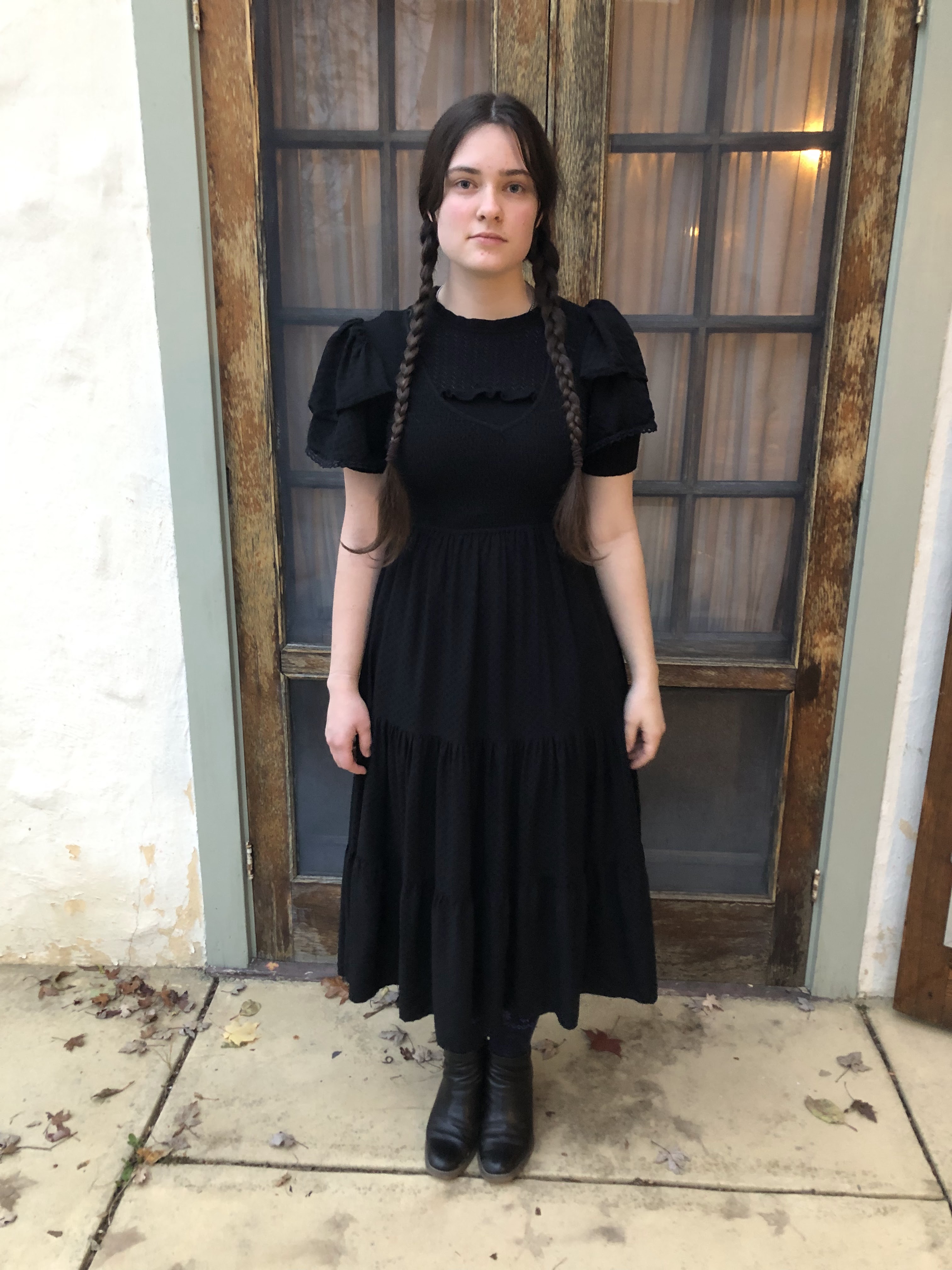
No. 3 as Wednesday Addams


No. 4 as The Joker