Wednesday, May 10, 2006
Who Would Have Thought...
NT John Farrell
Four Years Ago Today...
Tuesday, May 09, 2006
Prayers requested
Jack, who is only 8, was diagnosed with brain cancer last May. He had surgery and has been receiving chemotherapy and radiation treatment since. Last Wednesday, we found out that there is another spot on his brain in a different spot. He is having surgery again today to do a biopsy and see what, if anything, they can do. If the cancer is back, his prognosis is very poor. He has been really patient through all of this and never complains. We would greatly appreciate any prayers you could send his way.Please keep Jack and his family (and his aunt Barb!) in your prayers. I'll post any updates as I get them.
UPDATE: Barb posts in the comments below:
It definitely is cancer again, unfortunately...the surgeon could see spots on his brain on the entire area he viewed. Very bad news..His parents are devastated. It is so hard to watch your child suffer and know that, without a miracle, you're going to lose them...
Thanks to all who have prayed for him...we appreciate it greatly.
Monday, May 08, 2006
Why I Keep Talking
.. choleric correspondent who rebuked me for being too frivolous about the problem of Spiritualism. My correspondent, who is evidently an intelligent man, is very angry with me indeed. He uses the strongest language. ... The main substance of his attack resolves itself into two propositions. First, he asks me what right I have to talk about Spiritualism at all, as I admit I have never been to a seance. This is all very well, but there are a good many things to which I have never been, but I have not the smallest intention of leaving off talking about them. I refuse (for instance) to leave off talking about the Siege of Troy. I decline to be mute in the matter of the French Revolution. I will not be silenced on the late indefensible assassination of Julius Caesar. If nobody has any right to judge of Spiritualism except a man who has been to a seance, the results, logically speaking, are rather serious: it would almost seem as if nobody had any right to judge of Christianity who had not been to the first meeting at Pentecost. Which would be dreadful. I conceive myself capable of forming my opinion of Spiritualism without seeing spirits, just as I form my opinion of the Japanese War without seeing the Japanese, or my opinion of American millionaires without (thank God) seeing an American millionaire. Blessed are they who have not seen and yet have believed: [See John 20:29] a passage which some have considered as a prophecy of modern journalism."Don't judge a man before you've walked a mile in his moccasins" is a useful aphorism inasmuch as it reminds us to be compassionate to those in different circumstances, but as a guide for making moral decisions it leaves much to be desired. I don't have to engage in stupid behavior to be able to declare it stupid -- indeed, it strengthens my reputation for sense to avoid stupidity in the first place. Being able to decide from the description of a book or a movie whether or not I want to spend time and money on it means that I save a lot of time and money. I like to be challenged intellectually, but I expect an intellectual challenge to be intellectual, not a hackneyed rehashing of popular misconceptions.ILN June 9, 1906 CW27:207-8
Tolkien on the Eucharist
The only cure for sagging or fainting faith is Communion. Though always Itself, perfect and complete and inviolate, the Blessed Sacrament does not operate completely and once for all in any of us. Like the act of Faith it must be continuous and grow by exercise. Frequency is of the highest effect. Seven times a week is more nourishing than seven times at intervals. Also I can recommend this as an exercise (alas! only too easy to find opportunity for): make your communion in circumstances that affront your taste. Choose a snuffling or gabbling priest or a proud and vulgar friar; and a church full of the usual bourgeois crowd, ill-behaved children - from those who yell to those products of Catholic schools who the moment the tabernacle is opened sit back and yawn - open necked and dirty youths, women in trousers and often with hair both unkempt and uncovered. Go to communion with them (and pray for them). It will be just the same (or better than that) as a mass said beautifully by a visibly holy man, and shared by a few devout and decorous people. (It could not be worse than the mess of the feeding of the Five Thousand - after which [our] Lord propounded the feeding that was to come.)
Leaving Islam
Lina Joy has pettitioned the Malaysian government to have her religious status legally changed from 'Islam' so that she will no longer be ruled by Sharia and can marry a Christian man. However, to date, the Malaysian courts have insisted that as a matter of jurisdiction she must petition the Sharia court system to recognize her change in religion -- she cannot work through the secular courts until after her religous status has been changed.
Usceae provides significantly more information on the story. Do keep Lina Joy in your prayers.
Saturday, May 06, 2006
Dreher Looks East
Over and over again, I have seen the magnificent teaching and witness of John Paul II and the Catholic tradition undermined and even rejected at the parish level. I honestly don't know if I could keep my kids Catholic in the American church -- or even Christian.Having run into Rod in the comments sections of various Catholic blogs over the last few years, there's a sense in which I simply find myself thinking, "Well, that's not much of a surprise." As a result of covering the sex abuse scandals, Rod has become incredibly (one might almost say insanely) bitter about the institutional Church. And this, he says, has led to his main motivation for considering leaving the Church:
What moved us to consider Orthodoxy? It's a long story, but to cut to the chase, there were two things. The most acute was complete burnout over the Catholic sex-abuse scandal. I have always kept squarely in front of me the crucial point made by Father Andrew Greeley, who said that even if the Catholic church was run by psychopathic tyrants, that has nothing whatever to do with whether or not the Catholic faith is true. He is correct. That insight kept me solidly Catholic despite all the horrible things I was learning about church corruption and abuse of children. Nevertheless, the constant fear and anger I couldn't shake off began to eat away at me. Without my realizing it, my faith had become a cerebral thing.... Is it possible to live an authentic life of faith based only on cerebrality, on intellectual/doctrinal conviction? And if not, what do you do on Sunday morning?What Rod chooses to do is very much a matter between him, his eternal soul, and God. To loosely paraphrase Man For All Seasons, when you hold your eternal soul in your hands, you should be pretty careful not to let it slip through your fingers. But his description of his dilemma brought to mind several things.
The Road Not Taken
There are a number of real and important differences between Catholicism and Orthodox (petrine supremacy being one of the most important, it seems to me) but there is a certain sense in which modern Eastern Orthodoxy (both in its strengths and weaknesses) shows us something of where Roman Catholicism might have headed without Vatican II. The ancient splendor of the EO liturgy remains virtually unchanged over the last few hundred years. Countries with majority Orthodox populations have seen church attendence and belief plummet, but at the same time a new wave of dynamism have arisen from a tide of converts and cradle Orthodox rediscovering their faiths.
In some ways, the Roman Catholic bishops saw a similar world approaching when Vatican II convened. Belief and church attendence were already falling in countries like France, Italy and Spain in the 60s, although the 20th century had seen a number of intellectual converts and a theological and liturgical re-awakening that gave many great hope for the future. The fathers of the council hoped that by re-presenting the teachings of the Church to the modern world, they could stem the tide of un-belief.
In this sense, the experience of the Orthodox perhaps suggests that the collapse in belief and practice by Catholics around the world over the last forty years cannot simply be laid on Vatican II's doorstep. Rising prosperity and the triumph of the ideal of a pluralistic society has reduced the incentive for unbelieving Catholics to go through the motions. And the increased material comfort in our lives and the comparative low profile of suffering and death have made it easier to believe that "this is all there is -- and it's pretty good at that."
But given that with or without at Vatican II, the late 20th century was probably doomed to see a massive falling away from the faith, what was the advantage of the council? Or was it an unmitigated ill?
I think the Vatican II documents themselves did indeed achieve their objective of clarifying and representing the ancient faith to the modern world. And yet, the mere fact that there was a reform movement going on within the Church during the late sixties and early seventies opened the door to a torrent of abuses, the results of which we live with today. If there had been no Vatican II, there would have been no convenient hook to hang all the claims that rode under the 'Spirit of Vatican II' banner on -- and so I think it's true that we would have seen less chaos in Catholic liturgy and school rooms.
What would, I think, have happened, is that people would have increasingly seen Catholic belief and practice as a charming and old-fashioned window dressing to apply to major life events such as weddings and funerals, but not something that understood in any sense the modern world. The mass would have remained relatively stable, though perhaps over the last forty years changes would gradually have built up until we ended up with something rather like the 1965 Missal: Readings in the vernacular, but everything else in Latin, a few accretions such as the final gospel stripped away, but otherwise very much the same mass as was in the 1962 Missal which is currently considered 'traditional'.
We certainly wouldn't have seen the mass exodus of priests and nuns from the religious life had there been no Vatican II, but I think we would probably have seen vocations fall off rather steeply. And although we wouldn't have had some of the idiocy that passed for seminary formation in the 70s and 80s, we would probably have seen a continuation and perhaps even a worsening of the excessive mediocrity which plagued some seminaries in the 50s and early 60s, with seminarians reading second and third-hand schoolboy Latin summaries of what the Doctors and Fathers of the Church wrote rather than reading the true depth and breadth of our Catholic heritage. (Raymond Hedin, an ex-Catholic seminary drop-out, describes the pre-Vatican II education he received at the Diocese of Cleveland seminary in Married To The Church, a book which makes it rather easier to understand who the priests ordained before Vatican II could have gone so far wrong, so quickly after the council.)
We would have been spared the excesses of the Sr. Chitisters and Fr. McBrians of the world, but we probably would see today a great deal more strife and uncertainty between those trying to be orthodox. On the topic of religious freedom, there was strong and genuine disagreement between loyal Catholics before Vatican II as to whether the ideas put forth by John Courtney Murray (or, come to that, Karol Wojtyla) in the early 1960s were heretical. There was also real disagreement as to whether Wojtyla's ideas about human sexuality and the language of the body (as expressed in the 1960 Love & Responsibility) were indeed a sound explication of Catholic teaching on sexuality, or instead a dangerously 'modernist' approach -- utilizing as it did elements of phenomenology and personalist philosophy. In a Catholicism without Vatican II, it would be rather less clear whether Ratzinger and Wojtyla or Bishop Williamson represented a truer vision of Catholicism.
The Dangers of Excessive Ecumenism
There's been a great deal of emphasis on the hope of reunion with the various Orthodox churches in recent years, and certainly, we must all as Christians hope for the day in which the Great Schism will be healed. And yet, some of the more excessive statements one hears in connection with the ecumenical effort come far too close to indifferentism. While it is true that the Catholic Church regards the Orthodox churches as possessing valid sacraments and apostolic success, and as being in schism rather than heresy, this does not mean it is a mere matter of preference to leave Catholicism for Orthodoxy. After all, the SSPX has apostolic succession and valid sacraments, yet I would hope any good Catholic parent would be much concerned if his or her child left the Church for the SSPX.
The difficulty is further exacerbated in that while we consider the Orthodox to have valid sacraments and non-heretical (though not as developed) theology, many among the Orthodox do not consider Catholic sacraments to be valid, and consider Catholic doctrine to be heretical. Essentially, Catholics consider the Orthodox not to be heretics for the same reason that we do not consider Aquinas to be a heretic -- one can hardly expect the Angelic Doctor to have affirmed beliefs that were not definatively taught by the Church when he lived. And similarly, the Orthodox can hardly be expected to affirm doctrines that have been defined since the schism.
However, if someone who was previously a professed Roman Catholic leaves Catholicism for Orthodoxy, he is thus clearly rejecting Catholic doctrine, and so he is a heretic, even if someone born into Orthodoxy is not.
There Is No City of God on Earth
By his own description, one of the reasons why Dreher is currently finding it so hard to be Catholic is that initially, after his conversion, he expected so very, very much of it. It's tempting to think that Catholicism, or some little portion of it, is very near to perfect. And seeing as the institution Church is made up of humans, it clearly isn't.
Perhaps it's easier to see this as both a cradle Catholic and a student of history, but it's always seemed to me that the proof of God's divine guidance is not that the Church is so sinless, but rather that she has remained wholly true to the deposit of faith despite being populated and occasionally run by some exceedingly sinful people.
This isn't just something to keep in mind for generalities, however. There's also a danger in investing too much of one's belief in specific individuals and institutions. I always wonder a little when people gush about "I've never known such a holy priest. He really sums up for me the ideal of what the priesthood should be." I've been blessed to know some great priests, and may well even have one in the family eventually, as MrsDarwin's brother is currently in seminary. But people, no matter how good, are people -- not ideals. It's usually not good either for us or the object of our respect to think of someone as an ideal, whether it's the ideal priest, the ideal mother, the ideal business man or the ideal politician.
It Takes a Family -- Not a Parish
I grew up in Los Angeles Archdiocese, in two rather mediocre parishes. My wife went to CCD in the Diocese of Richmond, before moving to somewhat safer ground in Cincinnati. In both our cases, we have our families to thank for the fact that we were given a good education in the Catholic faith, not our parishes, schools or diocese. But even if we'd grown up in one of the conservative Catholic meccas like the Diocese of Lincoln, it's still our families that we'd primarily have to thank. Having a great, solid parish can certainly help, but children are formed in the home, not the parish. (Goodness knows, if the sudden collapse of our apparently solid catechesis after Vatican II taught us anything, it's that you cannot simply assume that exposing children to good liturgy and good nuns will automatically make them knowledgable and fervent Catholics.)
Nor need living in a run-of-the-mill suburban parish in the United States necessarily be a life of constant war and suffering for a good Catholic family. To be sure, it's harder than it ought to be. You may need to examine several different local churches to find a 'don't add anything' priest. But one must also decide what's worth hating and fighting over, and what's not. I wish we had a Novus Ordo (or indult) Latin mass at our parish. I wish we had a real organ. I wish we didn't occasionally sing Amazing Grace or southern spirituals. But at the same time, I know I need to keep in mind that the parish we found and settled in is in most essentials a good parish, and getting better rather than worse.
There's a temptation for many of us who love the Church dearly and want to see her historic wonders better reflected in daily parish life to become so critical as to be unsatisfied with anything. Somewhere out there is a person who watched John Paul II's funeral mass and fumed over a couple perceived (or real) liturgical abuses. Or how about the people who complain that the pastor of every parish near them is disgustingly effeminate? Now, I'm sure things are far worse in some parts of the country than the dioceses of Los Angeles, Steubenville and Austin where I've lived. But honestly, if you insist every single priest you meet is effeminate, is it the priests or is it you?
To provide a good Catholic formation for your children, it's necessary, I think, to provide two things. First of all, a solid grounding in Catholic doctrine and practice. Know the bible; know the catechism; read the lives of the saints; pray the rosary or the divine office; make sure your children are exposed to real Catholic art and architecture (even if you have to travel to do so); give your children a good grounding in the history of the Church and the writings of the saints and Fathers. But also, make sure that you don't become so uptight in your search for the right expression of Catholicism that your children's experience of Catholicism becomes poisoned with your bitterness. This may mean 'shopping' for a parish or even moving to a better diocese. But it also means being prepared to sweat the small stuff and appreciate the good as well as the bad. (I always admired the pastor of my parents' old parish for fighting and winning a knock-down-drag-out battled with the diocese to keep the tabernacle in the center of the church when it was renovated after the Northridge earthquake. And yet he drove us nuts by saying 'and became flesh' instead of 'and became man' in the creed.)
I have a very strong tendency to get political and factional about everything, yet I know I don't want my kids to think of Catholicism as 'one of those political things Daddy fights about', so I try to remain outside of parish politics and look on the bright side whenever possible. (And head for another parish if the bad side becomes too big to ignore.)
Friday, May 05, 2006
Wisdom from Teddy Kennedy
Iowahawk Guest Commentary by Senator Edward M. Kennedy
Like all Americans, I had high hopes for the future of the Oldsmobile and its passengers, as we struggle against the onrushing water and its poorly-designed shoulder belts. But as claustrophobia sets in we must begin to sober up and face the truth: hope is no longer an option.
It is time for us to recognize that our continued presence in this volatile region is a hinderance to the Oldsmobile and its people. Rather than helping the situation we are further weighing down the Oldsmobile, causing it to sink faster and faster into the quagmire of Chappaquidick Bay, creating a dangerous situation for both ourselves as well as its passengers who are desperately seeking an air pocket in which to start a better life.
That is why I believe we have reached the point where we must take a deep breath and immediately depart the Oldsmobile. We must seek through the watery darkness and release the belt latch of madness that has kept us here, and reach out for a sane and honorable window crank.
Yes, it's Iowahawk, but no language alert this time. Take the whole family!
A small world after all
As of late Tuesday afternoon, Nick Thomm of Ave Maria Radio has been moved to a regular semi-private room following a stay in the ICU while initially recovering from brain surgery. His color is coming back and he is already eating and feeling better. He has a bit of tingling in his arm but no paralysis or other adverse effects. They may have him up and walking around later this evening. Later in the week, he's looking forward to visitors.Darwin and I were at Steubenville with Nick and Jen, and Jen was in our Honors class (she and I were both sporting nifty engagement rings at the same time). Please remember them, and all of the Ave Maria Radio crew, in your prayers.
One change from the previous update is that a MRI from Tuesday morning indicates that at least 30-50% of the tumor was removed. Please continue your prayers for Nick and Jen and leave a message for the Thomms here. You can find the Litany for the Sick in the first two comments.
Catholicism & Fertility in Europe
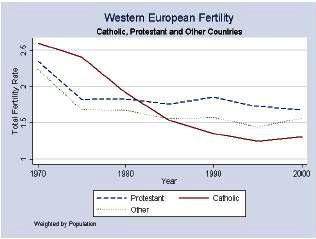
As you've no doubt read, the number of children per woman born in the majority Catholic southern European countries (Italy, Spain, Portugal) has plummeted in the last 35 years, going from being higher than the average TFR (total fertility ratio) in Europe to being significantly lower. (see graph)Previous researchers have noted that there is a correlation between fertility decline and church attendance decline in strongly Catholic countries (though the fertility decline seems to lag behind religiosity decline by roughly fifteen years -- something which makes intuitive sense: it takes a while to get Catholicism out of your system of thought). The two European counties with declines in church attendance over 30% in the last fifty years (Spain and Italy) have fallen much farther in fertility than Ireland, where church attendance is still comparatively high. Nor, the authors say, can the fall in fertility be strictly a result of higher workforce participation by women, because although Spain and Italy have two of the lowest fertility rates in Europe, they also have two of the lowest female workforce participation rates.
Two reasons for the correlation between fertility and Catholic religiosity are cited by the paper:
- Catholic church attendance represents affirmation of a set of values that encourages child bearing.
- Active Catholic communities provide a number of child-rearing resources (in the form of schools, parish activities, parish friends, etc.) which reduce the difficulty of rearing large families.
The paper seeks to draw on both of these factors to explain the varying declines in fertility in different majority Catholic countries:
Our argument so far can be summarized as a series of conjectures:To measure cultural and social services as represented by the Catholic Church, the authors studied the correlation of the nuns per 10,000 Catholics metric to declining fertility, and found that there was a strong and direct correlation between the number of nuns available to staff Catholic social and cultural institutions and the number of children that Catholics had.
i) The Second Vatican Council caused a sharp decline in clergy per Catholic, though the timing
differed across countries;
ii) That decline reduced social services, spiritual and tangible, provided to Catholic communities;
iii) The reduction in services raised the shadow cost of raising children, reducing fertility;
iv) The reduction in services also caused a drop in religiosity, as measured by church attendance.
Conclusion of the paper is that it was the collapse of visible Catholic social institutions and ways of life (as priests and nuns streamed out of the Church and new vocations radically slowed), even more than decline in actively held beliefs, which caused the sudden drop in Catholic fertility after Vatican II.
It's an interesting line of reasoning, with some good data to support it. Those of us who have remained active in the faith since Vatican II have in many ways had to increase our emphasis on the learned faith (the doctrines and history of the Church) in addition to, or even instead of, the active Catholic lifestyle/culture which was so strong in the pre-Vatican II Church. From that perspective, it seems strange and rather silly to me when people talk about changes such as vernacular liturgy and the option of choosing a different Friday penance (rather than abstaining from meat) as major crises in faith. But it is perhaps impossible for me, as a post-Vatican II Catholic (even a very conservative one) to understand how directly many people identified things like Latin and meatless Fridays with the essence of being Catholic.
Thursday, May 04, 2006
Dagger John
We are not the first generation of New Yorkers puzzled by what to do about the underclass. A hundred years ago and more, Manhattan’s tens of thousands of Irish seemed a lost community, mired in poverty and ignorance, destroying themselves through drink, idleness, violence, criminality, and illegitimacy. What made the Irish such miscreants? Their neighbors weren’t sure: perhaps because they were an inferior race, many suggested; you could see it in the shape of their heads, writers and cartoonists often emphasized. In any event, they were surely incorrigible.A fascinating account of a powerful man who rehabilitated family life, morality, education, spirituality, and social image among the Irish of the mid-to-late 19th century.
But within a generation, New York’s Irish flooded into the American mainstream. The sons of criminals were now the policemen; the daughters of illiterates had become the city’s schoolteachers; those who’d been the outcasts of society now ran its political machinery. No job training program or welfare system brought about so sweeping a change. What accomplished it, instead, was a moral transformation, a revolution in values. And just as John Wesley, the founder of Methodism in the late eighteenth century, had sparked a change in the culture of the English working class that made it unusually industrious and virtuous, so too a clergyman was the catalyst for the cultural change that liberated New York’s Irish from their underclass behavior. He was John Joseph Hughes, an Irish immigrant gardener who became the first Catholic archbishop of New York. How he accomplished his task can teach us volumes about the solution to our own end-of-the-millennium social problems.
The Conscript and the Crisis
In the course of a certain morning I came into one of the quiet squares of a small French town and found its cathedral. It was one of those grey and rainy days which rather suit the Gothic. The clouds were leaden, like the solid blue-grey lead of the spires and the jewelled windows; the sloping roofs and high-shouldered arches looked like cloaks drooping with damp; and the stiff gargoyles that stood out round the walls were scoured with old rains and new. I went into the round, deep porch with many doors and found two grubby children playing there out of the rain. I also found a notice of services, etc., and among these I found the announcement that at 11.30 (that is about half an hour later) there would be a special service for the Conscripts, that is to say, the draft of young men who were being taken from their homes in that little town and sent to serve in the French Army; sent (as it happened) at an awful moment, when the French Army was encamped at a parting of the ways. There were already a great many people there when I entered, not only of all kinds, but in all attitudes, kneeling, sitting, or standing about. And there was that general sense that strikes every man from a Protestant country, whether he dislikes the Catholic atmosphere or likes it; I mean, the general sense that the thing was "going on all the time"; that it was not an occasion, but a perpetual process, as if it were a sort of mystical inn.At a good liturgy (and occasionally at a bad one, too) there is a sense of timelessness: not that Catholics through the ages are repeating the actions of the Mass, but that at any point in history we're all attending the same Mass and only the accident of time keeps us from being immediately present to one another.
When Darwin and I were travelling in Europe during our student days, we enjoyed attending masses in Latin because even in a country where we understood none of the language, we could understand and participate at church. This sense of companionship, of all being fellow travelers at the "mystical inn" is not only limited to those Catholics separated by distance, but also by time. Chesterton says it better than I can: "the general sense that the thing was "going on all the time"; that it was not an occasion, but a perpetual process".
Wednesday, May 03, 2006
Money and Politics
Thus, one candidate may raise a great deal of money from big labor as a result of voicing his beliefs in favor of protectionism and high wages, while another candidate raises lots of money from large businesses as a result of supporting open boarders and 'right to work'. However, it is the beliefs that come first and the money that follows after.
Seen and heard in the checkout line
"Julia Roberts, George Clooney, Robert F. Kennedy Jr., Al Gore, and the call for a New American Revolution"
"The Threat More Dangerous than Terrorism: Global Warming"
Um, okay, guys. But getting a bunch of intellectual lightweights to spout off about Bush and Iraq isn't really going to spur Joe or Sally Q. Public (read: me in the checkout line) to start raving about a new revolution. Like I feel any solidarity with four filthy rich bozos!
And yeah, I'm really worried about the massive threat of Global Warming! Because Global Warming flies airplanes into buildings and blows up innocent people and hates America. But it must be more dangerous than terrorism, if Vanity Fair tells me it's so!
Shaking the dust of Vanity Fair from my cart wheels, I unloaded my cart and moved forward. The hispanic cashier and the black bagger were discussing the immigration walkouts of the other day, and the bagger was protesting that yeah, he would have walked.
"You would not!" laughed the cashier, tossing her hair.
"I would!" he insisted.
"You would not! You'd be too chicken." The cashier thought a moment. "I wouldn't walk out on school," she opined, "but I'd definitely walk out on work."
The horrendous threat of Global Warming hung over us like the sword of Damocles, and yet these two youngsters were laughing about getting out of work! I almost wished Julia Roberts would show up to make an impassioned plea for a New American Revolution. And everyone in this Texas grocery store would have stared at the odd green dress she wore for the Vanity Fair photo shoot, and then they would have turned away to continue discussing the Longhorns or my squeaking baby. Heck, Britney and Brad are more compelling than the pseudo-intellectuals -- at least they're having kids, which is what normal people worry about.
Tuesday, May 02, 2006
Combative Catholic Historian Needed
Such seems to be the trouble with the Wikipedia entry on Pope Pius XII, which draws far too heavily of resources like Hitler's Pope.
However, there is a very straightforward way to fix this. Somewhere out there among Catholic blog authors and readers, there must be someone rigorous and levelheaded who's up on the latest work on Pius XII by Rabbi David Dalin, Pierre Blet, Patrick Gallo, and Harold Tittman.
If you are such a person, or know one, have at it. We could use a better article out there by someone who's even more ready to sling historical citations that the currently dominant contributors.
The Other Secret of Fatima
Fatima is, of course, the name of Mohammad's favorite daughter, and in honor of her it has become one of the more common names for women it the Islamic world. Portugal was invaded by the Islamic Moors in 711, and the Moors were not fully driven out again until 1250.
It was some time during that period that the town of Fatima (where the appearances of Our Lady allegedly took place) received it's name -- though so far as I can tell it's unclear whether it was named directly after Mohammad's daughter or after a local woman named Fatima.
By the time of the apparitions it was not radical Islam but rather the militant atheism of Communism which was seen as the great threat to Catholicism, and it is that threat which several of the Fatima messages address.
The atheism that threatens Christianity today is not a militant, invading force, but rather a paralyzing nihilism and self-doubt -- and Islam once again threatens to overwhelm Europe. Perhaps Our Lady of Fatima (who appeared in a town named after Mohammad's daughter to warn of the necessity of resisting the militant forces arrayed against Christianity) is an apt patroness for the trouble of our own time.
Liturgical Norms according to Rick
If you're serious about getting a leading position on the liturgical committee here's what it takes:Thanks, Rick! I'm off to shop for that polyester pantsuit now!
1. You MUST wear polyester pant-suits. Nothing else will do.
2. Makeup is strictly forbidden.
3. You must have a take-charge personality (read be an uncompromising bitch).
4. Read Environment and Art in Liturgical Worship by the NCCB. It will be YOUR bible.
5. Read the GIRM. It's easier to find loopholes and counter Liturgical Nazis that way.
6. God gave you a priest so he should be the center of attention. Move the tabernacle out of the sanctuary.
7. If singing is praying twice, dancing must be praying thrice. Liturgical dancers are a must have.
8. Perhaps God's greatest gift to ecclesial art is felt. You can redecorate your entire church by spending $20 at JoAnn Fabrics and the labor is free...have the CCD kids cut out Jesus fish and glue to various swatches.
9. There is nothing more holy than holding hands at the Our Father. You must excommunicate anyone who fails to comply.
10. 5 minutes for the Sign of Peace is a bit too hasty. Our brothers and sisters just can't get caught up in that little time. How many times have you left Church thinking, "darn, I forgot to ask Fred about those persistant hemoroids. If only the Sign of Peace wasn't so rushed."
11. Father is over-worked, you must ensure that there are plenty of EMEs to distribute Communion for him.
12. It must be posted that there will be no kneeling. Some people can't kneel, and it wouldn't be polite for others to kneel in their presence...it would smack of spiritual pride.
13. It would also be beneficial to change your name to something like Gerty.
There are many more tips, but I'm out of time. Good luck Gerty.
--Gerty
Monday, May 01, 2006
The Sign
Liturgical Committee
Fr. A___ is in the process of forming a Liturgical Committee for the Parish. People interested in art, environment and learning more about the Liturgical Seasons of the Church are welcom. THis will involve time for workshops and formation, and the study of some Church documents. The committee will be responsible for the church environment during Christmas, Holy Week, and Easter season. If you are interested, please call the office and leave your name. Deadline for signing up is Friday, May 5, 2006.
Ching! I called this morning. If someone's going to be responsible for the church environment during the holiest days of the year, I'd rather it be me and see it done right than sit in the pew complaining about the decor.
Do you think it would help if I described myself as having studied theatre, acting, directing, and design, and mentioned that I'd designed sets for plays in college? Do you think that my few months of professional experience as a stage manager and production assistant would carry some weight? I wonder if that would matter more than a desire to follow the Church's guidelines for proper liturgy.
Q: If you were going to overhaul our parish's liturgy, what would be your first move?
A: I'd read the Church documents on Liturgy
Q: And then?
A: I'd read them again.
Q: And then?
A: I'd read them again, just to be sure.
I just hope I'll never find myself in need of Liturgical Anonymous.
Be Not Afraid
I'm not a fearful person by nature, but sometimes I find myself lying awake at night, staring into the darkness and wondering: what would I do if someone took one of my babies? How would I cope if a child of mine was molested? These are the horrible things that every parent fears. We do our best to keep our girls safe, but what if something happened? You can't just roll over and go to sleep after that thought lodges in your head.
And yet I can't live my whole life in fear of some phantom evil, or I'll miss out on the daily joys of a houseful of girls. If every time I look at one of my girls I see a potential victim, fear is winning. I once heard that the exhortation "Be not afraid!" occurs in the Bible 365 times, once for every day of the year. (I'm sure that's a matter of translations, and what about Leap Years in that case, but the idea is comforting.) And so, in the spirit of not being afraid, I offer two prayers.
For the Protection of my Children
Dear Lord, Loving Father,
You encouraged the little children to come to you.
Please protect my children.
Your angel warned Mary and Joseph of Harod's plan to kill Jesus;
send that same angel to me to aid me in my watch over my little ones.
I commend them to your loving care and the intercession of your Mother.
Amen.
For an Unbaptized Infant
Father and Creator of all life,
You knew my child before she was born.
Please give her special protection until the day of her baptism
when she will become a full member of your family.
Watch over her and keep her from all harm
until the day when her soul is cleansed from original sin.
I trust in your mercy and love.
Through Christ our Lord,
Amen.
The Worker and His Due
The source of the flap is, of course, that the retiring CEO of Exxon-Mobile received a retirement package worth 400 million dollars, while at the same time people are paying high prices at the pump. The 400 million is, I believe, a mixture of stock and cash and will be paid out over a period of years, however comparing it to the 2005 Exxon-Mobile gross revenues is still interesting. In 2005 Exxon-Mobile reporting 371 billion in gross revenue. The CEO's parachute equals 0.11% of this figure.
Now, a few years back I worked for a 25-employee, family-owned chemical distribution company. The company had about 25 million in annual sales, however since it mostly served as a sales agency (collected commission rather than buying and reselling product) with an average commission of 10%, it was in many ways more like a 2.5 million annual revenue company. Now, out of that 2.5 million in revenue coming into the company, about 1 million went to the founder, his son (current president), the COO, the controller and the top salesman, all of whom made 100-250k per year. The other 20 employees made 25-50k/year. The 300k that the company president took home every year represented more than 10% of the total revenues coming into the company.
I think if you took a look at a lot of small, privately owned businesses, you would find the same pattern. The owner often absorbs a large percentage of the total wages paid out. Sometimes, this is simply a case of the owner paying himself more because he can, but often in 5-30 person companies the owner is both responsible for a disproportionate percentage of the work, and also of the risk. If a corporate CEO's company goes bankrupt, he just goes looking for another job, but if a small business owner's company goes bankrupt, that can often mean bankruptcy for him and his family as well.
In additional to this personal risk factor for small company owners, the comparatively small dollar amounts involved keep them from looking quite as greedy as corporate CEOs. If the owner of a liquor store makes 75k/yr, while his four employees each make $12/hr, the employees may resent his nice clothes and Lexus, but the wider society will recognize that he's still making less than a lot of accountants and lawyers, who face far less personal financial exposure in their work.
The difficulty with big business is that, although the actual percentage of gross revenue which goes to paying key executives is actually lower than in a small business, there's simply so much money involved. We see this with the occasional outrage over the salaries of professional sports players. Clearly, a lot of people in this country would be ecstatic to make a middle class income of 60-75k a year to 'have fun' playing sports and being famous. Why, then, we sometimes ask, do professional athletes demand multi-million dollar contracts? The answer isn't so much that they wouldn't want to play for less, in the objective sense, but rather that they are clearly producing so much wealth, and want a piece of it. Say that between ticket sales, television, endorsements and such, a sports team is generating 250 million in annual gross revenue. Now, while the players might (in the absence of all this money flying around) be perfectly happy to play for an average middle-class income, knowing that the team owners are raking in 250 million based on what the players are doing understandably makes the players want to have a bigger piece of the action. After all, without the players there would be no income.
If a few top executives at a company really are making a very large personal contribution to the decisions which make the company a big revenue earner, then I don't think there's an inherent injustice in allowing those executives to make a lot of money. However, with money comes responsibility. Speaking as a Catholic, I don't think the moral issue is so much that you shouldn't make too much, as that 'from those to whom much is given, much is expected'. Christ repeatedly condemned people who simply liked to sit on a large pile of gold, dragon-like.
Also important, as a matter of justice, is whether a high-paid owner or executive is 'stealing' his high salary from the workers. This is often a hard thing to measure, since a mid level worker at a 1000 employee company may think, "How can an executive possibly be doing better work than I am, yet he makes ten times as much." Certain cases seem clear. If a business owner or executive has numerous employees making far less than similar-skilled workers in the industry, while he himself is pulling down a record salary, some sort of injustice seems to be at work. If, on the other hand, the company's workers are generally making average or above-average wages for their industry and skills, than high executive compensation may justly reflect key executive performance.
The other party, sometimes forgotten in all this, is the just return for the investors. Large companies cannot operate without large amounts of capital, and it is the stockholders who provide them with that capital. Thus, the stockholders perform an essential function in a publicly held company, and so they should justly receive a fair return on their investment (if the company is otherwise profitable) rather than the executives reducing profit by paying out all available funds into salary (a form of expense that decreases profits).