Friday, August 31, 2007
The Last Picture Show
If we just want to watch t.v. we have to go through the same procedure, since the contact for the cable on the back of the television was ripped out in one of the several incidents in which some young thing stood on the cabinet and tilted it enough to allow the t.v. to slide off. Both television and children have emerged relatively unscathed from these shenanigans (except, of course, for the cable contact). Not so the heirloom coffee table on which the t.v. landed full force.
Of late it's become more and more difficult to get the picture to resolve, and yesterday the contact finally gave up the ghost. There won't be many tears shed when the shell is put out on the curb. We didn't have a t.v. in the house when I was growing up, and Darwin's family rationed t.v. time sparingly. The girls can imitate the youthful example of their parents and find other things to occupy their time, like walking to school in the snow uphill both ways.
And then in a few months we can get one of those spiffy wall mounted t.v.s that won't take up valuable floor real estate, which we couldn't justify while the old t.v. still worked. Now if only the vacuum cleaner would finally die...
Politically Incorrect Truths about Human Behavior
Physical attractiveness, while a universally positive quality, contributes even more to women's reproductive success than to men's. The generalized hypothesis would therefore predict that physically attractive parents should have more daughters than sons. Once again, this is the case. Americans who are rated "very attractive" have a 56 percent chance of having a daughter for their first child, compared with 48 percent for everyone else. (emphasis mine)Here are some of the other "politically incorrect" truths:
- Men like blond bombshells (and women want to look like them)
- Having sons reduces the likelihood of divorce
- The midlife crisis is a myth—sort of
- Men sexually harass women because they are not sexist
Thursday, August 30, 2007
Thy Kingdom Come...
I'd never found Revelation particularly interesting reading. However, on further thought, it occurred to me that perhaps the fact that I found the book so uninteresting would be a good reason to go to the bible study. After all, it's part of the bible. I assumed that there must be something I was missing. Plus the study was being given by our new assistant pastor, fresh out of seminary and a really solid and enthusiastic guy. So I've been going.
It's still not my favorite book of the bible, but I think I'm beginning to "get it" more than before. Last night, covering chapters 4-7, a section struck me as in a sense reflective of some things I'd been thinking about lately.
In the second vision, the scroll with seven seals is brought forward, and it is asked who is worthy to open the scroll.
One of the elders said to me, "Do not weep. The lion of the tribe of Judah, the root of David, has triumphed, enabling him to open the scroll with its seven seals." Then I saw standing in the midst of the throne and the four living creatures and the elders, a Lamb that seemed to have been slain.... He came and received the scroll from the right hand of the one who sat on the throne. When he took it, the four living creatures and the twenty-four elders fell down before the Lamb. Each of the elders held a harp and gold bowls filled with incense, which are the prayers of the holy ones. They sang a new hymn: "Worthy are you to receive the scroll and to break open its seals, for you were slain and with your blood you purchased for God those from every tribe and tongue, people and nation. You made them a kingdom and priests for our God, and they will reign on earth." I looked again and heard the voices of many angels who surrounded the throne and the living creatures and the elders. They were countless in number, and they cried out in a loud voice: "Worthy is the Lamb that was slain to receive power and riches, wisdom and strength, honor and glory and blessing." (Rev. 5: 5-12)As the lamb opens the seals on the scroll, terrors are released upon the world to tear down the established order. In the context of last first/early second century, what is being discussed here is the chaos that doubtless must take place before the old pagan order of the ancient world can be remade according to the Christian faith. Part way through the various calamities described:
When he broke open the fifth seal, I saw underneath the altar the souls of those who had been slaughtered because of the witness they bore to the word of God. They cried out in a loud voice, "How long will it be, holy and true master, before you sit in judgment and avenge our blood on the inhabitants of the earth?" Each of them was given a white robe, and they were told to be patient a little while longer until the number was filled of their fellow servants and brothers who were going to be killed as they had been. (Rev. 6: 9-11)Here those who have given their lives for the faith and ascended to the heavenly kingdom are saying "faster please" -- asking when the reign of God on earth will begin. The answer is that they must wait until the suffering of the Church on Earth has reached its conclusion. Taken imminently, that might be taken to mean until a Christian society is established. Perhaps that's what the original readers saw it as. Or perhaps they saw it as the point when the temporal world was brought to its conclusion. Looking back, we can certainly see that despite the conversion of the Europe and beyond, a truly "Christian world" is necessarily illusive. And so we too continue to wait for the time when all will be rolled aside and true justice will reign throughout the world.
Perhaps this is a case of applying what you're thinking about at the moment to what you're reading, but it struck me that this speaks to a permanent tension within the Christian mind.
On the one hand, we believe that through Christ's Word we've come to understand how humans are meant to live their lives, and believing that we know that there's a natural desire to want to re-order the world to function more according to that truth.
On the other hand, Christian teaching pertains to how each one of us ought to lead our lives in order to one day be united with God in heaven; it does not describe a specific end state for earthly society. As such, attempts to perfect earthly society have distinct limitations.
The question of how much one should strive to perfect earthly society (and in what areas and by what means) versus how much one should hunker down and focus on one's own progress towards God remains a fertile ground for argument between Christians.
Wednesday, August 29, 2007
Wake up and smell the vocation
As the girls get older and more able to occupy themselves, it seems that we ought to have more free time for conversation and leisure. And in some senses that's true. But it seems that our role has expanded now, not contracted. Instead of just keeping babies from hurting themselves, we're finding that we need to keep big girls intellectually and physically engaged. We're not allowed to hoard our free time or our spare energies for our own purposes. We knew, of course, when we started that parenting was an absorbing job, but sometimes the reality of being on call all the time is daunting. It's fine when one can send the older ones off to make their own fun; not so fine is when it succeeds all too well and one finds they've been entertaining themselves with makeup or a pair of scissors.
God provides the grace necessary to handle the challenges of one's vocation. These graces, however, work on His terms, not ours. Having a truly Catholic family life doesn't mean that the children will be utter cherubs and never cause their parents a moment of worry or frustration. It means that when the water pours from the ceiling fan or someone wakes up the baby or throws a tantrum or takes a permanent marker to the carpet that one can step back and take a deep breath and refrain from beating the children or yelling (more than is necessary to make the point) just long enough to pray for that grace. Or even just long enough to let an earlier prayer for grace, said at a more peaceful moment, take effect.
In some situations, a line must be drawn. Take, for example, a purely hypothetical situation in which a five-year-old learns to pick the lock of her parents' door with a penny. It seems to me that the proper response to that sort of hypothetical invasion of privacy is swift and sharp, so that it is impressed upon the child that Mommy and Daddy are adults and need their privacy and that five-year-olds may never pick locks. Ever. Hypothethetically.
That's when you really wake up and smell the vocation.
GNXP: Ten Questions for Greg Clark
In his new book A Farewell to Alms, Greg Clark, an economic historian at the University of California, Davis, contends that "[t]he New World after the Neolithic Revolution offered economic success to a different kind of agent than had been typical in hunter-gatherer society: Those with patience, who could wait to enjoy greater consumption in the future. Those who liked to work long hours. And those who could perform formal calculations in a world of many types of inputs and outputs...."The GNXP interviews are always high quality, and this one sheds some interesting light on Clarks research and what he thinks it shows. This makes me even more curious to read the book.
Clark also provides archival evidence that in medieval Britain (and to a lesser extent in China and Japan) the wealthy-who presumably had those "middle class" skills in abundance-raised more children than the average person. If you put these pieces together-a system that rewards a new set of abilities, plus greater reproductive success for those who have those abilities-then all you need to get some form of selection is one more link: A transmission mechanism. On the nature of the mechanism, Clark leaves the door wide open. Could be parent-to-child cultural transmission, could be genes, could be both.
While much of the discussion of Clark's book has focused on his "survival of the richest" hypothesis, Clark himself appears to be equally devoted to demolishing the widely-held view that economic institutions are the key to modern economic growth. He notes that the British people had solid property rights, limited government, and sound currency for centuries before they had their Industrial Revolution. Drawing on early work by Nobel Prize-winner Douglass North, he argues that economic institutions are largely endogenous and relatively efficient, at least when we're talking about time horizons lasting a century or more. If institutional change wasn't the driving force behind modern economic growth, then what was? In Clark's view, the driving force was change within human beings themselves.
Tuesday, August 28, 2007
What Mr. Bennet Read All Day
Lately, this got me into wondering what exactly it was that Mr. Bennet spends all his time reading. He always seems to be hiding out in his library, book in hand. It seems out of character for him to be reading novels, and besides, Austen was writing in the very earliest days of the English novel: there weren't many to read. So what was he reading? (Pride and Prejudice was written in the late 1790s and published in 1813, so I'm putting the time period as about 1800.)
There are a few things I've read which I know were fairly popular at the time. Samuel Johnson's The Rambler (a series of periodical essays originally written in 1750-1751, which became highly popular once collected in book form) is a very enjoyable read, and seems Mr. Bennet's style. Also fun to read (and still popular though nearly 100 years old by 1800) were the collected essays of The Spectator.
The best thing I could hit on was doing a search on Advanced Book Exchange with the publication date range of 1750 to 1813 and using the vaguest possible keywords (I used "leather" cover and "good" condition). Here are the results. (There are 16,000+, so enjoy. But a few pages worth give a good feel.)
So what looked like good Mr. Bennet reading? Well, collections of essays seem to have been quite popular, the less famous cousins of The Spectator and The Rambler.
Histories also seem quite plentiful, such as this one: THE HISTORY OF MODERN EUROPE WITH AN ACCOUNT OF THE DECLINE AND FALL OF THE ROMAN EMPIRE: AND A VIEW OF THE PROGRESS OF SOCIETY, FROM THE RISE OF THE MODERN KINGDOMS TO THE PEACE OF PARIS, IN 1763. IN A SERIES OF LETTERS FROM A NOBLEMAN TO HIS SON. That sounds like the right sort of thing for Mr. Bennet.
You also have collections of letters and published diaries such as Letters of the Late Lord Lyttleton or Letters [Lettres} of the Marquise du Deffand to the Hon. Horace Walpole, afterwards Earl of Oxford, from 1766 to 1780. To which are added Letters of Madame du Deffand to Voltaire, from 1759 to 1775.
There are quite a few collections of sermons and general theological works (even a fair number of copies of the Imitation of Christ, mostly printed in Ireland) but I don't see Mr. Bennet as going for those as much, though I'm sure Mary read sermons of the more dull sort.
There's also quite a bit of poetry, but again, I don't see that as Mr. Bennet's cup of tea, unless it was satirical, translations of the classics, or perhaps a trifle ribald.
One also sees a certain number of biographies, some more or less colorful-sounding (of both real and imaginary people), which I could definitely picture as something Mr. Bennet would enjoy. Memoirs of Frederick and Margaret Klopstock or LIFE OF LORENZO DE' MEDICI, Called the Magnificent.
And finally, we see others among the early novels, such as the Vicar of Wakefield. I'm not sure this would have been Mr. Bennet's normal reading, though.
Hey there, Baby!
And speaking of babies, the Opinionated Homeschooler has finally emerged to report that she had a fine baby girl on July 16, and provides an excellent quote from her baby's namesake:
I would like myself to be a rent payer to the Lord; that I should suffer distress, that he would bestow a good blessing upon me. I would like a great lake of beer for the King of Kings. I would like to be watching Heaven's family drinking it through all eternity.Mmm, lake of beer...
Both these ladies are local to us, so I'm looking forward to the chance to meet the new arrivals.
Monday, August 27, 2007
Reading the Signs
Many people know the old adage about restaurant kitchens: to know if the kitchen is clean, check the bathroom. The same holds true for Soldiers, only it calls for checking windows. If you are going on a combat mission and Soldiers have not cleaned all their windows to a sparkle (during times when it is possible to do so), do not go with them. Soldiers with dirty windows are not watching for tiny wires in the road, nor are they scanning rooftops. They are talking about women, football, and the car they will buy when they get home. I will not go into combat with Soldiers with dirty windows.If all reporters knew as much about the military (and put as much work into doing good reporting) as Yon, I'd be a little more optimistic about that last line. But for all that the mainstream press makes a good punching-bag for conservative pundits, I don't doubt he's right that good ability to deal with the press is essential to being a good commander in Iraq these days.
I also look at the state of their weapons and ammunition. Does the machine gunner have lubricant? Before going out with them, does someone tell me what to do if there is any drama? Or do they just drag me into combat like a sack of potatoes? It’s usually very simple. A platoon sergeant will say, “Sir, you stay next to me and do what I tell you, we’ll probably get you back alive.” Although there are always exceptions, most of the Soldiers fall into the “ready, prepared and alert” category.
On the command level, there are other indicators. In counterinsurgency, as our Vietnam veterans will vouch, press has both strategic and tactical influence. Commanders who are afraid of the press or who cannot handle it cannot win this fight. They are often the same people who alienate Iraqis. I remember one captain who had allowed his men to ransack an Iraqi home, much later shouting in my face while his lip quivered with anger, “You are a piece of shit!” He could not handle having press around, and resented the very air they breathed, and he made sure they knew it. Of course anyone whose idea of winning is to bully Iraqis would not want media around. I watched him for months as a study in how not to do certain things. Tactically, he was competent and knew how to win the gun battles, but he was incompetent and inadequate for counterinsurgency.
Dealing with the press is just a reality, like the weather. We would never put a commander in the field who refused to make plans for fighting in the cold or heat. Although it’s just a reality, cold weather, for example, could destroy a unit overnight if they had not prepared for it. As with the weather, the press also influences the enemy. Cold weather freezes everyone’s toes; bad press stalls progress. In either instance, he who is better-suited and more adaptable has a supreme advantage. There was a time when many of our enemies in Iraq were beating us in the press, both their press and ours, but now that is changing.
Things That Don't Bother Me: Other People's Wealth
I'm sure there are indeed lots of things wrong with the world, and this may be one of them, but try as I might I honestly can't work up any worry over it. Once and a while I half-heartedly reply, "Well, it is their money. That's why they'd generally expect to keep it." Generally I just keep my mouth shut.
I'm hesitant to say that this kind of exercise is simply a matter of envy. Christ discussed the injustice of the rich man who does nothing for those in need at his very gates in the parable of the rich man and Lazarus. However, unlike many modern progressives I don't think that Jesus envisioned setting up vast government systems to redistribute wealth.
It seems to me that there rests on those who have earned or inherited great wealth a duty to use that wealth wisely, to store up treasures in heaven as well as on this earth. And yet, it doesn't strike me as worth worrying too much about it from my position. I rather question how much good it would do to take the money from the richest people in the world and give it to the richest government in the world, in order to "do good". Rather more important, it seems to me, is what each of us is doing with our own small bits of wealth, or lack thereof.
In the end, rich or poor, we're all headed in the same direction. At the end of Barry Lyndon, perhaps Stanley Kubrick's best film in my estimation, there's a quote which I can't seem to find at the moment that runs something like this: "All the players in this story, good or bad, rich or poor, all are now equal."
Or as Shakespeare put it rather bluntly: "The worm is the great equalizer."
Friday, August 24, 2007
Conditor alme siderum
What Book am I? Funny you should ask.

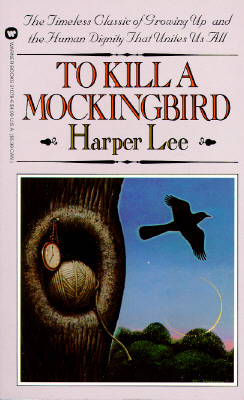
You're To Kill a Mockingbird!
by Harper Lee
Perceived as a revolutionary and groundbreaking person, you have
changed the minds of many people. While questioning the authority around you, you've
also taken a significant amount of flack. But you've had the admirable guts to
persevere. There's a weird guy in the neighborhood using dubious means to protect you,
but you're pretty sure it's worth it in the end. In the end, it remains unclear to you
whether finches and mockingbirds get along in real life.
Take the Book Quiz
at the Blue Pyramid.
I don't know that I agree with the conclusions about me, but I like the book.
I was tagged by Entropy, who thinks this test is "#@$*".
In honor of one not named Bartholomew
We had visitors at the time. The parents were staying in a hotel, but the kids were wedged in with us in our minute bedrooms. There were lots of bodies packed in a very small space, which made the heat seem more intense. I had given up my bedroom and was asleep on a couch in a small living room upstairs. There were not enough windows to open to cool the place down.
At 6:15 in the morning, my mom poked her head through the door and said, "Honey, my water just broke."
"Okay," I mumbled, and rolled over and went back to sleep. The midwives were on their way, and at 14, there wasn't really anything I could do about it.
The midwives arrived, and eventually everyone started to wake up. None of us kids knew much about labor. We'd attended a sibling class at the midwives' office, at which we learned that when a baby came out, it felt a bit like if you opened your mouth as wide as you could and then stretched the edges out with your fingers. We'd all tried it; it was kind of uncomfortable and it looked silly. Anyway, babies didn't come out of your mouth. Even our two-year-old sister knew that.
At some point someone must have said that the baby was coming, because everyone in the house who was not giving birth or assisting that process was jammed into the doorway, spectating. I don't know what my mom thought of this; it's probable that at that point she didn't care. There was baby's head, and then his head was out, and then goosh! there he was, on the bed. I was impressed. It was my introduction to labor, and my mom made it look so easy. Two hours, start to finish, and then the baby just popped out. It wasn't until I had my first that I realized that it is a misconception to base your ideas of what labor will be like on watching your mother deliver her sixth child. But at 14, I felt I had one up on the rest of the world, and afterwards, whenever I saw a movie or TV show in which a woman gave birth, I was superior. That wasn't what it was like -- I'd actually seen a birth.
My brother was a bit blue, but had a healthy set of lungs. (Still does.) Someone with a sense of propriety finally kicked us all out of the doorway, and we set out to make calls. The baby had been named Nathanael, in honor of the day's saint. But St. Nathanael is also known as Bartholomew, and one of the visiting kids decided that we should tell people that the baby was named Bartholomew Barabbas. This was about the funniest idea ever, and it was quickly put into practice. My parents were fielding calls for hours afterwards from concerned friends.
So, to not-Bartholomew Barabbas, I say: Happy birthday, old chum! You're just as loud and as good-looking as you were 14 years ago today.
Cost Hikes Get College Students Pregnant
I assume that it wasn't simply ceasing to use the birth control but also some other extra-curricular activities that ended the young lady in her current condition, but as she's a pre-med student I guess I can figure that one out for herself even if the reporter can't.
Now, as someone who at age 20 got through each college semester on around $250 in spending money: color me unsympathetic. By age 20, you should be able to do some basic math and use your brain a little. If you're planning a trip to Costa Rica, you have at least some money. And yet the sum of $25 (best measured in college as two pizzas and a six pack of beer) was apparently enough to encourage this student to stop taking birth control, but not stop having sex. Without consideration for the fact that raising a child is generally an expense of more than $25.
If people can't be virtuous, you'd think they could at least think.
Marriage Under Pressure
Thus, I was surprised when one of them was telling me a while back about how difficult it was for them to find a priest who would marry them. Apparently they'd tried to get married a year or two earlier, but no one wanted to marry then: the wife was under 18, and between the age and race difference, all the priests they talked to thought they should wait a while. When pregnancy made them search much more urgently for someone willing to marry them, they were slightly older, but had the pregnancy against them.
"Don't you know that getting married under these circumstances is perfect annulment material?" one priest asked.
"But we don't want to get an annulment, we want to get married," they said.
Now I should stop here and say that I see the priest's point. There is certainly a divorce and annulment crisis in the Church today, especially in America, and one doesn't want to make that worse. When a couple in their situation, who weren't even from his parish, walked in some priests door seven years ago, I can see why he'd be hesitant.
However, it also seems like there are certain points in life when reality gives you a good hard kick, and some people respond by getting their lives in order, coming back to the Church, etc. Sometimes getting pregnant is one of those times. Realizing that you're about to have a family has a way of making your life stretching out ahead of you come into a bit more long term focus.
So while I certainly understand not wanting to set up yet another divorce and/or annulment, it also seems like putting down the door entirely on people who want to get married because they have got pregnant is not necessarily a good idea. Call me old fashioned, but although I don't think a woman should marry someone she doesn't think would be a good husband just because she's pregnant, if a couple get pregnant to who want to be married, it strikes me as better to get it done before the baby is born than after.
Fortunately, our friends eventually found an older priest who, after spending some time talking to them, decided to take a risk on them. The risk paid off. With God's grace, things work out sometimes.
Thursday, August 23, 2007
The Fallacy of the Sex Life
It seems that Dinesh D'Souza had written a blog post based on the New Yorker article, and this had pretty much convinced de Waal that the entire thing was a conservative attempt to co opt discussion of his "sexy" apes. The Skeptics brought their own ax to grind to the table, remarking in an editorial note, "it is interesting that so many people wish to deny the undeniable relationship between humans and chimps, and at the same time cannot seem to help finding political meanings in primate behavior that supports either a liberal or conservative agenda."
The de Waal article is marginally worth reading, but it stikes me that in his overall defensiveness (perhaps a combination of his less than flattering treatment in the original article and the fact that D'Souza, whom he clearly despises, picked up the story) leads him to engage in some poor rhetorical moves.
For instance, he says that all the examples of purported violence among bonobos are from captivity, and yet two of the examples in the article are recounted by Hohmann as having occured in the wild.
On another occasion, he dispenses with what strikes me as a legitimate question as to whether or not all of the activity between bonobos which is usually described as group sexual activity for social bonding purposes is actually sexual (as in, whether the bonobos are relating to each other sexually, or just touching each other in what to humans would be sexual ways) by quoting the Bill Clinton/Paula Jones case. Clearly, that's not answering the question as to whether actions which would be sexual among humans actually carry that connotation among bonobos, and it's unfortunate to see that kind of unseriousness in response to what struck me as a pretty balanced, well researched article.
However, all this talk about whether the "hippie primate" who "makes love not war" is indeed the sort of gentle, oversexed creature that it is reputed to be got me thinking about the whole question of a "sex life".
You see, the thing that makes bonobos seem a bit unusual compared to many other animals is their tendency to engage in mating behaviors when not "in heat". While a tiny bit of this has been observed in chimps, chimp males are usually only interested in females when the females undergo the physical changes that indicate they're fertile.
In this sense, one of the things that has excited people about bonobos is that they seem to be interested in sex all the time -- just like many humans. While those of us who use NFP often note that Topic A becomes a bit more compelling during fertile periods, the signs of fertility are not widely observable among humans, and as a species we're pretty open to mating behavior at all times (headaches aside).
It's pretty common in popular culture these days to talk about the necessity of a "good sex life", a somewhat vague term which I take to mean having the openness and opportunity to have sex fairly often and enjoy it a lot. Well, that sounds pretty nice, doesn't it? And here's the bonobo to show that it's not just a human thing, it's a way that primates can get along and relieve tension so they don't fight all the time.
This fits pretty well with the human-as-mental-creature picture which has dominated our intellectual landscape since the Enlightenment. Here we've got this great thing we can do that forms close personal relationships and is a lot of fun as well. Shouldn't we all make sure to fit regular practice of it into our schedules?
Sounds like fun, but I think it fails to take into account our existence as physical creatures with biological systems that have specific purposes. There's a reason why they call them "reproductive organs", and it doesn't have to do with xeroxing.
Now this works out fine for creatures like the bonobos. Most species have a pretty scattershot approach to keeping the species going: every time you have the chance to conceive, you do; and if there isn't enough food or parental care to go around, the child dies. Most animals, left to their own devices, will get pregnant just about as often as their bodies and nutrition will let them. Pop 'em out, let 'em go.
However modern, first world, human society has managed to work itself in expected pregnancy to be very rare (and never to come unexpectedly) at exactly the same time it's decided that everyone needs a healthy and active sex life. Basically, we want to mate like bonobos, but not have every female going around the jungle either pregnant or with a small baby clinging to her back.
Modern birth control (and abortion) has made this possible to an extent, but holding mother nature in check with technology tends to add other complicating factors. It seems moderately hard-wired in humans for sex to create emotional pair-bonding, of the sort that you need between a pair of mates raising offspring that take 13-17 years to reach biological (much less intellectual) maturity. Taking the reproduction out of sex reduces the need for pairbonding, and so we provide ourselves with all sorts of ways to make ourselves unhappy why pursuing the "sex life" ideal.
I'm not saying that biological realities mean that sex should simply be a matter of closing ones eyes and thinking of England (though a vacation sounds like a good idea now that you mention it), but it seems to me that from a creature point of view we put ourselves into awkward places when we try to focus on having a "sex life" without admitting that we're really talking about a "reproductive life".
Wednesday, August 22, 2007
The Limits of Double Effect
The classic example is, in a case of a falopian pregnancy (something which often fatal to both mother and child, and from which the child is pretty much guaranteed to die) it is possible to remove the falopian tubes in order to save the mother's life. This has the foreseen side effect of the unborn child dying, since the tubes in which the child has implanted are removed. However, it is not considered as a similar moral act to an abortion because the object is to remove the tubes and save the woman's life, not to kill the child.
Now, I think it's pretty clear to anyone that this is a useful form of moral thinking. Many acts have consequences (known or unknown) that are not what we intend. And I know that I've seen a few people (generally in mentally vulnerable times like late high school) get themselves all tied up in knots of paralyzing worry over what the unforeseen results of their actions might be.
However, just as the possession of a good hammer does not turn everything into a nail, so the possession of a fun piece of moral reasoning does not mean that it should be applied everywhere. Case in point, I recently heard someone argue that it is inherently immoral for a soldier or police officer to intentionally use "lethal force". Rather, this fellow argued, that such a person uses force in order to achieve an objective (self defense, defending another, etc.) and might as a result "accidentally" kill his opponent.
Now, I understand what he's getting at here. Standard US rules of engagement specify that shooting an armed opponent is acceptable, finishing off a successfully neutralized wounded enemy with a shot to the back of the head is not.
But I think that attempting to use the principle of double effect in this kind of situation is deeply misguided. Attempting to argue that someone who sends a number of metal slugs in the direction of another human being at over a thousand feet per second doesn't mean to do them harm is just plain unrealistic. And by making the argument, I think one fails to deal with the moral facts of the issue and makes moral theology sound foolish into the bargain.
It seems to me that the argument that should instead be made is that certain circumstances justify the taking of life -- to the extent necessary to resolve the circumstance. A soldier, policeman, or an ordinary citizen defending his family may need to use lethal force against an aggressor in order to preserve his life or the lives of others. The taking of life is justified by the situation to the extent (and not beyond the extent) necessary to achieve that objective.
In that sense, the use of lethal force is a matter of justice. However, as Christians we believe that justice and mercy must always go hand in hand. And there is indeed a place where mercy kicks in.
While justice sometimes makes the use of lethal force to achieve some good necessary, mercy emphasizes the difference between the person and the objective. The enemy who is no longer in a position to threaten you must cease to be an enemy. The justification for using lethal force is gone when the objective is achieved.
Operationally, this may not be terribly different from the double effect explanation. But I think it is much more intellectually honest and morally sound.
Love Conquers All
In Jesus of Nazareth, Pope Benedict, in examining the Beatitudes, meditates on the verse "Blessed are the poor". That's from Luke; Matthew's account says "Blessed are the poor in spirit". Benedict reflects on the tradition of poverty in the scriptures:
The poverty of which this tradition speaks is never a purely material phenomenon. Purely material poverty does not bring salvation, though of course those who are disadvantaged in this world may count on God's goodness in a particular way. But the heart of those who have nothing can be hardened, poisoned, evil -- interiorly full of greed for material things, forgetful of God, covetous of external possessions.Benedict emphasizes the humility of the "poor ones of God":
On the other hand, the poverty spoken of here is not a purely spiritual attitude either. Admittedly, not everyone is called to the radicalism with which so many true Christians -- from Anthony, father of monasticism, to Francis of Assisi, down to the exemplary poor of our era -- have lived and continue to live their poverty as a model for us. But, in order to be the community of Jesus' poor, the Church has constant need of the great ascetics. She needs the communities that follow them, living out poverty and simplicity so as to display to us the truth of the Beatitudes. She needs them to wake everyone up to the fact that possession is all about service, to contrast the culture of affluence with the culture of inner freedom, and thereby to create the conditions for social justice as well.
These are people who do not flaunt their achievements before God. They do not stride into God's presence as if they were partners able to engage with him on an equal footing; they do not lay claim to a reward for what they have done. These are people who know that their poverty also has an interior dimension; they are lovers who simply want to let God bestow his gifts upon them and thereby to live in inner harmony with God's nature and word.Being "poor in spirit" transcends the material to be a spiritual asceticism -- which does often find its expression in a material simplicity. Still, the hallmark of Christianity is not poverty or asceticism or austerity. At the Last Supper, after dismissing Judas (the disciple who rebuked the penitent woman for wasting perfume on Jesus instead of selling it and giving the money to the poor), Jesus gives a poignant last charge: "My children, I will be with you only a little while longer. You will look for me, and as I told the Jews, 'Where I go you cannot come,' so now I say it to you. I give you a new commandment: love one another. As I have loved you, so you also should love one another. This is how all will know that you are my disciples, if you have love for one another" (Jn. 13:33-35).
Note the construction: "This is how all will know that you are my disciples, if you have love for one another." Love is the prerequisite: all Christian life stems from that love.
Your Catholic Snark for the Day
Nice Old Lady: Well, Father said it would be too much work to have it every day.
Darwin: Did someone tell him that he's not the one required to sit in the tabernacle all day and see everyone?
Tuesday, August 21, 2007
Is it almost fall already?
In a sense, though, I'm not sure what good plotting out our school year would do at this point. E. is only 5, and at this point we tend to base our educational ventures around whatever interests her that week at the library. The library is our best friend, and I'm sure that we're the library's best friend, judging by the amount of fines we just paid.
We've been using the Italic handwriting system. It's not imperative to me that the girls adhere strictly to the Italic system, but I like the letter forms and I feel that it's an attractive and easy font to learn with. J., who is almost four, likes to sit and trace letters while E. works on her handwriting. E. isn't necessarily interested in copywork, but she enjoys dictation, such as writing out a shopping list.
It's harder to work with J. because E. wants to come over and show off her superior knowledge by telling her all the answers. They're close enough in age that they like to work together, but it's hard to practice letters or reading with J. when E. keeps piping up from behind my shoulder. Perhaps it wouldn't be such a problem if J. wasn't content to let E. answer for her. Teach Your Child to Read in 100 Easy Lessons doesn't seem to be doing it for J. She seems to prefer reading in context, such as the Bob books or Hop on Pop.
Both girls are having fun with flash cards (alphabet and math), but the difficulty there is in keeping the baby out of the fray. She has fun with flash cards too -- she loves to fling them across the room. It's frustrating enough to try and keep her out of the big girls' hair (and crayons and flash cards) that we've found it hard to get much of anything done lately. Fortunately she enjoys sitting and listening to read-alouds, so that's what we've been focusing on.
As for read-alouds, we're working our way through The Secret Garden. This has so seized E.'s imagination that we've dug up a secluded corner of the yard and created our own "secret garden". Being only about 3 sq. ft., it doesn't compete with the great walled gardens of England, but she's proud of it.
A 'Pacifist' on the Iraq War
I read The Guardian, Le Monde (in French) Haaretz and Al Jazeera in English, as well as The Economist, the London Times and The Times of India. In addition, I read several blogs of servicemen in Iraq. I found them through AndrewSullivan.com, which links to them regularly. I have not trusted the Main Stream American media in over a decade.There is a certain honesty about this, though I can't say it's refreshing. And people say that "warmongers" are heartless...
The consensus of most writers at ALL these organs of media is that the war is lost, the people of Iraq want us gone so that they can pursue the sectarian civil war that they've been hankering after for centuries.
It is not our "white man's burden" to tell them they may not have that civil war, what form of government or what church-state relations they want. THAT is colonialist, racist patronizing posing as benevolent nation-building. All we are doing by staying is making our own relationships with these countries poisonous for generations to come.
We must leave, and leave sooner rather than later, so that the Iraqis, Kurds and Sunni Arabs can get on with the bloody business of "nation building."
During the American Civil War, Johnnie Rebs who had no material interest in preserving the South's "peculiar institution"--who were themselves dirt-poor and who had never thought to own a slave--were asked by their Union jailors why they kept fighting for the Confederacy with such relentless zeal. The Confederate prisoners of war answered, "Because you're here, where you have no business being." Why can't we understand that this is a natural human response, which the Iraqi people have EVERY RIGHT to feel.
The only way that act of international terrorism called Bush's war in Iraq would EVER have had any chance of "success" would have been if we had invaded Iraq, deposed and imprisoned Saddam, sent him to the Hague to be tried, and LEFT.
Compare that set of opinions motivated by "peace" with Michael Yon's dispatch about traveling with the first convoy of food from Baghdad to Baqubah in a number of months. I think in this case, there's more hope and care for humanity on the war side than the peace side.
The point of the original post on Vox Nova (which I think is rather more sentimental than thoughtful, and thus wanders astray a bit, but more on that later) is that if Christians are forced into war, they must still love their enemies even as they seek to defeat them. What strikes me in some of the more frank anti-Iraq-war rhetoric is that those in favor of an immediate and absolute pull-out seem to care much less about those who live in Iraq than those who advocate seeing things through to a point of relative stability.
Monday, August 20, 2007
More Heat than Light?
From the other side of the battlefield, Al Gore and Newsweek coordinated an assault on a few skeptics with all kinds of guilt-by-association accusations. They allege that a few scientists were offered $10,000 (!) by Big Oil to research and publish evidence against the theory of manmade global warming.I suppose this was supposed to sound good in a magazine, but 10k sounds like a pretty pathetic research grant. Also, this parting shot:
Of course, the vast majority of mainstream climate researchers receive between $100,000 to $200,000 from the federal government to do the same, but in support of manmade global warming. Apparently, that's okay since we all know that the federal government is unbiased and there to help, whereas petroleum companies only exist to force us to burn fuels that do nothing more than ruin the environment.
Little damage was done by the Gore-Newsweek assault, though, since the attack amounted to little more than a verbal "Well, your mama wears Army boots!" It didn't help matters that the magazine's own columnist, Robert Samuelson, published a follow-up article saying the allegation of bribes offered to scientists "was long ago discredited" and that "the story was a wonderful read, marred only by its being fundamentally misleading."
Oh, and by the way, in the interests of a fair fight, the next time someone sees Al Gore, could you ask him to stop calling us "global warming deniers"? I don't know of anyone who denies that the Earth has warmed. I'm sure this has just been an honest misunderstanding on Mr. Gore's part, and he'll be more than happy to stop doing it.I suppose the idea was to make it sound like "holocaust deniers". And "people who deny that human activity is primarily responsible for global temperature increases" just doesn't sound as incriminating.
[HT: John Farrell]
A Shelf Shall Rise
I took Friday off work to put some major work in on the project: because the books are piling up on the floor and MrsDarwin has told me I can't buy any more until I've finished the shelf.
The shelves were sanded and ready to go, so the next step was to cut the uprights even, which I did with the helps of a square, clamps and the circular saw. The uprights stand 7' 1" high. On the bottom, I cut out a space for it to nestle up against a baseboard, and also a two inch curve in the middle, so it stands on 2.5-inch-wide legs with the baseboard cut-out in the back.
I'd borrowed a router from a friend at work so I cut grooves for the shelves to rest in, about 1/8in deep. I was seriously worried about cutting them at different points on the two uprights, so I clamped them next to each other on my workbench and routed them both at once. The tricky part at this point is getting the shelves spaced right. You have to account for a two inch clearance on the router from the guiding edge to the edge of the bit, and then the bit is cutting a 3/4in groove. As a result, the shelves are not exactly the heights I'd meant. The first two came out a perfect 12in, but the next two came out to 10 3/4 instead of 11, and one that was meant to be 10in came out as 9 1/4 and so on. Still, they look moderately even, and books fit on them, which is the important thing.
Once I had my grooves cut, I drilled three nail holes down the center of each groove. The grooves thus serve three functions: provide extra support to the shelf, provide a channel for the wood glue, ensure exact placement of the nails so that they always go exactly into the center of the shelf.
That's where things stood as of Saturday evening. Sunday, we cleared all the furniture out of the dining room after church and started assembly. I'd thought a lot about how best to tackle assembling the shelf, and I ended up deciding that it was best to assemble it ladder-fashion, starting in the middle and working out. In the picture on the left, you can see it with three shelves in.The tricky thing with assembly is that there's no good way to clamp a 42" wide bookshelf, so the we'd put glue in both grooves, set the shelf, and then drive the nails in order to hold the shelf in place tightly for the glue to set.
Since I'm dealing with real wood rather than ply here, and since the African Mahogany in particular tends to re-warp a little bit after being milled, some of the boards had a slightly curvature (either lateral or horizontal) that we had to deal with. The biggest issue was with the top couple shelves, by which point we set it up on it's side and had MrsDarwin put all the weight she could on the upright in order to hold in flat and tight while I nailed it down.On the right you and see the shelf as we left it last night. The top is clamped down against its supports while it dries. Later this week we'll be putting the back on it and routing a curved edge along the top shelf and the outside edges. Last of all comes finishing, which after several experiments looks like it will be done with lacquer. So we're probably about a week out from having a finished shelf.
Saturday, August 18, 2007
Inscription on a Flyleaf
Many of the used books in my library have inscriptions. Most are simply the name of the previous owner, with perhaps a date.We have a first American edition of Anthony Trollope's Can You Forgive Her? (bought on Bibliofind from a Gay and Lesbian bookstore for $10) that is inscribed in beautiful handwriting John C. Spencer/ Nov. 1865. Mr. Spencer was very careful -- he also pasted a bookplate inside the front cover, which gives his name and city of residence (Milwaukee, Wisconsin) and notes that this is book No. 268. I would very much enjoy perusing Mr. Spencer's well-tended catalogue, but as his library is doubtless scattered among habitues of internet booksellers, that pleasure must be forgone.
C.W. Ihle. June 28, 1907.
That's an odd surname. Is it an abbreviation?
A few include addresses or phone numbers. I wonder what Mrs. Ellwood N. Hough (or, more likely, her heirs) would think upon receiving a mysterious postcard with the message, "I have your copy of Mamma's Boarding House." And why did she get rid of that book anyway? Or was her library junked by television-watching offspring after she went to that great library in the sky?
A copy of The Colleges of Oxford by Andrew Clark M.A is inscribed to
Robin
With his wife’s dearest love
Sept 27th/92 (That's 1892, by the way; the book was published in 1891.)
Was she interested in Oxford too? Or was she sweetly indulging her husband's favorite hobby horse?
And what is the story behind the inscription in Shakespeare's Songs and Poems?
With the hope that you'll be kept so busy reading these songs you won't have time to sing them. . .
Thursday, August 16, 2007
The Right to Life and the Right to Healthcare
I think that part of the reason that Social Teaching becomes such a hot button topic for American Catholics in particular is the peculiar dynamic into which they are forced (unless they are sufficiently willing to think outside the partisan box) by the current alignment of the two major parties in the US. On the one hand, the 'progressive' Democratic Party has become synonymous with support for abortion on demand, gay issues and euthanasia. On the other hand, for those who believe that the virtue of charity demands government sponsored action in the form of socialized healthcare and welfare (a dubious assertion in my opinion, but held by a number of people) the Democratic Party is again your only option. Thus, politically progressive Catholics sometimes find themselves in the position of justifying their party choice by insisting that socialized healthcare and other expanded welfare state programs will bring the country closer to the vision of a just society laid out in Catholic teaching than the outlawing of abortion and euthanasia and the preservation of the traditional legal definition of marriage would.
Any in-depth treatment of all this would, of course, require much more space and time than a blog entry permits (even on this notoriously wordy blog), but thinking about the topic it stuck me that a compare/contrast exercise on the "right to life" and the "right to healthcare" might provide an interesting view on the contrasting viewpoints.
First, let's look a bit at each term, and what it describes in regards to Christian morality.
The 'right to life' movement is pretty much centered around making abortion illegal. Clearly, making something illegal does not make it impossible. Homicide is illegal, and yet there are tens of thousands of homicides each year. Making abortion illegal would not bring us to a state in which no abortions took place. But by removing the legality and respectability from the abortion process, it would appear like less of an option to many people. Surely, it would be a long time (if ever) before it seemed as far beyond the realm of respectability as the murder of another adult -- but it would not longer have the "but of course we could always..." status that it now does as a fully legal and protected option.
Thus, we might summarize the aim of the 'right to life' as that of using legal sanction to help make it easier (in the sense of removing temptation) for people to make the right choice in regards to obeying the prohibition: though shalt not murder. There's also an element of a desire to have moral law (again: thou shalt not murder) and civil law agree.
People who talk about the 'right to healthcare' are usually advocating some sort of government sponsored universal healthcare. However, in this case, perhaps it's better to work in the other direction from in the previous instinct. What virtue (or avoidance of sin) does the 'right to healthcare' relate to? Among the corporal works of mercy is "visit the sick", but I think it's clear that to the extent that the easy remediable maladies listed in the corporal works of mercy (feeding the hungry, giving drink to the thirsty, etc.) are all to be actually treated rather than just observed, we are called upon to treat the sick to the best of our abilities.
Throughout much of human histories, these abilities were very limited indeed, but in this day and age advances in medical technology have made all sorts of treatments possible. Now clearly, just as it is the duty of those with food to feed those who have none, it is the duty of those able to provide medicine and medical care to those in need to do so to the extent possible. Our Christian duty of charity pertains to all necessities in life and to small comforts as well. We are, after all, told to love our neighbors as ourselves.
And yet, the reason we are told to feed the hungry, give alms to the poor, etc. is not with the end object of a world in which no one is hungry and everyone has enough money in mind. Not only did Christ say, "The poor you shall always have with you," but he also made few personal, tangible efforts to alleviate poverty during his life. When Christ told people to sell all that they had, give it to the poor, and follow him, he did so in order that they might "store up treasure in heaven" as opposed to having their hearts focused on the treasures of this life. He didn't say that his purpose was to "end world poverty". (In the same sense, legal prohibitions of murder are, from a religious perspective, there to serve as in aid in avoiding the sin or murder -- not to assure a society in which no one is killed.)
Now, of course, the difficulty with modern healthcare in regards to the Christian duty of charity is that so many aspects of it cannot be given by any one person. There's no one person who can say, "I think I'll give this poor person chemotherapy." So although a single person's charitable instinct may be the driving force behind getting healthcare for a particular person in a particular circumstance, it's not something that individual Christians can simply give. So while I think there's an element of immanentizing paradise at play in people's calls to provide universal healthcare (just as in calls to 'end poverty') there's also a realism, in that much of modern medicine is not in the capacity of any one person to give.
This, it seems to me, is why there's a good deal of difference between the moral imperatives behind the 'right to life' and the 'right to healthcare'. The desire to make abortion (and other forms of murder) illegal stems from a desire to have civil law reflect moral law, and thus guide people in making moral decisions. However, the desire to enact socialized medicine is a specific means of attempting to achieve the end of providing healthcare to all those in need of it. Whether it is indeed the best way, or even a good way, is a matter on which reasonable people might certainly differ. Because the moral good is not specifically an end state in which everyone receives a specific level of medical care, but rather that all of us, as Christians, to our utmost to make sure that our neighbors are cared for in all their needs.
India Turns 60
Three of the six people on my team at work grew up in India, and working in the technology sector that seems fairly close to standard. One of the things that's struck me talking to my co-workers is that unlike my own immigrant ancestors who came over from Mexico and Ireland and England with no intention of ever going back, most of them fully intend to head back to India within five to ten years in order to continue pursuing their careers there. Spending some time working in the US or UK has apparently become a pretty standard part of the Indian middle-class career path.
Given that India has a population of a bit over a billion people, and English is one of the standard languages that everyone learns in school there (plus their education system is quite good, especially compared to the creaking edifice of the US public schools) India is likely to become increasingly visible to the rest of us in the English-speaking world.
Wednesday, August 15, 2007
New Diocesan Metric: Seminarian to Parish Ratio
Atlanta Archdiocese (assuming 50 seminarians):
seminarian to parish: 0.526316
seminarian to priest: 0.19084
priest to parish: 2.757895
And, of course, that got me curious to look at our own Diocese of Austin. We have forty seminarians. There are also 200 priests and 125 parishes.
So the Austin Diocese metrics are:
seminarian to parish: 0.32
seminarian to priest: 0.2
priest to parish: 1.6
More Chant: Kyrie
Kyrie Eleison
This is a familiar melody, but that same familiarity makes me unsure if I'm chanting it, or just singing it.
Raymund Lully, Missionary to Islam
From the Christian History Institute (quoted in Abu Daoud's post) comes this about Raymund's conversion:
Raymond Lull would have seemed an unlikely person to remind the church of its missionary vision. A court gallant (that is, a fashionable ladies' man) and poet, he squandered his life in frivolity, romantic stories, love poems, and seduction. He was thirty before that changed.
But Jesus Christ, of his great clemency,
Five times upon the cross appeared to me,
That I might think upon him lovingly,
And cause his name proclaimed abroad to be...
It is reported that Lull's conversion was precipitated by a shock. He tried to lure a beautiful woman into a few moments of pleasure in bed with him. With quiet dignity, the woman revealed her breast to him--cancer-eaten. In a flash, he saw the futility of his lusts, and later transferred his love to the eternal Christ.
From the Catholic Encyclopedia:
From that time he seemed to be inspired with extraordinary zeal for the conversion of the Mohammedan world. To this end he advocated the study of Oriental languages and the refutation of Arabian philosophy, especially that of Averroes. He founded a school for the members of his community in Majorca, where special attention was given to Arabic and Chaldean. Later he taught in Paris. About 1291 he went to Tunis, preached to the Saracens, disputed with them in philosophy, and after another brief sojourn in Paris, returned to the East as a missionary. After undergoing many hardships and privations he returned to Europe in 1311 for the purpose of laying before the Council of Vienna his plans for the conversion of the Moors. Again in 1315 he set out for Tunis, where he was stoned to death by the Saracens.Despite his life of missionary activity and martyrdom, Raymund Lully was never declared a saint because of his belief that philosophy and theology were identical, a belief that was eventually condemned (sixty years after his death) by Pope Gregory XI. However his life of missionary activity is certainly admirable, and his work on a medieval logical engine sounds like the sort of thing that Umberto Eco would thrive on.
Raymond's literary activity was inspired by the same purpose as his missionary and educational efforts. In the numerous writings (about 300) which came from his facile pen, in Catalonian as well as in Latin, he strove to show the errors of Averroism and to expound Christian theology in such a manner that the Saracens themselves could not fail to see the truth. With the same purpose in view, he invented a mechanical contrivance, a logical machine, in which the subjects and predicates of theological propositions were arranged in circles, squares, triangles, and other geometrical figures, so that by moving a lever, turning a crank, or causing a wheel to revolve, the propositions would arrange themselves in the affirmative or negative and thus prove themselves to be true. This device he called the Ars Generalis Ultima or the Ars Magna, and to the description and explanation of it he devoted his most important works. Underlying this scheme was a theoretical philosophy, or rather a theosophy, for the essential element in Raymond's method was the identification of theology with philosophy. The scholastics of the thirteenth century maintained that, while the two sciences agree, so that what is true in philosophy cannot be false in theology, or vice versa, they are, nevertheless, two distinct sciences, differing especially in that theology makes use of revelation as a source, while philosophy relies on reason alone.
The Arabians had completely separated them by maintaining the twofold standard of truth, according to which what is false in philosophy may be true in theology. Raymond, carried on by his zeal for the refutation of the Arabians, went to the opposite extreme. He held that there is no distinction between philosophy and theology, between reason and faith, so that even the highest mysteries may be proved by means of logical demonstration and the us of the Ars Magna. This of course removed all distinction between natural and supernatural truth. Unlike Abelard's, however, Raymond's rationalism was of the mystic type: he taught expressly that, for the understanding of the highest truths, reason must be aided by faith; that once faith has flooded the soul with its radiance, reason, enlightened and strengthened by faith, "is as capable of showing that there are three persons in one God as it is of proving that there cannot be three Gods".
Tuesday, August 14, 2007
Pro-life dental work
(Am I alone in being an adult in America with all four of my wisdom teeth? One thing both dentists agreed on was that they rarely saw a complete set of wisdom teeth.)
I was torn between immense relief at this verdict, triumph that I was vindicated in my initial incredulity, and my sputtering outrage that some punk practice would have drilled all my back teeth for -- what? As a preventative measure? I cannot stress this enough: they would have drilled all my back teeth unnecessarily. If this does not arouse fear and loathing in you, you are not human.
Dr. H is very active on the local pro-life scene, and as she probbed and swabbed and cleaned she told me about a talk she'd recently attended about the importance of supporting maternity homes for young unwed mothers and their children. I couldn't make any more coherent response than "Uh hunh", but the hygienist said, "I sure wish that sort of thing had been around when I was young. Then maybe I wouldn't have had to give up my daughter."
The dentist paused and stared at her assistant of many years. "I never knew you'd had to give up a child."
As she passed implements over my head, the hygienist told us how she'd gotten pregnant when she was fifteen and had gone to live in a home for unwed mothers. The girls weren't really allowed to leave the grounds often, and were strongly pressured to give their babies up for adoption. She'd always wanted to find her daughter, who would be 26 now, and this desire had intensified now that her other children were grown now and also wanted to meet their older sister.
Rich Leonardi recently posted about the misconception floating out there that the pro-life movement only cares about children in the womb. Catholic pro-life work today takes many forms -- education, counseling, prayerful protests outside of abortion clinics, adoption support, and maternity homes that work to keep mothers and children together. I have not known many contemporaries who became pregnant as teenagers, but of those few, all had the support and love of their families and friends in keeping and raising their babies. Being a single mother is never easy, but the job of the pro-life movement is not to condemn these women, but to give them loving encouragement and moral support.
And remember, pro-lifers make the best dentists.
The Empire that Never Was
One of the interesting things that is mentioned in the book, is a plan that was briefly floated in June of 1940, after Paris has already been taken, while the French government has fled south. General de Gaulle and others in the French and British governments developed a plan to declare France and Britain to be a single united Franco-British Empire. Citizens of each country would be automatically made citizens of the other, and the fleets and colonies of the two empires would be held in common.
The goal was to keep the French Empire in the war, even as it became clear that continental France would be conquered within weeks if not days. The proposal was put before Churchill, who after brief hesitation endorsed the idea and proposed it via phone to French Prime Minister Paul Reynaud. Churchill hoped that in addition to keeping French naval and colonial resources in the fight, that a show or solidarity between France and Britain would inspire the French to continue fighting rather than surrendering.
Reynaud liked the idea, but he was already on the brink of being toppled by Philippe Pétain, who led the faction which wanted to seek terms with the Germans. Unwittingly, Churchill's proposal gave Pétain what he needed to consolidate his power. Rather than a show of solidarity, Pétain and his supporters saw the suggestion as an attempt by the English to swallow France and make it a colony of England. He and his supporters believed they would retain more Independence by siding with Germany. Within days, Pétain formed a new government, which reached terms with Germany. de Gaulle escaped to Britain, where he became the leader of the Free French.
Monday, August 13, 2007
I can hath cheezeburger?
Al of my transportation of sundrie materials and makynge of accomptes hath left me but litel tyme for writing. Ywis, it hath left me but litel tyme for food, sleep or breathinge. And yet in this derke tyme of sorwe and tene, ich haue foond much deliit in the merveillous japeries of the internet. No thyng hath plesed me moore, or moore esed myn wery brayne than thes joili and gentil peyntures ycleped “Cat Macroes” or “LOL Cattes .” Thes wondirful peintures aren depicciouns of animals, many of them of gret weight and girth, the which proclayme humorous messages in sum queynte dialect of Englysshe (peraventure from the North?). Many of thes cattes (and squirreles) do desiren to haue a “cheezburger,” or sum tyme thei are in yower sum thinge doinge sum thinge to yt.Oh. My. Goodness.
For many dayes ich haue desyred to maak Lolpilgrimes from the smal peyntures that Mayster Linkferste hath ymaad for my Tales of Canterburye - not oonly wolde it be a thing of muchel solaas to me, but it wolde be a good “pre writing exercise” (the which myn tutor, Archbishop Arundel, did alwey saye were of gret necessitee). And thus to-daye whanne ich had a smal spot of tyme bitwene a meetinge wyth a feng shui consultant and a recopyinge of the inventorie of carpentrie supplyes in Windsore, ich did go unto the wondrous LolCat Scriptorium of Gordon de McNaughton and did just go crazye. Syn ich haue not in many dayes y-poosted, ich shalle share with yow myn laboures.
The Maunciple
heere he shareth a lol concerninge the message of the tale ich haue planned for hym to telle
A New Catholic and the Old Mass
My family was not "traditionalist" in the sense that it has come to be used. But it was certainly traditional in many ways. On Sundays we said grace before meals in Latin, and learned some traditional Latin hymns, though we seldom heard them that way at church. We said a decade of the rosary before bed, kneeling before the statue of Christ the King in our living room. And we grew up on stories of the saints and the Ignatius Press Faith and Life books. (My mother attempted the Baltimore Catechism with us, but for me at least it was too late. I was in ninth grade and rebelled at the need to memorize short answers for things I figured I could explain myself. So I was told to go read Father Harden's catechism instead. The New Catechism of the Catholic Church had not yet been published.)
I grew up on the Los Angeles Archdiocese. This may perhaps only be my sense of memory, but it seems to me that perhaps liturgical insanity came a bit later there than in some other parts of the country -- perhaps under Manning with the memory of McIntyre still in the air the full storm force held off for a bit, or perhaps this is only youthful memory. The first parish I remember was the cast-cement-gothic St. Augustine's in Culver City, where incense was still standard at Sunday "high mass" -- though so were guitars, if memory serves. Altar rails were still in use in some parishes that we visited.Nevertheless, I was probably in my early teens by the time I first attended a mass in Latin, and although I knew that Vatican II had opened up the mass to common celebration in the vernacular and celebration ad populum, I didn't realize till much later that there were much of any other non-cosmetic differences between the 'old mass' and the new. I had, of course, looked at my parent's Latin missals from before the council, and we had a copy of the Latin order of the mass for the 1970 missal, which I'd also looked over as I started to learn Latin. But I certainly hadn't been exposed to the kind of "this is a total break" rhetoric that one hears in some traditionalist circles.
Despite my lack of experience with such things, I was consistently interesting in going to Latin mass (according to the new or old missal) for two reasons:
First, one of the most compelling things for me about Catholicism has always been its history, the fact that not only or beliefs but our liturgy stretch back, by small incremental changes, all the way to the times of the apostles. Since Latin was the primary language of liturgy in the West for a little over 1500 years, and many of the key phrases in the mass have (to my understanding) remained the same throughout that time, I wanted to experience a mass that tied directly through spoken work with those unnumbered other masses celebrated throughout the Western World over the last millenia and a half.
Second, one of the things I think most other inhabitants of modern suburban parishes will agree they have found lacking is a strong ritual sense in the liturgy. It's certainly not impossible to find this in the novus ordo. A number of parishes I've been to have done this well, and some indeed brilliantly. (I've never seen a mass as transcendent as the Easter vigil we went to at the Brompton Oratory. Truly two+ hours of heaven on earth.) However, since the new missal is more sparing in its rubrics, it's easy for a minimalist celebrant to produce a very bland liturgy. Whereas, at least on paper (and according to its devotees) the old mass seemed to require a great deal of ritual gesture as a matter of course.For both of these reasons, I had been interested in seeking out the mass according to the old missal. I did eventually manage to find several opportunities to go to Latin masses according to the new missal, by which I was very impressed. So I kind of assumed that the Tridentine mass would be even more so.
I've now been able to go to several masses according to the old missal -- all of them low masses (though I hope to be able to go to a high mass for the Assumption this week.) My reactions are not entirely what I expected.
What had drawn me most to the idea of the old mass was the text, the attraction of hearing the same words (or pretty close to them, depending on the time period) that have been spoken in most Catholic churches in the West for a thousand years and more. I've still retained enough Latin from being a Classics major in college that I can follow the mass pretty well in Latin, and so I had in my mind listening reverently as the ancient words of the Church were intoned. I was thus rather chagrined to discover what some have called the "blessed mumble" -- a quietsuperhighspeedallwordsruntogether method of pronouncing Latin that resembled (and perhaps was the inspiration for) the eight second Hail Mary that allowed my Irish grandmother to come close to getting rope burn with her rosary.
The other disappointment I found in attending a real old mass, as opposed to reading it and looking at pictures, is that the ritual gestures which seemed so clear and powerful in photographs and on the missal page were in real life often done in a small enough way (and, obviously, facing ad orientem) that they were difficult to see. Perhaps some of this is because all of the Tridentine masses that I've been able to attend have been celebrated by very old priests. If father is sufficiently bent to start with, it can be a little hard to tell from half-way back in a crowded church if he's standing, bowing or genuflecting.This is not, however, meant to be a "why I don't like the Tridentine mass" post. (And if anyone finds the touches of humor in the above paragraphs offensive, I hope they'll take it in the "family in-joke" spirit in which it was meant.)
Although we've been fortunate to find a lot more reverence brought into the vernacular liturgy of our parish with the arrival of our new associate pastor (fresh out of seminary), I remain drawn to the Latin language, and to the old mass -- at least in concept. And this has been much more actively on my mind the last few weeks since the publication of Summorum Pontificorum. It seems to me that Benedict XVI was not merely (as some people have suggested) tossing a sop to those who are locked on the idea of celebrating nothing but the 1962 missal. He said that the missals should be mutually enriching, and thus I'm sure that there are things that we need in the old missal. Some of them, I'm pretty sure I know what they are, since they're things that have always attracted me to the old mass. But at the same time, I find myself wondering if there are things which the old mass pretty clearly needs to learn from the new.
The old missal is full of beautiful, ancient phrases, and it seems a shame that the standard mode of reciting them makes it difficult to follow them clearly. I have read a number of people insisting that the silent canon is an important and ancient element of the mass. I'm certainly not enough of an expert to speak to that, but even if this is so, I wish the rest of the mass were routinely spoken clearly and at a more solemn pace. Although in the vernacular new missal we sometimes have problems with priests adding their own editorial comments to the words of the mass, I do very much appreciate the fact that the words are all there and clearly audible. Yes, one can always read the words out of the missal, but in a sense this strikes me as rather unhistorical. I can't imagine that missals were all that common for the laity before 1700 or so. Come of that, literacy wasn't all that common among most of the laity before 1700 or so. In all seriousness, the vision of the laity all quietly kneeling, reading along is something that only became widely possible within the last 200 years, and in many parts of the world, even more recently. I assume that before that people either simply followed other devotions (I've read that saying the rosary and other prayers during mass was fairly common in some places and times) or just watched. The most spiritually healthy, I'm sure, were deep in meditation. But most probably weren't.
Also, it seems to me that the 'dialog mass' was headed very much in the right direction, and I wish that (in its fullest form) it was simply the standard option for the old missal these days. Parts of the mass are clearly written in responsory form, and I assume that the practice of having only the server speak for the people was basically an artifact of the congregation not being sufficiently literate to read along and speak their parts. This is clearly no longer a problem in the modern world, and in that sense it seems much more appropriate to have the whole congregation make the responses than to continue using the server as a stand-in out of habit.
Of course, I'm not a liturgical expert, and no one is asking me for my advice on how to revise the missal. But then, from what I understand speaking clearly in those parts of the mass other than the canon and the secret (and perhaps at least speaking the canon in an audibly low voice? is that going too far?) and using the most full form of the dialog options is not an abuse according to the old missal. It just doesn't seem to be how people tend to do things.
In this sense, I have some hopes that if some younger priests (and you don't have to be all that young to have never celebrated mass prior to 1970) begin learning the old missal because of the motu proprio, perhaps some of the best aspects of the new form (the full dialog form, the clear speech, the visible gestures) will make their way back into the celebration of the old missal.
Friday, August 10, 2007
Nothing Succeeds Like Success
Dr. Clark’s first thought was that the population might have evolved greater resistance to disease. The idea came from Jared Diamond’s book “Guns, Germs and Steel,” which argues that Europeans were able to conquer other nations in part because of their greater immunity to disease.Clearly, there are potential pitfalls one gets into when applying evolutionary-style analysis to cultural questions. And yet, to the extent that these practices and attitudes are heritable (which certainly doesn't mean that they're strictly genetic, just that there's enough heritability for relative reproductive success to change the prevalence of attitudes) it stands to reason that they could be selected for.
In support of the disease-resistance idea, cities like London were so filthy and disease ridden that a third of their populations died off every generation, and the losses were restored by immigrants from the countryside. That suggested to Dr. Clark that the surviving population of England might be the descendants of peasants.
A way to test the idea, he realized, was through analysis of ancient wills, which might reveal a connection between wealth and the number of progeny. The wills did that, , but in quite the opposite direction to what he had expected.
Generation after generation, the rich had more surviving children than the poor, his research showed. That meant there must have been constant downward social mobility as the poor failed to reproduce themselves and the progeny of the rich took over their occupations. “The modern population of the English is largely descended from the economic upper classes of the Middle Ages,” he concluded.
As the progeny of the rich pervaded all levels of society, Dr. Clark considered, the behaviors that made for wealth could have spread with them. He has documented that several aspects of what might now be called middle-class values changed significantly from the days of hunter gatherer societies to 1800. Work hours increased, literacy and numeracy rose, and the level of interpersonal violence dropped.
Another significant change in behavior, Dr. Clark argues, was an increase in people’s preference for saving over instant consumption, which he sees reflected in the steady decline in interest rates from 1200 to 1800.
“Thrift, prudence, negotiation and hard work were becoming values for communities that previously had been spendthrift, impulsive, violent and leisure loving,” Dr. Clark writes.
Around 1790, a steady upward trend in production efficiency first emerges in the English economy. It was this significant acceleration in the rate of productivity growth that at last made possible England’s escape from the Malthusian trap and the emergence of the Industrial Revolution. [from the NY Times review linked to above]
On a side note, something that struck me in reading the NY Times articles was that Dr. Clark seemed to be somewhat surprised that the rich had more surviving children than the poor. It seems to me that one would expect to find this in any healthy society where resources are not so plentiful that people at all levels of society can have as many children as they want. This is one of the senses in which (up until the last century) humans tend to act like the creatures they are. It's generally within the last hundred years (and at certain other points in history in various societies: the beginning of the Roman Empire and certain periods in feudal Japan spring to mind) that not having children has come to be a sign of success.
This is probably related to (though as a cause or effect I do not know) the decline in dynastic thinking in modern society. Only a very small percentage of people in our current society have family estates or businesses which have existed for many generations, and require people to think in terms of bearing, raising, educating and training the next generation in order to carry things on.
Not that people don't think about "the next generation"; but it the general attitude I hear around the corridors at work (which I take to be a more standard milieu than our friends from church or among homeschoolers) seems to be that "the next generation" is simply something that happens. One may or may not produce a few members of it, but generally it's a strange and separate entity which tends to spring up, demand video games and college tuition, and then go off to do its own thing. If people think about "carrying on the family" it generally seems to be as a somewhat backward desire usually expressed by aging parents who want grandchildren to spoil before they are too old to enjoy it.
Hot Babe
The kind that gets carried into bed with mommy and daddy in the middle of the night whimpering with a 103.1 fever. Poor little pook.
Thursday, August 09, 2007
Me, chanting
Ad te levavi
Constructive criticism is welcomed. And of course it goes without saying that I'm not perfectly happy with every single pitch, but this is the take where the cat wasn't crying in the background.
Wednesday, August 08, 2007
Why Vatican II, Part 2
No, I don't really think so.
The poor level of active understanding which lay under the things everyone had memorized in elementary school certainly added to the sudden free-fall after the council, because all too many people had no clear idea of what was and what was not possible in the Church. But why call a council when there was no great heresy to fight?
I think Sheed's take, and one which is quite believable to me, is that in the unbounded optimism which so many in the Church felt in the 20s through the 50s, it seemed like the Church was ready to come out of the defensive posture which it had been in (to one extent or another) since Trent and win over the world.
From the point of view of a publisher, Sheed talks a bit in his book of the instinct which prevailed in much of the Church in the first half of the century of disciplining rather than disputing. Whether dealing with modernism or Feeneyism, Sheed argues that there was a tendency to label, reject, discipline and while perhaps not addressing the questions raised in a compelling fashion. Perhaps in keeping with this, Sheed describes several situations in which Sheed & Ward was asked by the Vatican to remove specific books from circulation -- though in each case it eventually proved that no one at the Vatican had actually read the book, they were simply acting in response to a complaint which had been passed up the ladder from priest or layperson who had objected to the book.
It sounds like, to some extent, a motivation for the council was that a combination of the optimism of Catholics about the overall strength of the Church, and an optimism about their standing in the world, led people to believe that the Church could afford to "loosen up a bit" and start discussing things more openly. Perhaps the Church could bring exciting new insights to the questions represented by modernism. Perhaps the Orthodox and even some Protestants could be won back into the fold. Liturgy and catechesis could be revitalized so that the laity (already just about the most educated and involved in the last thousand years) could become even more active in their faiths.
There were already encouraging signs. Gilson was bringing Thomism out of it's turn-of-the-century moribund state. The liturgical movement was seeing success in getting the laity to pray the mass, rather than pray their rosaries during the mass. There was a renewal of interest in the Church Fathers, the Eastern churches, scriptural analysis, etc.
So I think part of what John XXIII must have been thinking of in calling the council was: why not harness all this energy through a council? Why not really let it loose, rather than having small, dedicated groups of theologians, priests and laity struggling to bring about new things while at the same time occasionally suffering from stiff opposition from those who were suspicious of change on principle's sake. This had, after all, been a real problem in the last hundred years. Cardinal Newman was viewed with great suspicion by a great many in Rome. And more recently the liturgical movement, writers on religious freedom, non-Thomistic theology, etc. had often been under some level of suspicion.
To an extent, this has worked. We have seen a lot of good study of the early Church, the Eastern churches and great doctors of the Church other than Aquinas. We've seen John Paul II's Theology of the Body, which it's a bit hard to picture gaining wide attention in the pre-conciliar Church.
And yet, it's clear that there was over-optimism in the idea that the Church could open up discussion on everything without opening up confusion on everything. We were not nearly as strong as we thought we were. We were not nearly as well catechized as we thought we were. And we tried to make too many changes too fast, with the result that all too many people (bishops, priests, religious and laity) began to think that the "spirit" of the council was simply to change whatever one wanted whenever one wanted.
The result was chaos, and I think things are only starting to calm down now, as people find themselves bouncing off the increasingly clearly defined walls that holy men like our current pope have spent the last twenty years trying to build up and enforce. People are I think much more conscious that there are limits which aren't changing now than they were in 1977, and one may certainly hope and pray that in 2037, they will be more so than they are now.
Certainly, there are many results of the post-conciliar chaos that I would rather not have grown up with. However, it is hardly unique to experience periods of deep confusion in the Church's history. I thank God I wasn't born in 1378, at which point one would be 39 by the time that the Council of Constance ended the period of dueling claimants to the papacy.
Perhaps some day an article on Church history will say, "The period from 1968 through around 2020 saw much confusion at all levels within the Church, as the liturgical and theological implications of the Second Vatican Council were sorted out. A short but catastrophic drop in vocations caused some contemporary writers to speculate that the priesthood and religious life might undergo a fundamental change or be abolished all together, and liturgical life was often disrupted as a result of clumsy and excessive implementations of the council's allowance of some use of the vernacular in the liturgy. However, theological chaos gradually died down as it became clear that the Church's devotion to the deposit of faith was unshaken, and many of the liturgical disputes which at the time had rent the faithful were resolved when Pius XIV's new Roman Missal of 2023 clearly codified the rubrics of the 'new mass' and required the use of sung or chanted Latin propers on Sundays and Holy Days, while still allowing a fully vernacular, spoken 'low mass' on weekdays. It was perhaps in response to seeing Rome's increasing focus on the dignity of the liturgy the pope and the Patriarch of Constantinople formally declared their Churches to be in union in 2037, though formal union with the Greek and Russian Orthodox Churches would not follow for many more years."
The Myth of Convenience
While it's true that a frozen lasagna dish is usually faster to make than homemade lasagna, researchers from the University of California-Los Angeles wanted to find out how convenience foods are used in the real world. After they videotaped family cooking habits, the researchers saw that convenience foods weren't used as a time-saving substitute for the same dish made from scratch. Instead packaged foods offered a way for families to eat more elaborate meals than they would normally have time to prepare.The article also notes that most Americans take two trips to the grocery store a week, with an average time of 22 minutes a trip. We usually shop for an hour, once a week. Perhaps our longer shopping expeditions have to do with picking up numerous ingredients for meals. The study suggested that the time-saving effects of convenience foods might actually be found at the store, where it's quicker to pick up one prepared item than six or seven components of that same dish.When families did cook from scratch, they ate simpler fare -- like one-pot meals or stir-fry. In the end, dinner took about a half-hour to an hour to prepare, whether it was made from scratch or with convenience foods, according to the research, which was published in the July issue of the British Food Journal and funded by the Alfred P. Sloan Foundation, a nonprofit group that funds science, economic and other research.
Says anthropology researcher Margaret Beck from the Center on Everyday Lives of Families at UCLA, "When people use convenience foods, they are ramping up expectations for how elaborate a dinner should be."
The study is important because convenience foods tend to be high in preservatives, unhealthy fats and sodium. Nutritionists say parents often justify using the less-healthful convenience foods because they feel the time saved in cooking can be used to help kids with homework or play at the end of a busy day. But the discovery that a high use of convenience foods doesn't really put dinner on the table any faster should persuade families to opt for simpler, healthier fare, say health experts.
Frankly, it's a rare occasion when we have more than two dishes for dinner. We usually make one main dish, such as spaghetti and meatballs or macaroni and cheese. I know there's this shining ideal of the standard three-course meal consisting of a meat entree and a vegetable and a starch, but really, how many people cook like that every night? And here's a confession: we don't eat our vegetables every day. I like to eat fresh vegetables, but I'm not going to make a run out to the store just to pick up one green item for a meal. And since we've none of us come down with rickets or scurvy yet, I think that's okay.
Tuesday, August 07, 2007
People Who Get Kicked Around By History: Habsburg Edition
What most caught my interest, however, was the description of Archduke Franz Ferdinand, whose assassination was if not the cause of the Serbian war (which was in turn the cause of the Great War) at least the excuse that allowed it to happen at that time. He shoots, he scores...
Writers have compared the magic of the Potter stories to the magic that is condemned in the Bible, but that is the sloppiest sort of literary criticism; it's like saying that the Ancient Greeks were opposed to birth control because they fought against the Trojans.Zing!
I dream of chanting
Before I went to college I was quite musical. I had regular piano lessons over the course of twelve years, and studied viola for three years as a teenager. My family sings all the time, and not badly, either -- my sister, in particular, has been carrying off honors and winning vocal competitions for a few years . When I went to school, however, I stopped practicing my instruments, and I stopped singing, mainly because I lacked the confidence to sound less than polished in such a public setting. My one semester of voice class was an experience so utterly confusing that I came to the conclusion that I had no talent whatsoever.
Several factors have contributed to make me more confident musically: having the privacy of my own house in which to experiment and just be silly; having acquired a violin and (more importantly) a fine piano, and falling in with some young friends who are enough like my own family that I feel comfortable making merry music with them. And after a number of years I'm finally starting to assimilate what my voice teacher was trying to pound into my head.
Right now, my huge source of motivation is the proposed schola. I have been spending every spare minute learning chant. I listen to chant. I lurk on sacred music sites looking for advice. I have downloaded the Graduale Romanum. I dream about singing (no, literally). The basic, more hymn-like chants have been easy to learn, especially as I can already read neumes and can sight-sing. Not so easy is Ad te levavi, the Introit for the first Sunday of Advent. I wonder if some chant you have to hear to learn -- I finally had to find a recording and follow along before I could understand the vocal line. Perhaps part of the problem is thinking in terms of "tune". Chant follows its own internal logic, and that doesn't necessarily bear any resemblance to the logic and patterns of other forms of music.
Maybe some of you music types out there can give me some pointers. When I figure out how to post recordings, I'll put up some of my efforts for critique.
Monday, August 06, 2007
New Latin Missal
Guys Weekend: Beer, Cars
Left to myself, I'm not necessarily a car person -- but I am a person who likes to have some money left to my name occasionally. And so when the shop had humbly submitted a request to divest me to $1600 dollars, I had to equally humbly decline to have all the work done. Thus Saturday morning was spent becoming covered in brake dust.
Now, the thing about doing car work all morning on an August day in Texas is that it pretty much destroys your will to do anything else from there on out. But when you have five gallon of beer sitting on your kitchen counter that your wife would really like to see find another home, you know what is required of you.
For any other brewers out there (or those who could be tempted to become so) the project was to produce a mild, dark beer which was light enough in alcohol content that it would be refreshing (rather than debillitating) on a Summer afternoon, and which got most of its bittering from dark roasted grain rather than hops. We'd tried this before with some success, and the tastes before bottling suggested that this will be at least as much a success as the last one.
The recipe is:
6lbs Extra Pale Malt SyrupThis produces a dark brew of about 5% alcohol with slight amber highlights. It doesn't have the same this-is-your-meal-for-the-day thickness of a stout or porter (said as someone who edges towards baltic porters and imperial stouts) but definately has that good, roasted, dark beer taste.
1lb Chocolate Malt
8oz Crystal Malt 80
6oz Peated Malt
3oz Black Patent Malt
6oz Roasted Barley
1oz Fuggles (bittering)
0.5oz Fuggles (flavor)
Friday, August 03, 2007
Friday poetry (or not)
Eat your heart out, Shakespeare -- PoetBot can say it in four words.I've been reading John Donne lately, and here's what's been rattling around in my head:
Goe, and catche a falling starre,
Get with child a mandrake roote,
Tell me, where all past yeares are,
Or who cleft the Divels foot,
Teach me to heare Mermaides singing,
Or to keep off envies stinging,
And find
What winde
Serves to advance an honest minde.
If thou beest borne to strange sights,
Things invisible to see,
Ride ten thousand daies and nights,
Till age snow white haires on thee,
Thou, when thou retorn'st, wilt tell me
All strange wonders that befell thee,
And sweare
No where
Loves a woman true, and faire.
If thou findst one, let mee know,
Such a Pilgrimage were sweet;
Yet doe not, I would not goe,
Though at next doore wee might meet,
Though shee were true, when you met her,
And last, till you write your letter,
Yet shee
Will bee
False, ere I come, to two, or three.
Thursday, August 02, 2007
Peace, Love and Primates
A while back Razib linked to this lengthy article in the New Yorker about the field research on bonobos being done by German primatologist Gottfried Hohmann in the Republic of Congo.If you've read some of the pop-primatology that's come out over the last decade or so, you may have heard of bonobos. They have become something of a favorite in certain circles because early studies of bonobos (only recognized as a species separate from chimps in the '30s, and minimally researched until the '80s) suggested that bonobos were generally much more peaceful in their habits than their close cousins, chimps, in part because they appeared to spend a lot of time have recreational sex.
Bonobos are one of four species of great apes (chimps, gorillas and orangutans being the others) which are the species most closely related to humans among primates. Of these, chimps and bonobos are most closely related to humans, we shared a common ancestor about six million years ago. Chimps and bonobos are even more closely related to each other, their ancestry dividing only about two million years ago.
As modern primatology took off in the second half of this century, chimps received a great deal of attention. Some of this was simply a matter of celebrity in the person of Dr. Jane Goodall. It was also because there were more chimps around, and they were much easier to observe in the wild, since they roam through both deep forest and more open areas -- while bonobos live only in deep forests south of the Congo river.
At a certain time, chimps were romanticized as our less-fallen ancestors. Further research, however, revealed that chimps could be just as violent as humans. Researchers watching wild chimps not only observed fighting, murder, infanticide, cannibalism and rape -- they also witnessed a chimp civil war in which a group split into two geographical bands, the larger of which systematically wiped out the smaller.
Seeing this darker side of chimp behavior inspired a spate of writing about primordial primate brutality, theorizing that war and violence are one of the most basic human characteristics as a result of our primate ancestry.
It was against this backdrop that bonobo research really got going about fifteen years ago. At first, much of the research was done with captive bonobos, for the simple reason that wild bonobos were so illusive that researchs could easily spend months in the rain forests of Congo while catching only brief glimpses of the apes.
This initial research at first suggested that bonobos had a very different temperament than their chimp relatives. Researchers observed bonobos kissing, having sex even when the females were not in heat, and generally carrying on like a bunch of drunken cheerleaders. As if that weren't enough, the bonobos appeared to live in matriarchal groups.
An endangered species of primate, closely related to humans, that has a matriarchal society and appears to spend all its time making "love not war" -- does it get any more exciting for a politically hip grad student? I seem to recall a couple of earnest editorials in the LA Times back when we lived in California wondering, "Is it too late for humans to get back in touch with their inner bonobo?" Or as someone in the above-mentioned New Yorker editorial put it, it appeared that "If chimpanzees are from Hobbes, bonobos must be from Rousseau."
Perhaps unsurprisingly, it's not beginning to look like all of this may have been a bit premature. Dr. Hohmann's studies of wild bonobos are beginning to paint a picture of a creature not so very unlike its chimp relatives, and critics have pointed out that the studies on excessive bonobo sexuality featured adolescent bonobos living in zoos with not much to do other than the obvious.
One of the things that strikes me in all this is that, even after people have officially given up any idea of heaven or of objective good, there seems to be a very insistent yearning within the human person for some sort of world better than our own. Some of the neo-atheist works coming out lately seem to have a Rousseau-ian vision lurking not at all far beneath the surface. If only people could be truly wiped of all taint of religion, someone like Hitchens seems to think, we'd all be sitting around sipping coffee, hanging out in art galleries, and pursuing discreet affairs -- and everyone would be happy about it.
All this is contrary to the basic experience of life that there is in each of us that temptation towards pride, greed, etc. that allows us to turn any good (religion, love, learning, etc.) into a tool of domination and cruelty. The earthly paradise simply isn't there, either in a modified human society, or in some other species, and yet people (especially those who have given up any idea of a direction beyond this life) can't help looking for it.
Wednesday, August 01, 2007
Historico-Critico-Whatsit
There I came across their review of Benedict XVI's Jesus of Nazareth. Two selections:
I myself have used the Transfiguration more than once to illustrate the limits of historical criticism. For though historical critics, by an overwhelming majority, regard the episode as an unhistorical invention, it is clearly, in literary and theological terms alike, one of the high points of the life of Christ as told in the first three Gospels. Moreover, its un-historicity notwithstanding, the Transfiguration is the occasion for a brilliantly effective narrative assertion-not just that Jesus is the new Moses but also that suffering and divinity are not, or are no longer, mutually exclusive. For Ratzinger, to be sure, the episode is important for all these reasons. But he parts company with the critical majority in treating even this floridly mythological episode as a historical event no more problematical for open-minded historians than Jesus’ birth in Palestine. Any construction of it that would deny that it really happened, we are forced to infer, would be, in Ratzinger’s eyes, a disastrous descent into Gnosticism.A couple things struck me about this.
...
But it is one thing to reread the Bible in a way that makes God or God incarnate once again its central literary character and subject. It is another to claim that unless God’s actions as reported in the Bible-his Incarnation, for one; the Transfiguration of his incarnate person, for another-are historical, they are theologically meaningless. To do that is to make biblical interpretation a subject suitable only for those who approach history without any developed (“ready-made”) philosophy and who are prepared, in addition, to break with science and modernity (the “so-called modern or scientific worldview”). Few, even among the many who freely grant a connection between history and theology, will want to meet these conditions.
First, is the author's complaint against the "claim that unless God’s actions as reported in the Bible... are historical, they are theologically meaningless". I suppose it all depends what you mean by "theologically", but if one takes theology to consist of the rational study of God, it seems odd to take something of known human construction and use it as an input for reasoning about God. Given that the author refers to the transfiguration as "floridly mythological" I assume that he contends that the incident was invented by the gospel authors in order to make some larger point about the place of Christ in salvation and in the universe. Clearly it's possible for an author to express some truth(sometimes more more evocatively than through a straight, non-fiction discourse) through a fictional narrative. However, when one makes this claim about a key event in the Bible, one is left to wonder: If this is not an event but something the author tried to evoke via a fictional scene, how did the author know it was true in the first place?
It's not controversial to say that there are parts of the Bible that are in literary genres other than historical narrative. Even among the Gospels, I could imagine some authorial changes that would not interfere with the questions of truth and inspiration. Thus, if some of the parables are in fact conglomerations of the exact ones that Jesus told, or if the settings of certain events are moved (whether words were spoken on a hill, on a plain or in a boat, etc.) I don't think we'd necessarily run into a problem.
But the sheer scale of what's being said with the Transfiguration seems to preclude it's being in any significant sense different than what happened. Something like the annunciation, the transfiguration or to the resurrection strikes me as too surprising to be some sort of evocative fable. If you are an author consciously trying to make a point through fiction, you wouldn't do it through that kind of device.
Second, I was struck by the complaint: "To do that is to make biblical interpretation a subject suitable only for those who approach history without any developed... philosophy and who are prepared, in addition, to break with science and modernity...."
Well, in a sense, yes. If your "developed philosophy" consists of a belief that the incarnation didn't happen, then you're going to run into a lot of problems in regards to biblical interpretation. Of course, if that's your philosophy, I'm unclear why you're messing about with the bible in the first place. I mean, I've skimmed the Koran and some Hindu texts, but I don't sit around devoting lots of time to interpreting them, because I believe the religions they stem from are in great part false.
Also, we see here the "science and modernity" complaint against Christianity. This stems from a basic mis-understanding of what "science" is good at. The purpose of science is to, as efficiently as possible, predict the probable. The scientific mode of inquiry applies to physical, repeatable systems and circumstances. Thus, if the New Testament narratives are true, science would have very little to say about them. The NT does not insist that the incarnation and resurrection were examples of common and systematic events, rather it insists that they were extraordinary. Science is definately able to say "It is not in the nature of the human body to rise after three days" but it has nothing to say on the topic of "Did God choose to become man, suffer, die and rise of the dead?"
It was only as I was at the end of all this that I looked at who had written the review: Jack Miles of "God: A Biography" fame. Now, I haven't read the book, and it's been a while since I was reading the flap about its original publication, but doesn't it seem a rather direct slap in the face for an allegedly Catholic publication to have someone of Miles' type review a book about Christ by the pope?
"Do you hear that sound, Mr. Anderson?
It seems like with every passing week I hear more often that it is inevitable that Hillary will win the Democratic nomination, and then win the presidency. I suppose that not everyone sees Hillary as Eva Peron and Delores Umbridge rolled into one unappealing package. I guess on this one I'm like the lady who famously said of Nixon's election: "I don't know how it happened. No one I know voted for him."
Part of me keeps hoping that nominating Hillary would be another example of the Democrat's inability to understand what would actually appeal to the half of the country not already in their interest group. Kerry was nominated pretty much strictly on the grounds of his "electability", which turned out not to be quite the force it was imagined to be.
And yet, the Republicans are seeming about as tone deaf this time around as when they presented us with the Dole/Kemp ticket. Indeed, I feel like I get some of the same, "Oh well, we're not going to win this one," vibe from people this time around as I did in '96.
All of which is rather too many words to say: I'm not relishing what I see coming up for the '08 elections.